
Wheelless Motorcycles: Has the Future of Mobility Already Begun?
What´s moment?
By Marcelo Salamon
7/12/20267 min read
Abstract: This article analyzes the profound conceptual and technological transformation within the two-wheeled vehicle industry, focusing on emerging prototypes and patents of motorcycles that eliminate traditional wheels or incorporate revolutionary motorized spheres and gyroscopic stabilization. It explores the technical core enabling these innovations—artificial intelligence, high-fidelity sensors, high-efficiency electric powertrains, and magnetic levitation—alongside their projected benefits for traffic safety, accessibility, and urban sustainability. Finally, it outlines the economic, regulatory, and infrastructural hurdles bounding the transition from corporate R&D labs to public roads.
Keywords: Urban Mobility, Futuristic Motorcycles, Gyroscopic Stabilization, Artificial Intelligence, Electric Vehicles, Omnidirectional Spheres.
Introduction
The history of terrestrial transportation is inextricably linked to the evolution of the wheel—one of humanity’s most fundamental and enduring inventions. For millennia, vehicle design, ranging from animal-drawn chariots to modern supercars, has relied on the premise of a rotating circular contact point with the ground. In the world of two-wheeled transit, this dependence is even more dramatic: the physics keeping a motorcycle upright are fundamentally tied to the gyroscopic effect generated by the spinning wheels, paired with the continuous, active balance adjustments made by the rider. However, the twenty-first century has ushered in an era of unprecedented technological acceleration, challenging engineering dogmas once thought immutable. In recent years, avant-garde designers, engineers, and tech firms have unveiled disruptive motorcycle concepts that challenge everything we know about transit.
Imagine a vehicle that not only balances itself, completely eliminating the risk of low-speed tipping, but also glides laterally as smoothly as it moves forward. Some of these conceptual designs appear to hover over a single omnidirectional sphere; others deploy electronic stabilization systems so robust and refined that they remove the need for rider balancing altogether, functioning as autonomous, self-correcting safety cocoons. In more radical, forward-looking scenarios, engineering blueprints even envision eliminating continuous mechanical road contact entirely through advanced magnetic levitation and directional propulsion systems.
While many of these daring ideas currently reside in laboratory testing bays, high-fidelity 3D renderings, or heavily guarded corporate patent portfolios, they serve as an undeniable compass for the future of transportation engineering. They reveal a horizon where the motorcycle transitions from a purely mechanical, analog machine into an intelligent, hyper-connected node within a broader computational mobility grid. The overarching question facing the global automotive industry and tech enthusiasts is no longer whether motorcycles will fundamentally change, but rather when and how these disruptive technologies will become accessible to the mainstream commercial public.
How Would They Work? The Core Pillars of Tomorrow's Engineering
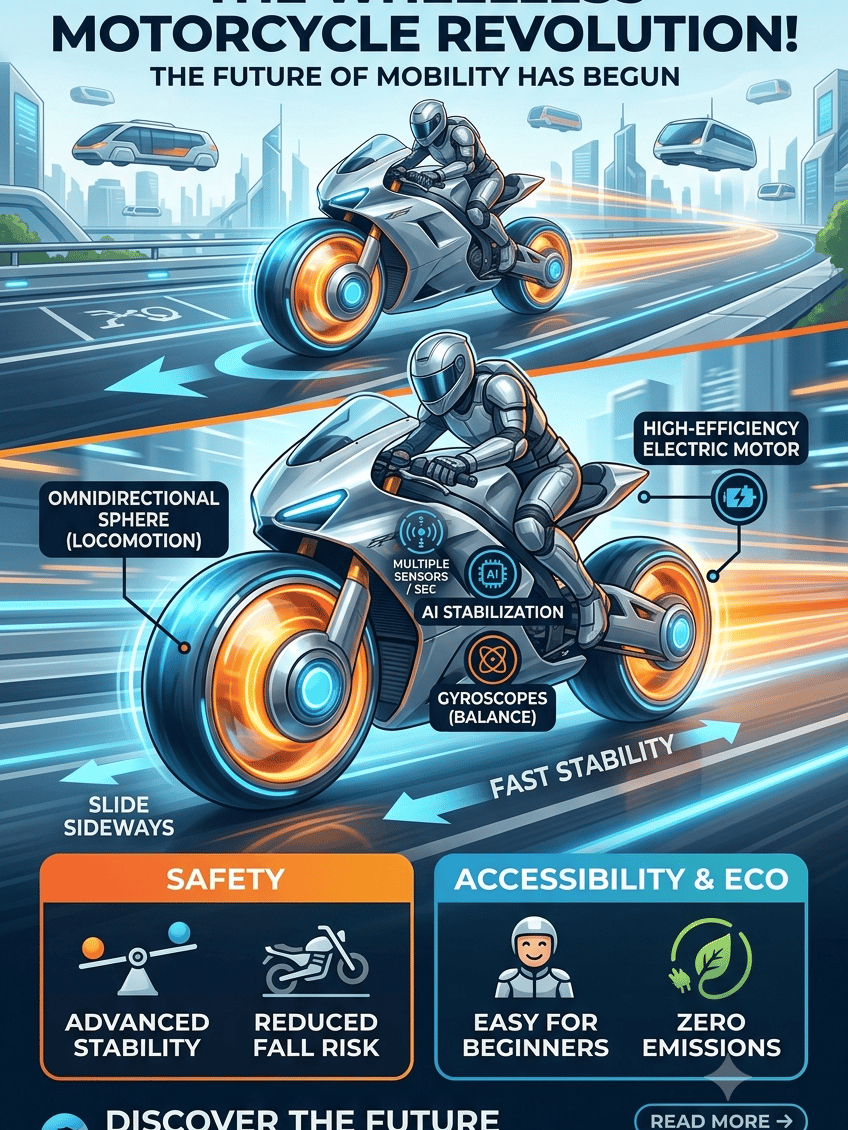
Replacing or redefining the traditional wheel requires a multidisciplinary scientific toolkit blending precision mechatronics, computer science, and advanced electrical engineering. The operation of a wheelless or self-balancing motorcycle rests upon four fundamental pillars: real-time artificial intelligence processing, high-fidelity inertial sensors, high-speed electronic gyroscopes, and high-torque electric motors.
Instead of relying solely on the rider’s physical reflexes to maintain static and dynamic equilibrium, the vehicle takes control of its own center of gravity. Onboard computers running neural network architectures continuously process thousands of data streams per second. Microelectromechanical systems (MEMS) and inertial measurement units (IMUs) mathematically track the motorcycle's pitch, roll, and yaw angles. Upon detecting the slightest unintended wobble—whether from a sudden crosswind, a pothole, or rider hesitation—the system reacts within milliseconds, engaging internal gyroscopic actuators that apply immediate counter-forces to stabilize the chassis automatically.
Regarding actual locomotion, two primary engineering tracks dominate contemporary research. The first centers on omnidirectional vehicles, which substitute inline front and rear wheels with one or two motorized, solid spheres. These spheres are manipulated by magnetic induction systems and internal drive rollers, enabling the motorcycle to execute instantaneous 360-degree movements. The vehicle gains the unique ability to slide sideways, spin on its axis in tight quarters, and parallel park perpendicularly with millimeter precision, bypassing the geometric constraints of traditional steering.
The second track, which is noticeably more futuristic, explores adapting magnetic levitation (Maglev) technology—already proven in high-speed rail networks across Asia and Europe—for individual passenger transit. Utilizing superconductors and specialized magnetized road surfaces, these motorcycles could hover a few inches above the ground, entirely erasing mechanical friction. However, engineers freely acknowledge that commercial Maglev integration for everyday commuters on standard public roads remains a distant prospect, constrained by deep physical, energetic, and civil infrastructure limitations.
The Advantages of a New Paradigm
This structural shift toward smart, high-stability, or unconventional rolling systems brings a robust suite of benefits poised to reshape both individual commuting and broader urban spaces. The most immediate advantage is a dramatic decline in traffic accidents via superior vehicle stability. Statistically, motorcyclists are among the most vulnerable commuters worldwide, facing high rates of severe injury from low-traction skids, wet pavement slides, and sudden tip-overs. A gyroscopically stabilized motorcycle actively counters these hazards, mitigating human errors that frequently lead to road fatalities.
As a direct result of this enhanced active safety, the learning curve for novice riders or individuals with limited physical mobility drops precipitously. The psychological and physical hurdles of mastering two-wheeled balance are effectively engineered away. Operating one of these next-generation models feels much closer to the intuitive experience of a virtual simulation, opening up agile, space-efficient two-wheeled transit to a vastly broader demographic of urban commuters.
From an environmental standpoint, these platforms are natively designed around zero-emission electric powertrains. Streamlining or removing traditional mechanical components translates into a significant drop in atmospheric and noise pollution within dense metro areas. The pervasive acoustic stress of modern cities, largely driven by internal combustion engines, would give way to the faint hum of high-efficiency electric induction motors.
Finally, these vehicles offer seamless, native integration with advanced autonomous driving systems and AI-managed traffic networks. Built on fully digital architectures, these next-gen motorcycles cease to be isolated actors; instead, they function as node points within a Vehicle-to-Everything (V2X) ecosystem. They exchange real-time data with surrounding cars, smart traffic lights, and satellite navigation grids. This enables AI-driven route optimization, predictive cross-traffic collision avoidance, and the deployment of autonomous, shared fleets that reposition themselves dynamically to meet shifting commuter demands.
The Technical and Regulatory Hurdles Ahead
Despite the revolutionary potential of these innovations, the path spanning prototype testing and large-scale assembly lines is fraught with steep economic, technical, and legal roadblocks. The most immediate barrier is the high cost of research, development, and advanced manufacturing. Precision mechatronics, such as high-RPM gyroscopes, ultra-low-latency processing chips, aerospace-grade composite alloys, and multi-layered sensor redundancies, drive manufacturing costs to premium levels. Early commercial iterations would likely be restricted to luxury buyers, with estimated retail prices easily exceeding $30,000 to $50,000 during initial low-volume runs, preventing immediate adoption by everyday working-class commuters who rely on cheap two-wheeled transport.
Another critical bottleneck relates to battery technology and energy density constraints. Continuous gyroscopic balancing and intensive onboard AI processing draw massive amounts of power, competing directly with the drivetrain for available energy. Current lithium-ion batteries, while sufficient for full-sized electric cars, remain too heavy and bulky for the compact frame of a motorcycle. Widespread commercial viability depends on the maturation of next-generation solid-state batteries, which promise to double energy density while cutting total weight and recharge times in half.
Government regulation and legal frameworks present another monumental challenge. Traffic codes across the globe have spent over a century evolving around rigid definitions of motorized transport. Homologating and classifying a vehicle that lacks distinct inline wheels or glides on omnidirectional spheres requires rewriting foundational laws. Furthermore, legal liability in accidents becomes highly complex: if a self-stabilizing motorcycle crashes due to a software glitch or an algorithmic freeze, does liability rest with the rider or with the tech corporation that coded the vehicle's operating system?
Additionally, high-speed aerodynamic stability remains under intense scrutiny by automotive safety boards. While computer-guided stabilization performs flawlessly at low speeds, the dynamic behavior of a single sphere or a wheelless hull at highway speeds—under severe crosswinds and aerodynamic wake from semi-trucks—demands exhaustive real-world validation to ensure system failures do not cause catastrophic high-speed accidents. Lastly, infrastructure remains a massive logistical hurdle; implementing concepts that rely on active road-embedded magnets or dynamic induction charging requires multi-billion-dollar overhauls of urban civil engineering.
The Next Era of Personal Transit
Mapping technological trajectories requires a careful balance between healthy skepticism and forward-looking optimism. Yet, looking back at the recent history of human innovation, the line between impossible and obsolete blurs remarkably fast. Just a few decades ago, widespread highway electrification, autonomous semi-trucks operating without human drivers, and commercial orbital rockets landing vertically on ocean platforms were ideas confined entirely to speculative science fiction. Today, they are standard line items in global corporate budgets and industrial operations.
The evolution of futuristic, alternative-wheel motorcycles will follow a similar path of technological maturation. It is highly probable that the most radical wheelless designs—such as those utilizing pure electromagnetic levitation—will remain restricted to high-tech exhibition grounds, closed corporate campuses, or specialized luxury niches for the next few decades. However, the true value of these vanguard R&D initiatives lies not just in their most extreme final products, but in the gradual trickle-down of intermediate technologies into mass-market commuter vehicles.
The synergy of vehicle electrification, active safety AI, advanced materials like graphene, and high-performance inertial assistance is set to reshape urban commuting permanently. Long before skies or highways fill with hovering hulls, we will witness standard commuter bikes adopting compact, intelligent gyroscopic modules to prevent intersection slide-outs, or affordable electric urban scooters utilizing rear spherical drive units to park sideways in dense urban spaces. This evolutionary transition will be smooth, practical, and steady.
Conclusion
The public discourse surrounding wheelless motorcycles and automated stabilization systems proves that the future of urban mobility is not an abstract concept for the next century, but an ongoing process active in research facilities today. These breakthroughs compel us to rethink city layouts, transportation policy, and the fundamental relationship between humans and personal transport machines. Far from being empty design exercises or speculative tech corporate theater, these projects address deep, systemic pain points of modern metropolitan life: the urgent need for individual transit options that are drastically safer, cleaner, space-efficient, and structurally smart.
How fast these advanced models integrate into the fabric of everyday city life depends entirely on our collective capacity to resolve engineering cost barriers and establish updated regulatory frameworks that match private sector innovation. The undeniable reality is that engineering has broken free from its legacy paradigms. By challenging the multi-millennial reign of the conventional wheel, tomorrow's engineers are laying the groundwork for an era of unprecedented transit freedom, demonstrating that the only true limit to technological evolution is the scope of our collective imagination and engineering execution.
References
Garcia, R. M. (2024). Two-Wheeled Vehicle Dynamics and Active Stabilization Systems (2nd ed.). New York, NY: Tech-Mecha Press.
International Journal of Urban Mobility. (2025). The Integration of Artificial Intelligence and Gyroscopic Actuators in Personal Commuter Vehicles. Journal of Advanced Transportation Systems, 18(3), 142-159.
MIT Technology Review. (2025). The Death of the Wheel? How Omnidirectional Spheres and Maglev are Changing Transport Design. MIT Technology Review Tech Insights. Retrieved from https://www.technologyreview.com
Souza, T. L., & Mello, A. C. (2025). Electric Vehicles and the Future of Cities: Infrastructure, Solid-State Batteries, and V2X Networks. San Francisco, CA: Academic Tech Books.
Zhang, X., et al. (2026). Autonomous Balance Control of Two-Wheeled and Sphere-Based Robotic Vehicles Using Deep Reinforcement Learning. IEEE Transactions on Robotics, 41, 884-899.
Contact
Contact us for questions or suggestions
contact@turingvision.com
fone: + 55 54 99122 0659
© 2026. All rights reserved. https://turingsvision.com/privacy-policy