
The Universal Architect: Alan Turing's Mathematical and Moral Legacy
Turing
Salamon & Salamon
4/24/20263 min read
Executive Summary
Alan Turing’s contributions span the foundational theories of modern computer science, the strategic orchestration of wartime intelligence, and the birth of Artificial Intelligence. This article examines his transition from the conceptualization of the Universal Turing Machine—the logic engine of all contemporary devices—to his pivotal role in deciphering the Enigma code, a feat that fundamentally altered the course of World War II. Furthermore, it addresses the moral imperative of his posthumous recognition, contrasting his scientific genius with the systematic persecution he faced. Today, Turing’s legacy is not just memorialized in the Turing Award or legal pardons, but in every interaction we have with the digital world, underscoring the necessity of intellectual freedom in the advancement of human technology.
Introduction
Long before the existence of physical hardware, Alan Turing dreamt the digital world into reality. In 1936, at a time when "computation" was still a manual, human-centric endeavor, Turing published a seminal paper that introduced the concept of the Universal Machine. He proved, through rigorous mathematical logic, that a single machine could simulate any human logical process if provided with the appropriate algorithmic instructions. This insight transformed the machine from a static, task-specific tool into the dynamic, programmable foundation of every smartphone, tablet, and server we utilize today. As we stand in 2026, navigating a landscape defined by AI and automated logic, we are essentially living within the framework of Turing’s initial design.
The Foundations of Digital Logic
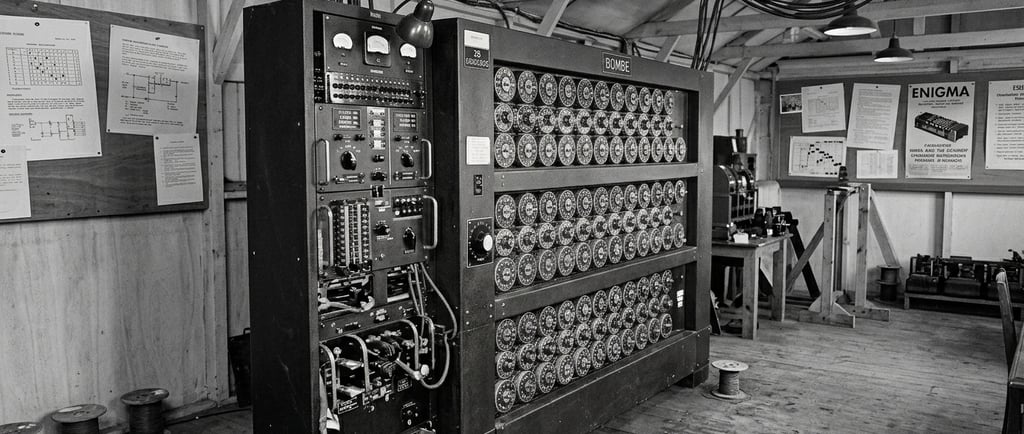
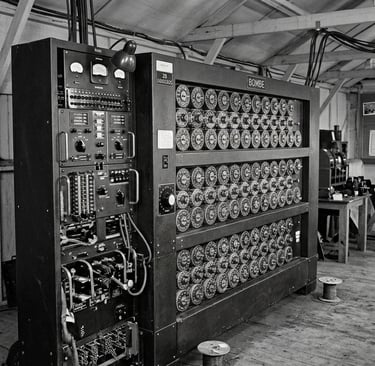
Turing’s conceptualization of the Universal Machine was not merely an invention; it was a paradigm shift. He proved that a machine could be "reprogrammed" to perform infinite tasks, establishing the birth of software. During the Second World War, he translated this theoretical genius into practical hardware at Bletchley Park. His design of the "Bombe"—an electromechanical device capable of testing millions of cryptographic permutations—enabled the decryption of the Enigma, an achievement historians estimate shortened the war by two years and saved over 14 million lives.
Intelligence and the Imitation Game
Beyond hardware and cryptography, Turing pioneered the field of Artificial Intelligence. By asking the provocative question, "Can machines think?", he established the "Imitation Game" (the Turing Test). This benchmark for machine intelligence remains the gold standard for assessing the cognitive development of modern Large Language Models and autonomous systems. Turing’s vision was never about creating a "replacement" for humanity, but about exploring the limits of logic and the potential for a new form of "synthetic" intelligence.
A Legacy of Injustice and Redemption
The brilliance of Turing’s career was brutally truncated by the legal standards of 1950s Britain, where his personal identity was criminalized. Following his prosecution for "gross indecency," he was subjected to chemical castration, a profound injustice that eventually led to his tragic death in 1954. It was not until 2013 that Queen Elizabeth II granted him a posthumous royal pardon, symbolically correcting a historic wrong. Today, his legacy is codified in the Turing Award—the "Nobel Prize of Computing"—and his image on the British £50 note, serving as a permanent reminder that intellectual freedom is a prerequisite for human advancement.
Essential Equipment for the Modern Professional
In the spirit of innovation and practical efficiency, here are some recommended resources for those who, like Turing, value the integration of high-quality tools into their daily professional and personal routines:
Pro Tork New Liberty 3 Solid White Helmet (Size 58): An excellent cost-benefit option, offering high quality and a competitive price point for daily commuters.
Reflective Waterproof Motorcycle Rain Gear: A premium set (jacket and pants) designed for motorcyclists and delivery professionals, featuring reflective material for safety and high-durability construction.
Pro Tork V-PRO JET 3 Red Modular Helmet (Size 60): A top-tier modular helmet structure providing superior protection and comfort for those who prioritize safety and versatility in their daily transit.
Bibliography
Copeland, B. J. (2025). Turing: Pioneer of the Information Age. Oxford University Press.
Hodges, A. (2026). Alan Turing: The Enigma (Updated Edition). Princeton University Press.
Leavitt, D. (2025). The Man Who Knew Too Much: Alan Turing and the Invention of the Computer. W. W. Norton & Company.
Turing, A. M. (1950). Computing Machinery and Intelligence. Mind Magazine (Centennial Edition).
Contact
Contact us for questions or suggestions
contact@turingvision.com
fone: + 55 54 99122 0659
© 2026. All rights reserved. https://turingsvision.com/privacy-policy