
THE SILENT REVOLUTION OF MEDICINE
Robot
MEDICAL TECHNOLOGY
Salamon and Salamon
6/7/202610 min read
📝 EXECUTIVE SUMMARY
This article provides a technical, analytical, and economic overview of automation in medicine and mental health. It covers the global fleet of over 10,000 active surgical robots, a nearly 50% drop in hardware costs, and a 30% boost in hospital productivity. It highlights the success of automated hair transplantation using the ARTAS® iX system and projects a massive professional shift between 2030 and 2040, when the market will invert to 80% robotics/AI execution and 20% human supervision. The text underscores the massive fiscal relief for governments worldwide through reduced public sector payrolls, decreased disability benefits, and the accelerated return of healthy citizens to the workforce. Finally, it outlines the new roles for professionals responsible for programming, maintaining, and legally auditing the high-definition logs and recordings generated by these machines.
📌 INTRODUCTION
For centuries, medicine rested upon an immutable triad: the physician’s clinical eye, the dexterity of their hands, and the knowledge accumulated over decades of practice. This triad has not been destroyed—it has been silently expanded by advanced engineering and computer science. We are witnessing the beginning of a profound metamorphosis in healthcare, where the convergence of high-precision hardware and artificial intelligence algorithms redefines the boundaries of what is possible.
From complex operating rooms to specialized hair transplant clinics, and now reaching into mental health offices, machines are operating where once only human judgment and touch could reach. This article delivers a detailed technical analysis of this transformation: the systems in operation, the drastic drop in costs enabling their expansion, the benefits in patient volume, and the massive fiscal savings generated for governments worldwide, culminating in exact projections for the workforce transition between 2030 and 2040.
📊 The Global Market in Numbers and Current Fleet Size
Total Active Robots Worldwide: There are currently approximately 10,000 to 12,000 robotic surgical systems installed and active globally (with over 8,000 belonging to the da Vinci platform and the remainder divided among new competitors).
Historical Procedure Volume: More than 12 million robotic surgeries have been performed in medical history.
Annual Volume: Over 1.5 million surgeries are performed by robots every year across the planet.
$21.2 Billion: The global medical robotics market value registered in 2022, projected to grow at a Compound Annual Growth Rate (CAGR) of 16.9% through 2030.
📉 Falling Costs: The Democratization of Technology
In the early days of this technology, surgical systems carried a fixed price tag between $2 million and $2.5 million, coupled with predatory maintenance contracts due to a total lack of competition. This landscape has shifted drastically:
Hardware Price Reduction: With the expiration of early patents and the arrival of competitors like Versius (CMR Surgical) and Hugo RAS (Medtronic), the average cost of new compact, modular platforms has dropped to the $1 million to $1.2 million range (a nearly 50% reduction in acquisition costs).
Per-Procedure Cost: The development of semi-reusable robotic instruments and miniaturized robots (such as the MIRA™, weighing just 2.2 lbs) has driven down the cost of surgical consumables, allowing mid-sized regional hospitals to adopt the technology.
🩺 Increased Surgical Volume and Macroeconomic Impact (The Human and Fiscal Benefit)
Robotics and AI have radically boosted hospital productivity, creating an unprecedented scale of care. For governments and public healthcare systems, the high initial investment translates into billions of dollars in mid-to-long-term savings due to structural efficiencies:
Reduced Inpatient Stay and Hospitalization Costs: Robotic procedures reduce hospital stays by an average of 2 to 3 days compared to traditional open surgeries (e.g., pancreatectomies and colorectal surgeries). This turnover frees up hospital beds much faster, allowing the same facility to perform up to 30% more surgeries per month within the same physical footprint. Fewer inpatient days dramatically lower government expenditures on patient meals, medications, and hospital hospitality.
Cuts in Public Sector Payrolls: AI-driven diagnostic automation and robotic procedures sharply reduce reliance on large, permanent clinical staffs. Governments will no longer need to hire as many career physicians as public employees (who generate lifelong financial liabilities via government payrolls, payroll taxes, and stable, specialized public pensions). Instead of maintaining massive, costly human bureaucracies, the public sector shifts toward technology maintenance contracts and lean supervisory teams.
Reduction in Welfare and Disability Benefits: Medical errors, hospital-acquired infections, and lengthy recovery periods drain public coffers through sickness benefits, disability pensions, and early retirements. With the millimeter precision of robots, complication rates are dropping to historic lows. Healthier populations treated with high accuracy rely far less on government safety nets and subsidy programs.
Accelerated Return to the Workforce: A worker operated on via robotic pathways or screened early by AI recovers their labor capacity in a fraction of the traditional time. Instead of spending months sidelined from the productive economy, citizens quickly return to the workforce. They resume producing, consuming, and generating tax revenue for the state—turning a potential welfare deficit into an economic surplus.
Technical Execution Speed: In automated hair transplantation (using the ARTAS® iX system), the extraction time for follicular units dropped from 4 manual hours to 2 robotic hours, optimizing clinic schedules and multiplying daily patient capacity.
🗺️ The Current Landscape and Regulation
Regulatory approval for medical robots is accelerating exponentially.
In China: At least 92 AI-driven medical devices were approved through mid-2024 (a $1.59 billion market projected to reach nearly $18.9 billion by 2030).
In the US: The FDA has cleared hundreds of medical devices powered by AI and Machine Learning algorithms.
In Brazil: The da Vinci (Intuitive Surgical) system dominates the landscape, operating in premier centers such as Albert Einstein, Sírio-Libanês, and AC Camargo.
⚡ Major Recent Highlights:
MIRA™ (Feb 2024): The first miniaturized surgical robot approved for assisted surgery (~2.2 lbs), specifically designed to democratize robotic surgery in smaller hospitals.
Symani Surgical System (2024): Approved for reconstructive microsurgery, featuring arms with 7 degrees of freedom. It operates on delicate structures like vessels under 0.8 mm by completely filtering out natural human hand tremors.
ACE (XACT Robotics): A percutaneous robot under 4.4 lbs used for biopsies. It uses non-linear steering to curve its trajectory inside the body, adjusting to the patient's breathing movements in real time.
🛠️ Anatomy, Engineering, and Hardware
A modern surgical robot costs between $1 million and $2.5 million because it represents a confluence of high-end engineering:
Structural Materials: Robotic arms are built primarily from titanium alloys and aerospace-grade aluminum, chosen for extreme rigidity, lightweight profiles, and the ability to withstand autoclave sterilization at 273°F (134°C). Joint mechanics utilize surgical-grade stainless steel (AISI 316L).
Motion Transmission: Motion-routing cables consist of 0.2 mm tungsten filaments that transmit movements with a latency of less than 1 millisecond.
Haptic Feedback Control: Optical encoders measure positioning with an accuracy of 0.01 mm. MIT laboratories and Force Dimension are already testing integrated piezoelectric sensors capable of detecting force variations as low as 0.01 N (the equivalent of ten milligrams).
Ultra-HD Vision Systems: Stereoscopic 4K cameras at 60 fps alternate between white light and near-infrared fluorescence (ICG imaging), making blood vessels glow. Real-time image processing is powered by heavy-duty embedded GPUs like the NVIDIA Jetson family.
💇♂️ Case Study: Robotic Hair Transplantation
The ARTAS® iX system has revolutionized trichology through computer vision and AI:
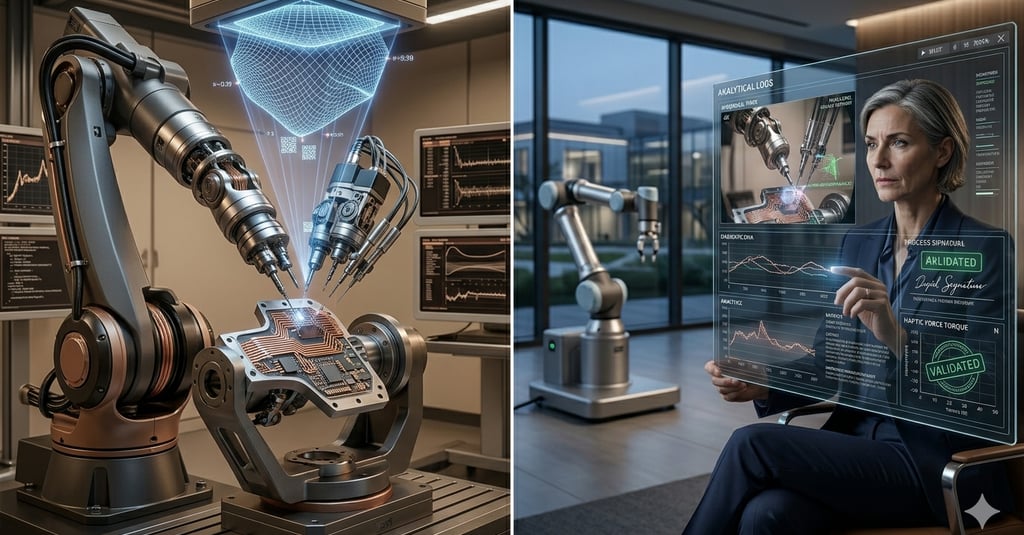
How it Works: It maps the patient's scalp using a coordinate grid anchored by QR codes. The AI calculates the exact exit angle of the hair follicle (ranging between 15° and 45°) and harvests it using a 0.9 mm dual-needle punch.
Real Advantages: Extraction time drops from 4 hours (manual) to about 2 hours (robotic). More importantly, the transection rate (accidental cutting and destroying of the follicle during extraction) plummets from up to 25% in manual procedures to under 3% with the robot.
BHT (Body Hair Transplant): New algorithms are calibrated to harvest body hair (from the beard or chest), dynamically adjusting to sharper angles and different growth cycles when scalp donor areas are depleted.
⏳ The Workforce Replacement Timeline (2030–2040)
The replacement of healthcare professionals will not happen overnight. It follows a strict timeline dictated by technological maturity and regulatory pacing:
Beginning in 2030 (The Inflexion Point): Generative AI and Large Language Models specialized in medicine (like Google’s Med-PaLM) alongside advanced health wearables will take over triage consultations, automated radiology reporting, and preventative diagnostics. Bill Gates notes that by 2030, AI will be capable of delivering medical advice with the same accuracy as a top human specialist.
The Transition Process: The automation expansion continues aggressively throughout the decade, absorbing repetitive administrative tasks, dermatological skin screenings, and laboratory data cross-referencing.
By 2040 (The Market Inversion): In technical, diagnostic, and repetitive specialties (such as Radiology, Pathology, and routine Dermatology), the labor market will completely flip its proportions:
Old/Current Landscape: 10% Automation / 90% Human Physicians.
The 2040 Landscape: 80% Market Domination by AI and Robots / 20% Human Physicians (who will transition into final auditors and legal sign-offs for automated outputs).
🧠 The Case of Psychology: Total Automation and Mental Health
Contrary to legacy assumptions, Clinical Psychology and Psychiatry face a path toward total automation by 2040:
Convolutional Algorithmic Therapy: Specialized AI models focused on integrative behavioral therapy can analyze facial micro-expressions (via camera), voice tone, speech pacing, and text patterns in real time. They identify anxiety triggers, depression, and stress levels with mathematical stability, completely free of human bias or fatigue.
Continuous Availability: The virtual/robotic psychologist provides highly personalized care 24/7, dynamically adapting its linguistic framework to the patient's long-term historical data accumulated over years.
🛠️ Who Controls the Machines? The New Owners of Coding and Recordings
If robots assume the burden of diagnosis and surgery, who is held accountable? The answer reshapes the medical career profile:
Biomedical Software Engineers and Data Scientists: These professionals will be directly responsible for programming neural networks, updating kinematic algorithms, and calibrating the fine haptic sensors of medical machinery.
Medical Auditors and Technical Supervisors: The remaining 20% of human medical professionals will not perform manual labor. They will be responsible for auditing and approving the video recordings and data logs generated by the robots.
Every automated surgery and robotic psychological session generates massive data logs and pixel-by-pixel high-definition video recordings. Senior doctors and psychologists will act as forensic experts and legal validators, ensuring the AI operated within safety parameters before signing off on the case file.
Hardware Maintenance and Biosafety Technicians: Specialists dedicated to thermal sterilization protocols, replacing worn tungsten filaments, and executing sub-millimeter mechanical calibrations on robotic arm assemblies within hospitals.
🌐 The Tech Giants Behind the Machines
Intuitive Surgical: Creator of the da Vinci system and industry pioneer since 1995. Holds an ironclad barrier of over 2,800 patents.
Medtronic: Developed the Hugo™ system, a modular platform featuring independent, cart-based robotic arms for clinical flexibility.
CMR Surgical: Creator of Versius, a compact, highly portable robot designed to fit into smaller operating rooms and serve regional hospitals.
Native-AI Startups: Caresyntax (delivering real-time surgical risk analysis and automated reports) and Moon Surgical (whose Maestro system acts as a collaborative robotic assistant to steady and augment human laparoscopic movements).
🔮 The Near Future: Wearables and Nanotechnology
Health Wearables: Mass-market commercial devices like the Google Pixel Watch 3 can autonomously detect cardiac arrest and automatically summon emergency services.
Circulatronics (MIT): Injectable, red-blood-cell-sized microdevices designed to navigate the bloodstream to deliver targeted intravascular brain stimulation or chemical readings without surgery.
Total Biometric Scanning (2035): Smart rings or patches will simultaneously track tissue pH, interstitial glucose, specific inflammatory markers, and full-waveform blood pressure via infrared spectroscopy. AI will analyze these metrics against the user's personal baseline history rather than population averages, predicting systemic failures years before the first physical symptom shows.
💻 The Software Layer: The Invisible Engine
Hard Real-Time Systems: Robotic surgical controllers run on Real-Time Operating Systems (RTOS) like VxWorks or real-time Linux patches, locking command latency to a maximum of 1 to 2 milliseconds. This safety threshold currently prevents transcontinental telesurgery over public internet lines due to network jitter.
Neural Networks and Computer Vision: Real-time tissue recognition uses Convolutional Neural Networks (CNNs) trained on millions of frames of surgical video. Models are trained on massive enterprise GPU clusters (such as NVIDIA A100s) and quantized to run locally on the console's edge hardware.
Elite Physics Simulators: Training platforms leverage engines like the SOFA Framework to model tissue elasticity, dynamic bleeding, and structural resistance, ensuring skills acquired in VR transfer seamlessly to real human operating rooms.
⏳ Consolidated Medical Robotics Timeline
1985: The PUMA 560 robot performs the first computer-tomography-guided robotic-assisted neurosurgery biopsy.
2000: The FDA clears the iconic da Vinci surgical system, launching commercial robotic surgery.
2011: Introduction of the ARTAS system in the US for automated hair transplant harvesting.
2016: The STAR (Smart Tissue Autonomous Robot) successfully performs completely autonomous soft-tissue suturing on animal models without human intervention.
2022: FDA clearance of the ACE system for non-linear percutaneous navigation and market expansion of CMR's Versius.
2024: Miniaturized robot MIRA™ is validated; China hits a record milestone with 92 approved AI medical devices.
2025: MIT unveils circulatronics; consumer wearables hit the market with autonomous cardiac arrest dispatch capabilities.
2030: Onset of widespread structural replacement in diagnostic imaging, automated triage, and primary clinical consults via advanced AI.
2040 (The Zenith): Full market integration achieved with 80% robotic and algorithmic execution across technical healthcare sectors, alongside the consolidation of audited robotic psychology systems.
🏁 CONCLUSION
The transition of medicine and analytical psychology toward models predominantly executed by artificial intelligence and robotic systems represents more than a victory of technical innovation; it marks a wholesale restructuring of global public finance. The stark market inversion projected for 2040—where intelligent systems assume 80% of the operational and technical workload, leaving 20% to human professionals—will deliver some of the largest fiscal relief margins in modern history to state governments.
By curbing the need to fund expansive, permanent public sector payrolls, mitigating long-term welfare expenditures on disability benefits, and, above all, rapidly returning cured citizens to the active workforce, medical automation pays for itself many times over. Humanity stands to inherit a healthcare delivery model that is exponentially more scalable, swift, and affordable. Meanwhile, the remaining human physicians and psychologists will experience a profound evolution in status: they will step away from the physical exhaustion of manual, repetitive tasks to establish themselves as the developers, data log auditors, and legal gatekeepers of a flawless automated machine. The robots inherit execution and scale; human beings retain governance, ethics, and the final word.
📚 REFERENCES
Intuitive Surgical Data Report: Cumulative global procedure logs and active commercial installation base metric sheets for the da Vinci surgical platform.
U.S. Food and Drug Administration (FDA): Public safety filings, approvals, and de novo clearances for artificial intelligence and machine learning-backed medical devices (MIRA™, ACE XACT Robotics, and Pixel Watch 3 frameworks).
National Medical Products Administration (NMPA - China): 2024 White Papers regarding the commercial registry and implementation metrics of algorithmic clinical prediction and diagnostic AI systems.
McKinsey Global Institute: Economic impact analysis reports focusing on labor automation thresholds, core automated task competencies within clinical workflows, and fiscal returns across public versus private healthcare networks.
Restoration Robotics / Venus Concept Tech Manuals: Robotic system engineering white papers and clinical validation data tracking follicular unit transecction margins via the ARTAS® iX interface.
Massachusetts Institute of Technology (MIT) Labs 2025: Research briefs and laboratory data sheets detailing intravascular microdevice navigation and circulatronics architecture.
GlobalData Health Intelligence: Macroeconomic sector modeling, compound annual growth rate (CAGR) tracking, and supply cost evaluations for surgical robotics through 2033–2035.
CNN Business / Bill Gates Public Keynotes: Sector analysis essays and prospective projections detailing the operational capabilities of large language models and generative AI frameworks in replacing technical cognitive labor.
Medscape & Journal of Medical Internet Research (JMIR): Peer-reviewed clinical trials monitoring the socioeconomic impact of shortened hospital stays via targeted robotic interventions and algorithmic behavioral tracking in diagnostic mental health.
Contact
Contact us for questions or suggestions
contact@turingvision.com
fone: + 55 54 99122 0659
© 2026. All rights reserved. https://turingsvision.com/privacy-policy