
The Silent Revolution: How Artificial Intelligence Is Transforming the Home Computer and Everyone’s Work
From home to work IA
NEW TECNOLOGY
Salamon & Salamon
6/11/20267 min read
Abstract
This article analyzes the impact of transitioning Artificial Intelligence from large cloud-based servers directly onto personal computer hardware, specifically through the emergence of NPU-equipped "AI PCs." It explores the immediate advantages of this evolution regarding data privacy, processing speed, and internet connection independence. Furthermore, the text examines how this technological decentralization redefines productivity for freelancers, independent contractors, and small businesses, accelerates the automation of routine processes, and forces a profound restructuring of the labor market. Ultimately, it highlights the increasing demand for strategic human skills to successfully coexist with intelligent tools.
Introduction
For decades, the home computer was a relatively simple tool that operated in a predictable, limited fashion. The average user relied on a standard processor to run everyday programs, enough RAM to open a few browser tabs, and a hard drive tasked with storing photos, videos, and documents. It was useful, undoubtedly, but the true brain of the technology was not there. The real intelligent processing was restricted to immense servers owned by tech giants, far removed from any office desk or apartment study corner. This dynamic dictated market rules for a long time, requiring constant, high-powered connections for even the most basic intelligent tools to function.
This scenario has changed permanently and profoundly. We are witnessing one of the greatest transformations in the history of personal computing: the arrival of Artificial Intelligence directly into your computer's hardware, without relying on the cloud, without annoying latency, and without the need to pay expensive monthly fees for external servers. AI has finally left the data centers and arrived on your desktop. This technological decentralization redefines not only our relationship with machines but also alters the very structure of the global job market.
The Rise of the "AI PC" and a New Breed of Machine
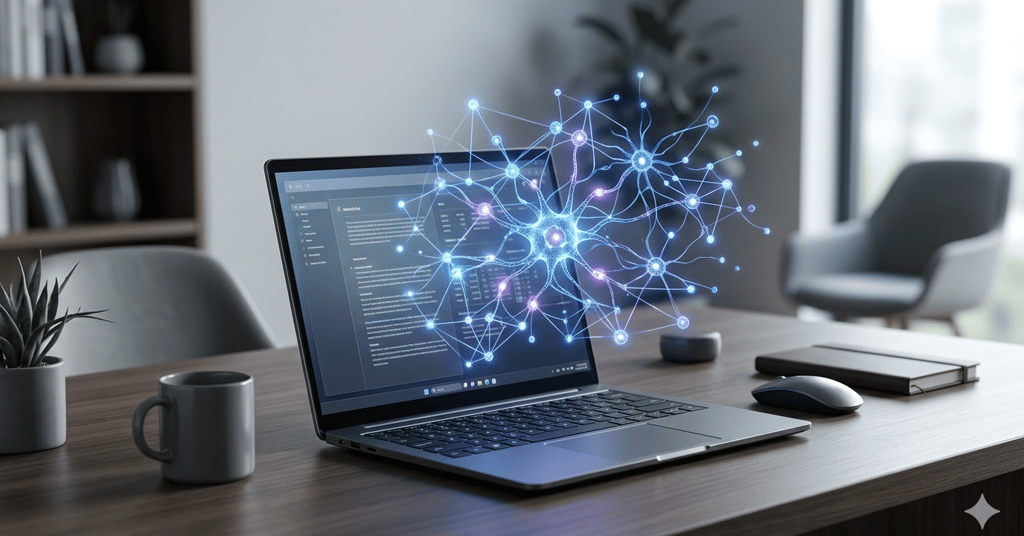
The term "AI PC" no longer belongs to the realm of science fiction and has ceased to be mere corporate jargon at tech events. It is a consolidated reality driving the market forward. We are facing a new generation of personal computers equipped with a revolutionary component called an NPU (Neural Processing Unit)—a processing unit dedicated exclusively to executing artificial intelligence tasks.
Unlike a conventional processor (CPU) or a graphics card (GPU), which split their functions between rendering graphics and general operating system calculations, the NPU was designed specifically to run machine learning models with extreme efficiency. This means complex tasks like voice recognition, real-time translation, text generation, and deep image analysis happen locally on the device itself, without overloading the rest of the system.
Major semiconductor manufacturers have invested billions of dollars in this technology, integrating NPUs into their latest chips. The practical result of this effort is that anyone with a modern computer already has, or soon will have, the power of native artificial intelligence in their hands. Market numbers confirm the magnitude of this paradigm shift. Global technology consultancies estimated that worldwide shipments of AI-integrated computers reached a staggering 114 million units, representing 165% growth over a short period and capturing nearly half of all personal computers sold globally.
Privacy, Speed, and Independence: The Three Pillars of Local AI
When artificial intelligence runs locally on your own work equipment, three major immediate advantages stand out, transforming the daily routine of anyone who relies on technology to produce:
First and foremost is true data privacy. Because processing occurs inside the computer’s chip, sensitive information never has to leave the device. No strategic files, internal conversations, or confidential documents need to be uploaded to a third-party server in the cloud to be processed. For professionals who handle strictly confidential information on a daily basis, this local security serves as a watershed moment, ensuring total compliance with data protection regulations.
Second, zero-latency speed transforms the user experience. System responses become instantaneous. This completely eliminates the wait time required for data to travel to the cloud, get processed on a distant server, and return to the screen. This agility makes audio transcription, simultaneous translation, and writing assistance tools feel truly fluid and natural.
Finally, internet independence ensures business continuity. Because the AI model is installed and runs offline, professionals who are traveling, working in areas with poor connectivity, or facing a local network outage still maintain full, unrestricted access to their smart tools. Productivity is no longer held hostage by a stable internet connection.
The Turning Point for Freelancers and Small Businesses
If you work independently or manage a small firm, you must understand the impact of this transformation because it is happening right now, reshaping market competitiveness. Artificial intelligence integrated into the personal computer is eliminating the need for a range of support roles that previously required traditional hiring or expensive outsourcing.
Recent productivity studies reveal that independent professionals and freelancers who incorporate AI into their daily routines save an average of eight hours per week. This time savings, when multiplied by millions of professionals worldwide, represents a structural shift in the economic landscape. Parallel data indicates that more than half of all small businesses have already integrated generative AI into their daily operations—a massive leap demonstrating that this technology is no longer the exclusive playground of large corporations.
Practical examples of this transition are eye-opening. Documented corporate case studies highlight mid-sized companies that successfully restructured their staff from 48 down to 30 employees without experiencing any loss in revenue. This was achieved through the strategic implementation of AI agents focused on digital marketing, basic customer service, and lead management. This automation generated an estimated savings of nearly $250,000 per year, replacing legacy software and redundant workflows. In other sectors, companies report that autonomous AI agents are already responsible for generating the vast majority of their platforms' source code and accurately resolving most customer support requests.
What AI Does on an Average Person's Computer Today
Far from being a promise for future decades, artificial intelligence already executes a wide array of practical, accessible functions in any professional's daily routine:
Writing and Copyediting: Highly complex professional emails, draft contracts, robust business proposals, articles, and technical reports can be drafted, proofread, and adapted for different audiences in just seconds, maintaining a surprisingly high quality standard.
Meeting Transcription and Summarization: Smart tools can transcribe video calls in real time and, at the end of the video conference, deliver a detailed executive summary with key action items, eliminating the need for manual minute-taking.
Automated Customer Service: Advanced chatbots handle the vast majority of initial customer interactions naturally, resulting in drastic improvements in response quality and ensuring much faster resolution for common issues.
Content Creation and Marketing: Assisted writing platforms build complete email marketing campaigns, engaging social media posts, detailed scripts for corporate videos, and entire content strategies based on direct prompts.
Design and Presentations: Modern software uses intelligent algorithms to generate highly professional, perfectly laid-out visual presentations in minutes, allowing any professional to build impactful material without requiring deep graphic design knowledge.
Task and Project Management: Project management platforms integrate intelligence to automatically prioritize tasks, identify operational bottlenecks before they cause delays, and ensure strict compliance with deadlines.
Data Analysis and Finance: Automated tools clean complex spreadsheets, uncover hidden financial patterns, and generate predictive charts and dynamic dashboards, streamlining processes that used to require dedicated analysts for days.
SEO and Website Optimization: Intelligent systems analyze web search trends, suggest ideal structures for blog articles, and autonomously optimize corporate pages to improve rankings on search engines.
The Employment Question: Replacement or Evolution?
Ignoring the impact of automation on the labor market would be naive. Artificial intelligence is changing hiring dynamics and, in certain niches, eliminating traditional job positions. Entry-level operational roles, administrative assistants performing repetitive tasks, basic content writers, first-tier support agents, and data analysts focused purely on sorting are already feeling the effects of this transition. Renowned academic studies point to a noticeable reduction in entry-level software development openings, precisely because AI tools have absorbed the writing of simpler code.
However, a more mature and contextualized analysis of the landscape reveals important nuances. The majority of small and medium-sized businesses are not carrying out mass tech-driven layoffs; instead, they are refraining from opening new support positions and covering those operational demands using intelligent tools. On the flip side, professionals who have learned to master and integrate these technologies into their daily workflows stand out significantly: they produce more, deliver projects in record time, and capture a larger client portfolio without needing to inflate their teams or operational overhead.
The skills that complement the work of algorithms continue to be highly valued by global leaders. Intrinsically human capabilities, such as emotional intelligence for handling complex negotiations, disruptive creative thinking, the capacity to solve unprecedented problems, and long-term strategic planning, gain even more relevance. The professional of the future does not seek to compete against the machine but uses artificial intelligence as a powerful multiplier of their own productive capacity.
What to Expect in the Coming Years
The trajectory of this technology is one of clear acceleration. As neural processing units become even more powerful and language models shrink into lighter, more compact, and efficient structures, increasingly affordable computers will be capable of running highly sophisticated local systems. The ability to count on a highly capable virtual personal assistant—one that can write, organize workflows, research market data, analyze scenarios, and communicate with precision—will be available 24/7 to anyone with a modern computer.
For freelancers, consultants, and small business owners, the time to understand, test, and adopt these tools is now. Those who choose to delay this technological integration run a real risk of finding themselves obsolete against competitors who can deliver in a few hours what used to take days of manual labor—and at a competitive price point that no traditionally structured team will ever be able to match. The technological revolution is not a distant promise; it has arrived and is operating right now on your desktop.
Conclusion
The transition of artificial intelligence from the corporate, restricted environment of the cloud to the local hardware of personal computers solidifies one of the most democratic turning points in the history of information technology. By decentralizing cognitive processing power and placing it directly into the hands of everyday users via dedicated NPUs, the tech industry has removed classic barriers of latency, chronic connectivity dependence, and, above all, the inherent risks to data privacy. For sectors handling strict professional confidentiality, this independence ushers in a new era of security and operational efficiency.
However, the greatest reflection of this transformation does not lie in the technical sophistication of silicon components, but rather in the profound restructuring it imposes on the labor ecosystem. The local automation of support activities and operational routines is flattening the organizational structures of small offices and independent professional networks. Far from representing the end of human labor, this scenario establishes a new competitive baseline: the market will cease to compensate the execution of repetitive tasks and will instead place an even higher premium on critical thinking, emotional intelligence, and the human capacity to orchestrate these new tools as performance multipliers. The silent revolution is over; what we are witnessing now is the urgent need for strategic adaptation in the years to follow.
References
GARTNER. Gartner Forecasts Worldwide Shipments of AI PCs to Reach 114 Million Units. Stamford: Gartner Research, 2025. Available at: https://www.gartner.com/. Accessed on: June 11, 2026.
STANFORD UNIVERSITY. Human-Centered Artificial Intelligence (HAI): AI Index Report 2025. Stanford: Stanford University, 2025. Available at: https://hai.stanford.edu/. Accessed on: June 11, 2026.
WORLD ECONOMIC FORUM. The Future of Jobs Report. Geneva: WEF, 2025. Available at: https://www.weforum.org/. Accessed on: June 11, 2026.
Contact
Contact us for questions or suggestions
contact@turingvision.com
fone: + 55 54 99122 0659
© 2026. All rights reserved. https://turingsvision.com/privacy-policy