
The Silent Revolution
How Robots Crept into Our Daily Lives in 2026
NEW TECNOLOGYDOMESTIC ROBOTS
By Marcelo Salamon
6/24/20268 min read
Executive Summary
In 2026, robotics has permanently crossed the threshold from science fiction to everyday reality. Driven by the fusion of advanced mechanics and next-generation Artificial Intelligence, autonomous machines are seamlessly integrating into our daily infrastructure—from high-efficiency laser-mapping home vacuums to smart hotel delivery fleets and public sidewalk food delivery services. The ultimate frontier, however, belongs to general-purpose bipedal humanoids. As global superpowers race for dominance—with China scaling production and the US pioneering cognitive software—the rapid adoption of these lifelike machines shifts the global conversation from technical feasibility to deep ethical, social, and economic realities.
Keywords: home robotics, humanoids, artificial intelligence, automation, service robots, technology 2026, autonomous delivery, smart hotels, robotics in China, future of work.
Introduction
Until recently, the idea of living alongside robots seemed restricted to movie screens or the pages of science fiction classics. In 2026, however, that boundary has permanently vanished. What makes this historical moment special is not just isolated mechanical breakthroughs, but the fusion of robotics with next-generation Large Language Models (LLMs) and advanced computer vision. This synergy has endowed machines with an unprecedented ability to adapt, interpret context, and learn in real time.
The truth is that this revolution began quietly and without central planning. Robots have left their static stations on industrial assembly lines and gained the mobility required to navigate the most unpredictable environment of all: human daily life. If you look closely around you, you will notice that automation already shapes how we clean our homes, check into hotels, or receive our meals. Robots have successfully entered the urban ecosystem—and they are here to permanently transform our social infrastructure.
Home Robots: The Pioneers of Domestic Autonomy
The first mass point of contact for the average consumer with practical robotics occurs right inside the home. Far from being considered mere expensive toys or tech eccentricities, robotic vacuums from brands like Xiaomi, WAP, and Roomie have become essential household appliances at the turn of this decade.
The major evolution seen in 2026 lies in their integrated sensor arrays. Current models utilize advanced laser mapping systems (LiDAR) combined with small cameras equipped with artificial intelligence for real-time 3D obstacle avoidance. This means the robot not only hits furniture less often, but it can also identify and steer clear of specific dynamic objects, such as charging cables, stray shoes, and even pet accidents.
Furthermore, charging docks have evolved into true autonomous maintenance stations. They empty the robot's dustbin on their own, wash and dry the mopping pads with hot air to prevent odors, and refill the device's water tank. In the retail market, access to this technology has democratized significantly, with entry-level models starting at around $150 and the most advanced, fully self-sufficient ecosystems reaching up to $1,200.
The Human Angle: In practice, this technology redefines time management and family harmony. For Mariana and Roberto—professionals managing heavy dual-income work schedules, raising two toddlers, and owning a high-shedding Golden Retriever—the robot vacuum has effectively become a crucial member of the household. "We used to spend at least 40 minutes every single night vacuuming up fur and dust just to prevent the kids' allergies from flaring up. Now, we program the robot via the app to run while we are at the office. We've gained back nearly five hours of free time a week. That is time handed right back to our family," Mariana shares.
Robots in Hotels: A New Era of Commercial Hospitality
While robots handle invisible maintenance inside the home, they have taken over the front lines of customer service and internal logistics within the hospitality sector. Major global hotel chains, such as Marriott and Mandarin Oriental, have deployed fleets of service robots to optimize guest experiences and mitigate ongoing labor shortages in the service industry.
In lobbies and reception areas, models like Pepper play the role of digital ambassadors. By utilizing facial expression analysis algorithms and natural language processing (NLP), they can gauge a customer's mood, process rapid biometric check-ins, answer frequently asked questions about the amenities in multiple languages, and provide precise directions around the hotel grounds.
For behind-the-scenes logistics, the standout is Swiftbot, a robot specializing in both vertical and horizontal deliveries within buildings. It was designed with direct software integration into hotel elevator automation systems. The robot sends a command via Wi-Fi to call the elevator, rolls in, selects the correct floor, and navigates corridors without bumping into guests or luggage. Operating 24 hours a day, 7 days a week, Swiftbot delivers fresh towels, toiletries, and room service orders directly to a guest's door, triggering a smartphone notification the moment it arrives.
Concurrently, heavy-duty cleaning of large common areas has been delegated to industrial robotic scrubbers boasting up to 5 hours of continuous battery life, mapping convention halls in the dead of night. While European and US models lean toward task-specific assistants, the transition in China is even more radical: since 2025, full-scale humanoid robots have been deployed to manage back-of-house inventories and transport heavy luggage through high-tech hotel lobbies.
Food Delivery: Autonomy Hits City Sidewalks
The delivery sector and last-mile logistics are undergoing a profound restructuring driven by public sidewalk automation. In the United Kingdom, Uber Eats solidified strategic partnerships in 2026 to roll out commercial fleets of autonomous delivery robots across major urban centers. With expansion plans already underway for other Western European capitals later this year, the model has proven economically viable for short-distance trips under two miles.
These delivery robots feature a compact, electric-powered design resembling a motorized cooler on wheels. They travel strictly on sidewalks, using an arsenal of sensors—including 360-degree cameras, ultrasonic sensors, and short-range radar—to safely navigate dense pedestrian flows, curbs, and street signs. The cargo compartment remains electronically locked throughout transit, opening only when the end customer enters a unique pin code generated by their app upon the robot's arrival.
Introducing this technology brings clear benefits to restaurants, which can drastically cut the fees and overhead associated with sending out small meals. Cities also benefit from reduced carbon footprints and lighter motorcycle traffic on main roads. However, the advancement has sparked intense regulatory and social debates. Labor unions and labor experts warn of the direct impact on gig workers who rely on delivery ecosystems for income, driving urgent conversations regarding urban labor laws and potential taxes levied on automated workforces.
Humanoids: The New Frontier of General Utility
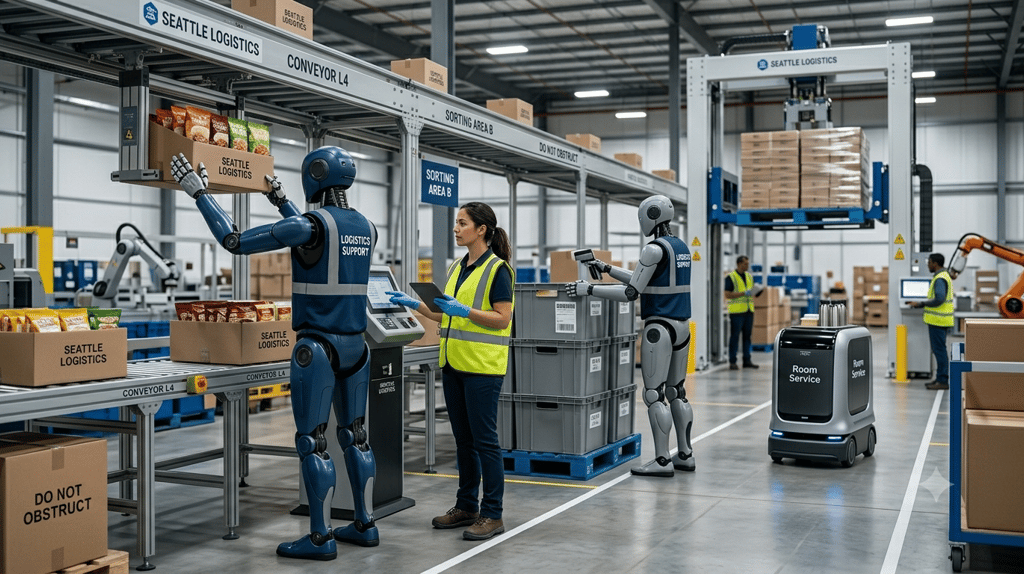
The true technological and cultural turning point of 2026 belongs to general-purpose humanoid robots. Leaving behind the laboratory phase where prototypes merely shuffled around awkwardly, bipedal robots equipped with highly articulated, tactually sensitive hands have begun entering the commercial market with scalable pricing and business models. The industry has pivoted aggressively toward the Robot-as-a-Service (RaaS) framework, allowing companies and consumers to adopt the technology without a prohibitive upfront capital investment.
Among the top market leaders defining this space are:
1X Neo: Developed in partnership with major AI firms, Neo is available for a direct purchase price of $20,000 or through a monthly subscription model of $499. Neo’s primary technical edge is deep imitation learning. Instead of being programmed line-by-line to wash dishes or fold sheets, it learns new tasks by watching videos of humans executing those same actions, replicating the movements while dynamically adjusting its physical force.
Unitree G1: A low-cost model geared toward extreme mechanical agility. It is capable of executing complex movements and manipulating small objects with high precision, tailored for light industries and office support roles.
Tesla Optimus and Figure AI: Built primarily for industrial environments and heavy logistics, these robots are taking over repetitive, ergonomically hazardous, or unsafe tasks on automotive assembly lines and e-commerce fulfillment warehouses.
China holds an isolated lead in the industrial scaling of this category. Driven by massive government incentives and a highly integrated component supply chain, the country projects reaching a milestone of over 10,000 humanoid units actively operating across commercial, logistics, and manufacturing sectors by the close of this year.
Humanoids with Human Facial Features: Balancing Utility and Affection
Beyond the cold mechanical efficiency of industrial robots, vanguard companies—with a strong emphasis on Asia's DroidUP—have crossed a complex psychological line: developing humanoid robots with ultra-realistic human features. Instead of sporting visible plastic or metallic finishes, these machines utilize advanced silicone polymers that mimic the texture and elasticity of human skin, complete with internal heating systems that give them a "warm touch."
This aesthetic evolution is not merely decorative; it is engineered to shatter initial psychological rejection, making it easier to introduce these robots as therapeutic care assistants and companions for the elderly. However, this visual lifelikeness has ignited deep ethical and sociological debates on a global scale:
Public Acceptance and the "Uncanny Valley": Although designed to comfort, many users report psychological unease and distrust when interacting with an entity that blinks, smiles, and simulates micro-expressions artificially.
Privacy and Non-Stop Surveillance: Because they are equipped with high-definition cameras and directional microphones to interpret commands and read expressions, these robots capture an uninterrupted stream of biometric, visual, and behavioral data inside private homes, raising serious questions about who controls and stores this cloud data.
The Artificial Emotional Bond: As integrated AIs allow humanoids to simulate empathy, active listening, and continuous emotional validation, psychologists warn of human social isolation. An unprecedented philosophical dilemma emerges: to what extent is it healthy and ethical to allow individuals to form deep emotional attachments to tools programmed to mimic affection?
The Global Grid: Which Countries Are Leading the Charge?
The geopolitical and commercial race for supremacy in the robotics era highlights vastly different governmental and market strategies among the world's leading economies:
China (42.6% of the Global Market): The nation has cemented its position as the global factory of modern robotics. The Chinese strategy zeroes in on mass scale and driving down hardware production costs. By dominating the supply chain for high-precision electric motors, high-density batteries, and lightweight alloys, China can deliver thousands of humanoids to market at a fraction of Western competitors' prices, aggressively automating its own commercial and manufacturing sectors.
The United States ($1.31 Billion Invested in 2025): The American approach centers heavily on software and intellectual leadership. The country directs its billions in venture capital toward building the "brains" of the robots: foundational AI models, neural network algorithms, and computer vision systems that unlock genuine autonomy. It remains the birthplace of the leading cutting-edge startups mapping out the conceptual architecture of general-purpose robotics.
Europe (Accelerating Growth): The European bloc has carved out its niche by focusing on smart urban logistics infrastructure, such as automated ground delivery networks. At the same time, Europe stands out as the sector's regulatory powerhouse, leading the creation of strict legal frameworks that protect citizens from data privacy abuses and ensure physical safety as humans share public spaces with machines.
Japan (Focus on Local Automation and Healthcare): Facing one of the most severe demographic crises on the planet, Japan treats robotics as a social survival tool. With an aging population and a critical shortage of healthcare workers, the country's investments are funneled directly into medical assistance robots, mobility aids for the elderly, rehabilitation exoskeletons, and companion robots to combat senior isolation.
Brazil (Emerging Consumer): The Brazilian landscape positions the country primarily on the consumption side of the value chain. The domestic market reports record sales for basic home cleaning robots and simple home automation due to their immense convenience appeal in major cities. However, the country remains far from developing its own proprietary hardware, manufacturing high-tech components locally, or adopting humanoids on a large scale across the service sector, relying almost entirely on tech imports from Asia and North America.
Conclusion
Economic indicators solidify an undeniable reality: the global market for home and service robotics is on the verge of exponential expansion, projected to skyrocket from $17 billion in 2026 to an astonishing $107 billion by the year 2034. The technology required to decentralize machines and insert them right into our homes and cities has already overcome engineering bottlenecks to reach clear commercial viability.
The real question confronting humanity is no longer technical or chronological—we know how, and we know they have already arrived. The challenge moving forward is sociocultural and regulatory. Are we truly prepared to reconfigure the job market, redefine our concepts of privacy, and adapt our psychology to share our dinner tables, sidewalks, and most intimate social routines with silicon assistants? In a world where machines learn by watching human actions, the mirror of robotics hands us back the most vital question of all: what do we want to prioritize and protect within our own humanity?
References
International Federation of Robotics (IFR): World Robotics Report 2025/2026 – Service Robots.
Statista Market Insights: Home Robotics Market Size, Share & Trend Analysis, 2026-2034.
1X Technologies / Unitree Robotics: Commercial Launch and Pricing Specifications for Neo and G1 Models (2026).
MIT Technology Review: The Rise of Humanoid Robots in Commercial Spaces and the Ethics of AI Companionship (2026).
Contact
Contact us for questions or suggestions
contact@turingvision.com
fone: + 55 54 99122 0659
© 2026. All rights reserved. https://turingsvision.com/privacy-policy