
The Rocket That Puts It in Reverse: How an "Impossible" Idea Overthrew a Billion-Dollar Monopoly and Reinvented the Space Race
How Vertical Landing Shattered the Cold War Paradigm, Slashed Launch Costs, and Opened the Cosmos to Private Enterprise
SPACENEW TECNOLOGY
Marcelo Salamon
6/25/20269 min read
Abstract: For decades, launching a rocket into space meant losing it forever. Every single mission demanded the construction of a brand-new vehicle, turning space exploration into an exclusive privilege for governments with astronomical budgets. This article analyzes the historic transition from expendable to reusable rockets, comparing costs, technologies, nations, and companies involved, while evaluating the environmental impact of this radical shift. A quiet revolution—but one that could define the next century of humanity.
Keywords: reusable rockets, SpaceX, Falcon 9, Starship, Blue Origin, space race, launch cost, space sustainability, NASA, China in space.
Introduction
Imagine if every time you took a commercial flight, the airplane was destroyed upon reaching its destination. No airline could ever survive such a business model. Yet, that is exactly how humanity operated in space for over sixty years. Every rocket launched was a single-use vehicle: it took off, separated its stages over the ocean, and was never seen again. The cost of this approach was simply prohibitive—and for a long time, no one seriously questioned whether there was another way.
The Apollo Era in the 1960s consolidated this disposable model as the absolute norm. The Space Shuttle in the 1980s promised to break this logic by introducing a reusable orbiter—but the massive external tank was still discarded, costs remained stratospheric, and two fatal accidents scarred the program irreparably. When the Shuttle was retired in 2011, NASA found itself relying entirely on Russian rockets just to send its astronauts to the International Space Station.
It was into this vacuum that a seemingly ludicrous idea emerged: what if the rocket simply came back? What if, after delivering its payload to space, the booster slowed down in mid-air, reignited its engines, reversed its trajectory, and landed upright—completely on its own—at the exact spot from which it departed?
Today, this "impossible" feat is routine. And it changed everything.
The Era of Expendable Rockets: What Used to Be Normal
To understand the magnitude of the current revolution, one must comprehend what came before. Cold War-era rockets were engineered with a single purpose: just get there. The question of "what happens to the rocket afterward?" simply was not part of the equation—or rather, the answer was always the same: it crashes into the ocean.
The Space Shuttle, launched by NASA between 1981 and 2011, was the most ambitious attempt to break this cycle. Across 135 missions spanning three decades, the program accumulated a total development cost estimated at $211 billion (adjusted to 2012 dollars). The "ticket price" per astronaut hovered around $170 million—and that does not even account for the staggering maintenance expenses that made each mission even more expensive in practice.
The tragedy of the expendable model became even more apparent with the Space Launch System (SLS), the rocket developed by NASA for the Artemis program to return to the Moon. According to the agency's Inspector General, a single launch of the SLS costs between $2.5 billion and $4 billion—and the vehicle is entirely expendable. To put that into perspective: with that amount of capital, one could build multiple schools, hospitals, or fund years of vital scientific research. Instead, it all ends up at the bottom of the sea after just a few minutes of flight.
This model was not just expensive. It was structurally unsustainable for any future where space exploration ceased to be a monopoly of global superpowers.
The Turning Point: How Vertical Landing Technology Was Born
The seeds of change were planted long before Elon Musk or Jeff Bezos entered the arena. In 1991, McDonnell-Douglas, backed by US Air Force funding, began developing the DC-X—Delta Clipper-Experimental—a low-altitude demonstrator capable of vertical takeoff, maneuvering, and landing back at its point of origin. The program was canceled in 1996, but its influence on the industry endured.
It was upon these shoulders that SpaceX, founded by Elon Musk in 2002, built its vision. While traditional competitors viewed the expendable rocket as an inevitable destiny, Musk tackled the problematic model as an engineering problem waiting to be solved. The mission was clear: reduce the cost of access to space by orders of magnitude.
In December 2015, the world paused to watch something many judged entirely impossible: the first stage of a Falcon 9 took off, delivered its payload into orbit, and came back—landing softly on four legs just a few hundred feet from its launch pad. Cameras around the globe broadcasted the moment in real time. Veteran NASA engineers watched with expressions blending pure disbelief and profound admiration.
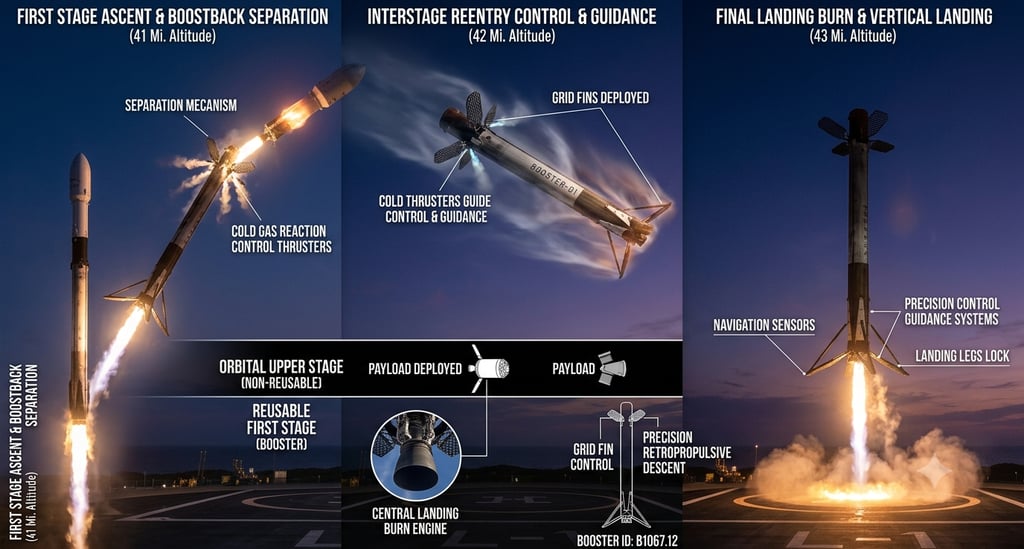
The Falcon 9 landing mechanism involves a precisely timed sequence of events: after second-stage separation, the booster executes a boostback burn to halt its upward trajectory, flip itself using cold-gas thrusters, and reignite its main engines for the final entry and landing burns. Four landing legs deploy mere seconds before making contact with the ground—or with an autonomous drone ship at sea when the mission demands it.
With Starship, the technology took another massive leap. The Super Heavy, the system's massive booster, does not just land—it is caught mid-air by two enormous mechanical arms installed directly on the launch tower, a maneuver SpaceX nicknamed "Mechazilla." The rocket literally "puts it in reverse" in mid-air and is embraced by the very infrastructure it departed from. Science fiction turned into operational reality.
A Comparative Breakdown of Costs: Before and After
The cost discrepancy between expendable and reusable models is not incremental—it is entirely transformative. Below is an overview of estimated costs per launch across major historical and modern launch vehicles:
Saturn V (Apollo) | NASA/USA | Expendable | ~ $500 million (adjusted)
Space Shuttle | NASA/USA | Partially Reusable | ~ $1.5 billion
SLS / Artemis | NASA/USA | Expendable | $2.5 billion – $4 billion
Soyuz | Roscosmos/Russia | Expendable | ~ $80 million
Falcon 9 | SpaceX/USA | Reusable | ~ $67 million – $74 million
Starship (projected) | SpaceX/USA | Fully Reusable | $50 million – $90 million (and falling)
Because the first stage (the booster) represents between 60% and 70% of a rocket's total manufacturing cost, recovering it intact completely redefines industry margins. According to Elon Musk, refurbishing and upgrading a flight-proven booster costs less than 10% of the total cost of building a brand-new vehicle. This means that by the second launch of the same booster, the unit cost plunges vertically compared to any expendable competitor, turning every additional mission into pure economic gain.
The practical impact is dramatic. When NASA partnered with SpaceX to fly American astronauts into space again following the Shuttle's retirement, the cost per seat dropped from roughly $170 million (Shuttle) to approximately $55 million—and the trend continues downward.
The cadence and scale have made the reusable model not just viable, but commercially unbeatable. The Falcon 9 has captured roughly 90% of global commercial orbital launches, executing missions at intervals of just a few days using boosters that, in many cases, have surpassed the milestone of 20 reused flights.
Who Else Is in the Race? The Global Landscape
The reusable rocket revolution is not a phenomenon exclusive to Elon Musk. A global race is underway, with different countries and corporations at various stages of development.
United States
SpaceX maintains an isolated lead, but Jeff Bezos's Blue Origin is moving to cement its presence in the orbital class. While the company already mastered suborbital vertical landings with New Shepard for space tourism, its focus has shifted toward New Glenn, a heavy-lift orbital vehicle designed with a fully reusable first stage built to land on floating ocean platforms. Both companies are fiercely competing for billion-dollar NASA contracts for the Artemis program as well as major commercial launch agreements.
NASA, meanwhile, operates in a dual role: on one hand, it maintains the expendable SLS for political and contractual reasons; on the other, it invests billions into the Artemis program using SpaceX's Starship as the Human Landing System. The contradiction is recognized internally—the agency's Inspector General went as far as to classify the ongoing costs of the SLS as "unsustainable."
China
The Chinese advancement is rapid and systematic. The country launched the Long March-12B, utilizing kerosene and liquid oxygen as propellants in both stages, as part of its state-backed investments in reusable technologies to slash mission costs. In the private sector, Chinese startups like Landspace and Space Pioneer are conducting tests with partially reusable rockets, while other projects like Kinetica-2, Pallas-1, and Nebula 1 are in advanced stages of development. Though still trailing SpaceX in operational flight hours, China possesses the resources and state determination to close this gap rapidly.
Europe
The European Space Agency (ESA) operates the Ariane 6, which remains entirely expendable, but faces mounting pressure to adapt its long-term strategy. Aggressive pricing from SpaceX has rendered European rockets far less competitive in the global commercial market. Reusability projects are currently under discussion, but Europe is still scrambling to recover lost time and position itself in this new era.
Russia
The Russian space program is enduring a prolonged crisis. Following decades of leadership—where the Soyuz rocket was the world's preferred, hyper-reliable transport for astronauts—geopolitical isolation and international sanctions have suffocated Roscosmos. The Soyuz remains a robust workhorse, but its purely expendable architecture and the lack of incoming capital prevent the development of large-scale reusability technologies.
Startups and New Players
Rocket Lab, an American-New Zealand company, is actively developing first-stage recovery technologies (including testing mid-air captures using helicopters). Relativity Space is betting on 3D-printed rockets with integrated reusability designs. The global ecosystem of aerospace startups has never been more active—a direct byproduct of the financial proof-of-concept established by the reusability market.
The Environmental Impact: Fewer Debris, But Not Zero
The environmental dimension of rocket reusability is frequently underemphasized in public debate—yet it introduces solid arguments alongside complex ethical dilemmas.
The Clear Advantage: Ending Physical Debris
In the expendable model, every launch generated tons of metallic waste: stages discarding into the oceans, fragments lingering in low Earth orbit, and pieces re-entering the atmosphere uncontrollably. Scientific studies published by NASA demonstrate that the re-entry of space debris contributes to the presence of aerosolized metals in the stratosphere—such as lithium, silver, copper, and niobium—with climatic consequences that are still poorly understood.
Reusability eliminates this issue at its source: a rocket that returns intact to its base generates zero discarded hardware. Experts from ESA and environmental organizations recognize reusability as the primary solution to curb the compounding growth of operational space junk.
The Other Side: Atmospheric Emissions and Satellite Re-entries
However, the brutal surge in total annual launches—a direct consequence of cheaper flights—presents new challenges to the ozone layer. Beyond the gases emitted during liftoff, a new bottleneck has emerged: the disposal of the massive internet megaconstellations that these very rockets deploy.
Because satellite internet constellations require the deliberate de-orbiting and burning of hundreds of older spacecraft in the atmosphere to avoid creating orbital debris, the problem simply migrates from the ocean floor straight into the stratosphere. Satellites undergoing re-entry release aluminum oxides, compounds that can alter the planet's thermal balance. Scientists estimate that space traffic now vaporizes more than 3,300 tons of electronic waste in the atmosphere every year.
As a researcher noted in the MIT Technology Review: "We need to make a decision, as a society, about whether we prioritize reducing space traffic or reducing emissions." Reusability elegantly solves an acute environmental issue, but the massive commercial scale it unlocks inevitably amplifies another.
Does It Make Economic Sense? Do the Math?
The core economic question is simple: does investing in reusable technology actually pay off? Based on real-world market data, the answer is unequivocal: yes—and overwhelmingly so.
The initial development of the Falcon 9 cost SpaceX approximately $400 million. With that single vehicle, the company went on to dominate the vast majority of the global commercial launch market. Every time a booster flies repeatedly, it slashes marginal costs to a mere fraction of what it takes to forge a metal hull from scratch.
The Starship system, the next generation, required a far heavier investment—with capital injections estimated around $15 billion for its integrated development. Yet the projected scale justifies the risk: the ability to launch massive payloads, massive batches of Starlink satellites in a single go, and future lunar missions drops the projected cost per launch to a tiny fraction of what the government's SLS consumes.
The model worked so remarkably well that SpaceX evolved from a doubted startup into a titan of the private market, valued at over $210 billion and standing as one of the most highly anticipated IPOs in the history of capital markets. Reusable rocketry is not just brilliant engineering—it is one of the most disruptive business models of the twenty-first century.
Conclusion
The history of reusable rockets is, at its core, the story of an obvious question that took decades to be taken seriously: why destroy something that can be used again?
The answer did not come from government space programs, which were bogged down by political budgets and entrenched legacy contractors. It came from companies willing to fail publicly, explode prototypes, rethink the physics of the problem from scratch, and persist right where the traditional aerospace industry had given up. The result has radically transformed costs, frequency, and access to space exploration in less than a decade.
What once cost billions now costs tens of millions. What used to happen just a few times a year now occurs routinely in a matter of days. Space exploration has ceased to be the exclusive monopoly of state superpowers and has opened wide for the private sector, mid-tier nations, and scientific missions that previously stood zero chance of securing funding.
New actors—ranging from China and Blue Origin to dynamic startups around the globe—are accelerating this democratization. The environmental impact is broadly positive in terms of mitigating space debris, but demands strict scientific oversight regarding upper-atmosphere emissions and re-entries as flight volumes continue to multiply.
The commercial question is no longer whether reusable rockets are here to stay. The question now is far more urgent for the market: who can run fast enough to avoid being left behind?
References
NASA. Space Shuttle Program: Historical Overview. NASA.gov.
NASA Office of Inspector General. Report on Artemis/SLS Program Costs. Available at: https://oig.nasa.gov
SpaceX. Falcon 9 Launch Vehicle Overview & Starship Mission Specification. Available at: https://www.spacex.com
CNN Business. SpaceX expands capital injections into fully reusable rocket project.
CNN Business. China launches rocket incorporating reusable technology guidelines via Long March-12B.
Blue Origin. New Glenn Mission and Heavy-Lift Orbital Architecture Overview. Available at: https://www.blueorigin.com
MIT Technology Review. The hidden impact of satellites and rocket emissions on the upper atmosphere.
Meio Bit. NASA: Structural costs of the SLS and Orion capsule are unsustainable in the long run.
Seu Dinheiro. How vertical landing engineering and reuse shifted the aerospace market valuation.
Wikipedia. Space Shuttle / DC-X Delta Clipper. Connected to historical aerospace engineering archives.
Contact
Contact us for questions or suggestions
contact@turingvision.com
fone: + 55 54 99122 0659
© 2026. All rights reserved. https://turingsvision.com/privacy-policy