
The Real Imitation Game: What Alan Turing Actually Meant by the "Turing Test"
Alan Turing
BIOGRAPHY
Salamon & Salamon
5/29/20266 min read
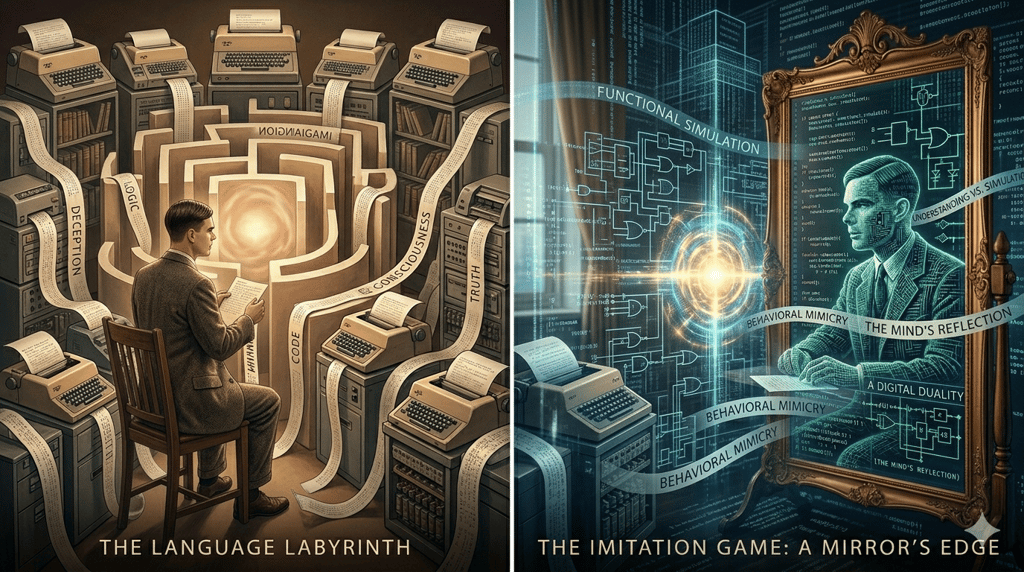
Summary: Think you know the Turing Test? Think again. Dive deep into the brilliant strategy behind Alan Turing’s 1950 paper, explore the forgotten parlor game that inspired "The Imitation Game," and discover why modern AI giants like ChatGPT and Gemini still struggle to pass his true test of deception.
🚀 Introduction
In 2014, the Hollywood blockbuster The Imitation Game brought the tragic and brilliant life of Alan Turing into the cultural mainstream. While the film focused heavily on his wartime codebreaking at Bletchley Park, its title pulled from a profound, existential question Turing posed five years after the war ended. In 1950, while working at the University of Manchester, he published a philosophical paper that would forever dictate the trajectory of computer science.
Today, almost everyone in Silicon Valley and the broader tech world throws around the term "The Turing Test" as the ultimate benchmark for Artificial Intelligence. The popular narrative is incredibly straightforward: if a computer can trick a human into believing it is also human through a text-based chat, it has passed the test, proving that machines have finally achieved the capacity to "think."
But there is a massive catch: that is not what Alan Turing was trying to prove at all. In fact, the mainstream interpretation of the Turing Test completely flattens the philosophical genius of what the father of computing was actually investigating. He wasn't setting up a benchmark for computer hardware; he was creating a philosophical mirror to challenge our own definitions of humanity.
🔬 The Philosophical Trap: Why Turing Avoided "Thinking"
To understand the true nature of the test, we have to look closely at how Turing begins his seminal 1950 paper, Computing Machinery and Intelligence. He starts with a bold declaration: "I propose to consider the question, 'Can machines think?'" But instead of spending hundreds of pages arguing over semantics, Turing immediately discards the question as a dangerous, unscientific trap.
Turing understood that terms like "thinking," "mind," and "consciousness" are impossible to define objectively. If a human claims they are thinking, how can anyone else truly prove it? In philosophy, this is known as the problem of other minds—or solipsism. Turing realized that if scientists spent decades trying to define "thinking" before building an intelligent machine, they would never write a single line of code.
Instead of getting bogged down in an endless theological and philosophical debate about artificial consciousness, Turing did what any master cryptanalyst would do: he replaced the unanswerable, abstract question with a practical, measurable, and behavioral experiment. He called it The Imitation Game.
🎲 The Forgotten Victorian Setup: A Game of Gender Deception
In its earliest iteration described by Turing, the game didn't involve a computer at all. It was based on a popular Victorian parlor game. Turing’s original setup involved three distinct players:
Player A: A man.
Player B: A woman.
Player C: A human interrogator (of either gender) who is locked in a separate room, away from the other two.
The interrogator’s goal is to correctly determine who is the man and who is the woman solely by reading typewritten answers to questions sent back and forth. To make things fascinating, Player A’s explicit objective in the game is to trick and deceive the interrogator into making the wrong guess. Player A must actively lie, mimic feminine speech patterns, and steer the interrogator off course. Meanwhile, Player B’s objective is to help the interrogator, declaring, "I am the woman, don't believe him!"—though the interrogator has no way of knowing if Player B is telling the truth.
Only after setting up this complex human game of psychological deception does Turing introduce his revolutionary twist: What happens if a machine takes the place of Player A (the man) in this game?
As Turing wrote: "Will the interrogator decide wrongly as often when the game is played like this as he does when the game is played between a man and a woman?"
💡 The Crucial Distinction: Turing wasn't testing whether a machine could generate a perfect, flawless encyclopedic answer. He was testing whether a machine could successfully mimic the nuances, hesitation, intentional errors, emotional deflections, and conversational strategies of human behavior under the pressure of active deception. It wasn't an evaluation of mathematical capacity; it was a test of linguistic performance and empathy simulation.
🛡️ Anticipating the Critics: Turing’s Defenses
Turing was so far ahead of his time that in his 1950 paper, he dedicated a massive section to anticipating and rebutting the exact arguments critics would use against AI decades later.
The Theological Objection: The argument that thinking is a function of man’s immortal soul, and thus a machine cannot think. Turing brushed this aside, stating it puts an arbitrary limit on omnipotence.
The "Heads in the Sand" Objection: The sheer terror that a machine could outthink us. Turing noted this required no rebuttal, as it stems from emotional fear rather than scientific fact.
Lady Lovelace’s Objection: Named after Ada Lovelace (the first computer programmer), this argument states that a computer can never do anything truly original; it only does what we order it to do. Turing countered that computers surprise humans constantly, and that "originality" in humans is often just the recombination of things we have already learned.
The Argument from Consciousness: The idea that a machine cannot write a sonnet or feel pleasure because it doesn't feel its own creation. Turing pointed out that the only way to know if a machine feels is to be the machine, which is an impossible standard we don't even apply to other humans.
🤖 The Modern Verdict: Would Advanced LLMs Pass the Real Test?
Fast forward to the present day. We live in an era dominated by incredibly sophisticated Large Language Models (LLMs) like ChatGPT, Claude, and Gemini. If you look at standard text conversations, these models routinely trick casual users into thinking they are interacting with a human. So, have we officially crossed Turing's finish line?
If Alan Turing walked into a modern AI lab today, his answer would likely be a sharp: Not yet.
While modern generative AIs are jaw-droppingly eloquent, they often fail the specific, strategic deception required by the original, adversarial Imitation Game.
1. The Trap of Perfect Consistency
A machine trying to pass the true Turing Test has to know when to pretend not to know something. If you ask a modern LLM to multiply two 10-digit numbers, it will spit out the exact answer in microseconds. A human wouldn't do that; a human would hesitate, sigh, complain about the math, or make a careless calculation error. Modern AIs struggle to simulate human limitations convincingly unless explicitly prompted to act dumb.
2. The Lack of Strategic Intent
Modern AI predicts the next most probable word based on massive statistical data. It does not have an underlying, conscious motive to keep a secret or actively deceive an opponent. In Turing's game, the machine must dynamically strategize to protect its hidden identity from a hostile interrogator who is actively trying to trip it up with trick questions, riddles, and emotional bait.
When subjected to a rigorous, adversarial interrogation designed by a trained skeptic—someone who probes for temporal awareness, deep logical consistency across hours of chat, or the ability to understand sarcasm—modern AI models still display patterns of artificial alignment and politeness that give away their synthetic origin.
🏁 Conclusion
Alan Turing’s greatest insight in 1950 was that we don't need to build an organic brain or a biological soul to achieve Artificial Intelligence. He successfully decoupled intelligence from biology. He argued that if something behaves indistinguishably from an intelligent agent, it is, for all practical and scientific purposes, intelligent.
The Turing Test was never meant to be a magical declaration that machines can feel, suffer, or love. It was a beautifully designed mirror reflecting our own humanity back at us through the medium of language. As we continue to refine our AI models, we aren't necessarily making them "think" in the biological sense; rather, we are perfecting the ultimate imitation—proving that language, the very tool we use to define our humanity, can ultimately be mastered through the pure, cold logic of a machine.
📚 References
TURING, Alan M. Computing Machinery and Intelligence. Mind, v. LIX, n. 236, p. 433–460, October 1950. (The original paper where the Imitation Game was introduced).
HODGES, Andrew. Alan Turing: The Enigma. London: Vintage Books, 2014. (The definitive biography providing deep context on Turing’s philosophical views on machine intelligence).
SAYGIN, Ayse Pinar et al. The Turing Test: 50 Years Later. Minds and Machines, v. 10, p. 463–518, 2000. (An academic review of the historical misinterpretations and structural evolution of the test).
SEARLE, John R. Minds, Brains, and Programs. Behavioral and Brain Sciences, v. 3, n. 3, p. 417-424, 1980. (The foundational "Chinese Room" argument regarding the difference between functional simulation and true cognitive understanding).
Contact
Contact us for questions or suggestions
contact@turingvision.com
fone: + 55 54 99122 0659
© 2026. All rights reserved. https://www.turingsvision.com/privacy-policy