
The Physics of Space Survival
Between extreme chemical reactions and orbital mechanics, the precision engineering that sustains human life on the edge of space
SPACE
By Salamon & Salamon
6/11/20268 min read
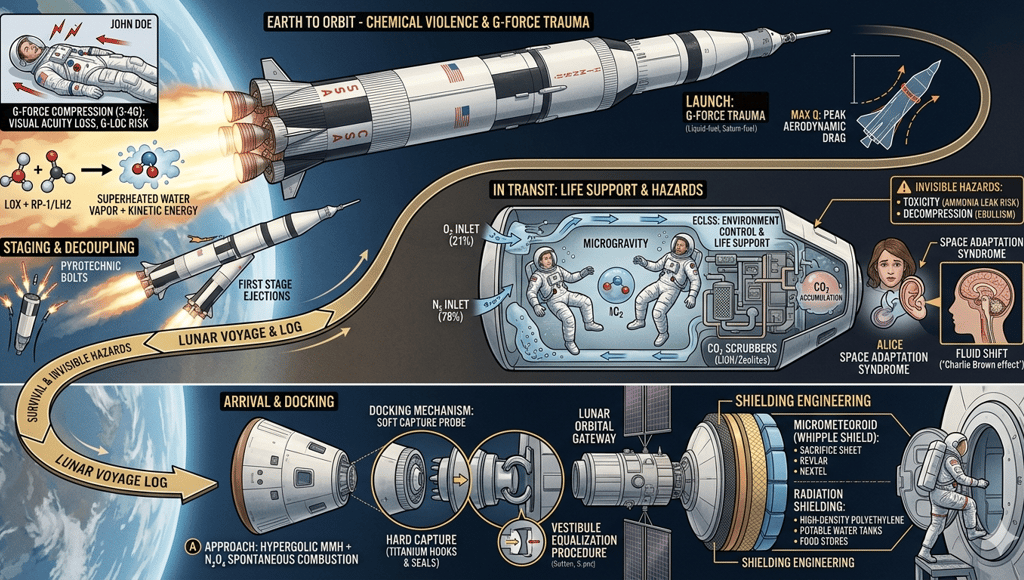
Humanity’s journey to the Moon represents the pinnacle of aerospace engineering, where the fragility of a biological organism is tested against the most violent and merciless forces in the known universe. Leaving the safety of Earth’s atmosphere and entering the deep vacuum of space is not merely a feat of navigation; it is a continuous battle managed by extreme chemical reactions, fluid dynamics, and closed artificial ecosystems. Every second of a lunar mission demands absolute precision, where the boundary between survival and catastrophic disaster is maintained by millimeter-thin layers of advanced materials and rigorous mathematical calculations of orbital mechanics.
Engine Roar and the Chemical Reactions of Launch
Breaking free from Earth’s gravity requires a colossal release of thermal energy converted into kinetic energy. Upon ignition on the launchpad, the rocket’s main engines initiate highly controlled, high-energy redox (reduction-oxidation) reactions. In modern liquid propulsion systems, liquid oxygen serves as the universal oxidizer, cooled to cryogenic temperatures. It is mixed under high pressure with liquid hydrogen or a highly refined kerosene known as RP-1. The complete chemical reaction between hydrogen and oxygen results in the formation of superheated water vapor, releasing massive thermal byproducts and generating a monumental thrust that pushes the vehicle upward.
In solid rocket boosters, which frequently assist the launch vehicle during the initial minutes of ascent, the chemistry is distinct and even more aggressive. A homogeneous mixture is utilized where ammonium perchlorate acts as the oxidizing agent and atomized aluminum powder serves as the actual fuel, all bound together by a polymer matrix. Once ignited, this chemical reaction produces aluminum oxide, hydrogen chloride, nitrogen gas, and water vapor, unleashing an absurd amount of energy that cannot be throttled or shut down once combustion has begun.
As the vehicle accelerates vertically through the dense layers of the atmosphere, it reaches the point known as Maximum Dynamic Pressure, or Max Q. This is the most critical physical moment of the launch, where the increasing speed of the rocket and the density of the surrounding air combine to create the greatest aerodynamic drag force against the vehicle’s structure. The structural integrity of the rocket is stressed to its absolute limit as it rips through the upper atmospheric layers.
The Human Body Under G-Force and Biological Risks
Inside the capsule, astronauts experience the direct physical consequences of this monumental acceleration. The human body begins to endure G-forces that multiply the crew member’s body weight by three to four times normal. Under a stress of 3G to 4G, physiological effects are immediate and severe. The artificial gravity generated by acceleration drains blood away from the astronaut’s head toward the lower extremities. To mitigate this effect and prevent the brain from suffering an abrupt oxygen deprivation, astronauts travel flat on their backs, positioned perpendicular to the acceleration vector.
Even in this protective position, physical risks remain entirely real. Severe chest compression occurs, making breathing an act of extreme mechanical effort. Visual acuity progressively decreases, causing “grayout” due to reduced blood flow to the retina. If the acceleration exceeds tolerable limits or the seat positioning fails, the astronaut can experience G-force induced loss of consciousness (G-LOC)—a state of biological blackout that is extremely dangerous during critical maneuvers.
Beyond physiological strain, the launch phase presents the highest risk of catastrophic mechanical failure. The turbopumps feeding the engines operate at extreme pressures and speeds, and any microfracture can result in a massive explosion of the propellant tanks. An infinitesimal misalignment in the thrust vector of the engines can cause the rocket to tumble, leading to immediate structural disintegration by aerodynamic forces. To save the crew in such nightmare scenarios, the capsule is equipped with a Launch Escape System—a tower of ultra-fast solid-fuel rockets mounted on top of the vehicle that, in the event of an anomaly, rips the crew cabin away from the main rocket booster in fractions of a second.
Staging, Separation, and Transition to the Vacuum of Space
When the first stage consumes all its propellant, the staging process occurs. Pyrotechnic explosive bolts or high-pressure pneumatic separation systems are triggered, ejecting the empty structure. At that exact instant, acceleration ceases abruptly before the next stage ignites. The astronauts’ bodies, which were previously crushed against their couches, are thrown forward, held back only by their harness straps. This marks the sudden onset of microgravity.
Following definitive exit from Earth’s atmosphere and the separation of all main booster stages, the astronauts remain isolated within the lunar transit spacecraft. Survival becomes entirely dependent on the Environmental Control and Life Support System (ECLSS). To execute necessary course corrections during the multi-day transit to the Moon, the spacecraft utilizes a Reaction Control System (RCS), consisting of small maneuvering thrusters placed around the hull. These thrusters utilize chemical compounds known as hypergolic propellants, generally combining monomethylhydrazine (MMH) and dinitrogen tetroxide (N2O4). The vital characteristic of these chemicals is that they ignite spontaneously upon contact with each other, requiring no spark or ignition system, which provides crucial reliability in the vacuum of space.
Space Adaptation Syndrome and the Internal Atmosphere
The absence of gravity profoundly alters the functioning of the human organism. During the first few days in orbit, the crew faces Space Adaptation Syndrome (SAS). The vestibular system located in the inner ear, which is responsible for balance and spatial orientation, fails to function correctly due to the lack of a gravitational vector to pull down on fluids and otoliths. The brain receives completely conflicting data from the eyes and muscles, resulting in severe bouts of nausea, vomiting, and intense spatial disorientation that complicates the execution of basic tasks.
Simultaneously, a massive fluid shift occurs within the body. Without gravity pulling blood and water toward the legs, these fluids migrate rapidly into the chest and head regions. Astronauts experience noticeable facial puffiness (the “Charlie Brown effect”) and continuous nasal congestion. The heart, detecting an apparently excessive volume of blood in the central body, signals the renal system to increase fluid elimination via urination, initiating a dehydration process that alters the body’s electrolyte balance.
To keep the astronauts alive and conscious, the capsule’s internal atmosphere is rigorously controlled. The system replicates Earth’s conditions at sea level, maintaining a gaseous mixture of approximately 78% nitrogen gas and 21% oxygen gas under a pressure of 14.7 pounds per square inch (1 atmosphere). This balance is essential to guarantee correct cellular oxygenation and prevent pulmonary disorders.
Invisible Hazards: Gas Toxicity and Vacuum Decompression
Living inside a spacecraft reveals unusual physical hazards. One of the most severe risks is the accumulation of carbon dioxide. On Earth, warm air and exhaled breath rise naturally due to gravity-driven thermal convection. In microgravity, convection does not exist. If an astronaut remains stationary or sleeps without forced air circulation, their exhaled carbon dioxide forms an invisible, toxic bubble around their own face, causing headaches, mental confusion, and suffocation from hypercapnia. To prevent this, cabin fans must keep the air in perpetual motion, directing gases toward chemical scrubbers that utilize lithium hydroxide or zeolites to react with and remove the carbon dioxide from the environment.
Another hidden chemical danger is the risk of internal toxic contamination from leaks. External cooling systems frequently utilize liquid ammonia to dissipate heat generated by the spacecraft’s electronics. A micro-leak of this fluid into the cabin interior would be fatal, causing immediate burns to the respiratory tract, pulmonary edema, and death by chemical asphyxiation. Furthermore, floating debris generated by sloughed human skin cells, clothing lint, and gases naturally released by plastics and electronics (outgassing) accumulate in the floating air, requiring complex mechanical and activated charcoal filtration systems.
Hand in hand with chemical risks is the mechanical danger of decompression. In the vacuum of space, external pressure is zero, while the interior of the spacecraft is inflated to 14.7 psi. The hull functions as a literal pressure cooker. An impact from a small piece of orbital debris or a micrometeoroid can puncture the cabin wall, initiating a rapid decompression event. Should a catastrophic decompression occur while astronauts are not wearing pressurized suits, the abrupt drop in pressure will cause body fluids, such as tissue water and blood, to boil immediately at normal human body temperature (ebullism), resulting in death within seconds.
The Docking Process at the Lunar Station
Upon reaching the vicinity of Earth’s natural satellite, the transit spacecraft must unite with the lunar orbital space station or the lunar lander. This process requires surgical precision driven by orbital mechanics. Both structures are traveling at thousands of miles per hour relative to the Moon, and the approach must be conducted at extremely low relative velocities, measured in inches per second. The pilot or autonomous flight system executes small burns with the hypergolic maneuvering thrusters to align the rotational and translational axes perfectly.
Initial contact occurs via a soft-capture system, where dampened mechanical latches guide the spacecraft’s probe into the station’s receptacle, absorbing residual kinetic energy from the light impact. Next, a hard-capture ring is engaged, utilizing high-strength titanium structural hooks to pull and lock the two structures together in a permanent, airtight seal. Advanced elastomeric seals and compression rings secure the junction against the external vacuum.
Before any hatch can be opened to allow the crew to pass into the lunar station, a pressure equalization procedure is mandatory. Sensors analyze the small dead space between the two hatches, known as the vestibule. If any pressure differential exists, the mechanical force exerted on the hatch would make opening it impossible or cause a violent blast of wind capable of injuring the crew. Flight computers inject or vent gases from this space until pressures are equalized. Chemical sensors also verify that no toxic gases or smoke have leaked into the vestibule before granting final authorization to open the hatch.
Shielding Engineering Against Debris and Deep-Space Radiation
A permanent space station in lunar orbit demands radically advanced protection concepts. The walls are not made of simple solid metal, as a thick aluminum block would be prohibitively heavy and inefficient. Instead, engineers deploy the Whipple Shield concept. The outermost wall consists of a thin sacrifice sheet of aluminum alloy placed several inches away from the main pressure hull. When a micrometeoroid striking at hypervelocity hits this first barrier, the kinetic energy of the impact is so brutal that the debris completely disintegrates and vaporizes into a cloud of plasma and tiny, less harmful fragments. This cloud expands in the void between the walls, losing momentum before striking the inner layers, which are composed of high-strength fabrics like Kevlar and Nextel that absorb the remaining kinetic energy without breaching the internal pressure hull.
The greatest protective challenge in deep space, however, is invisible radiation. Beyond the protection of Earth’s magnetic field (the Van Allen radiation belts), the station and its crew are exposed to Galactic Cosmic Rays (GCRs) and Solar Particle Events (SPEs), which consist of high-energy protons and heavy atomic nuclei traveling at near-light speed. When these particles collide with the atoms of conventional heavy metals like lead or steel, they shatter the metallic nuclei, generating a secondary radiation (bremsstrahlung) that is even more penetrating and hazardous to human cells.
For this reason, modern deep-space radiation shielding utilizes materials composed of light atoms rich in hydrogen, which possess a superior ability to slow down and absorb space protons without generating dangerous radioactive subproducts. Engineers utilize thick layers of high-density polyethylene (HDPE) within the walls of the habitats. Furthermore, the internal layout of the station is intelligently engineered: potable water storage tanks, fluid recycling systems, and even compartments of dehydrated food are positioned around the interior walls of the crew quarters and command posts, functioning as additional biological shields to preserve cellular integrity and safeguard the astronauts’ DNA against mutations and long-term damage.
References
Buckley, Jay C. Space Physiology. Oxford: Oxford University Press, 2006.
Clement, Gilles. Fundamentals of Space Medicine. New York: Springer, 2011.
Eckart, Peter. Spaceflight Life Support and Biospherics. Torrance: Microcosm Press, 1996.
El-Genk, Mohamed S. Space Nuclear Safety and Radiation Protection. Springer, 2020.
National Research Council. Protecting the Space Station from Meteoroids and Orbital Debris. Washington, D.C.: National Academies Press, 1997.
Sutton, George P., and Oscar Biblarz. Rocket Propulsion Elements. New Jersey: John Wiley & Sons, 2016.
Turner, Martin J. L. Rocket and Spacecraft Propulsion: Principles, Practice and New Developments. Praxis Publishing, 2009.
Wertz, James R., and Wiley J. Larson. Space Mission Analysis and Design (SMAD). Torrance: Microcosm Press, 1999.
Wieland, Paul O. Designing for Human Presence in Space: An Introduction to Environmental Control and Life Support Systems. NASA Reference Publication, 1994.
Contact
Contact us for questions or suggestions
contact@turingvision.com
fone: + 55 54 99122 0659
© 2026. All rights reserved. https://turingsvision.com/privacy-policy