
THE NEW SPACE RACE: FROM METHALOX PROPULSION TO CISLUNAR INFRASTRUCTURE
An Engineering Analysis of Rocketry, Interplanetary Logistics, and Life-Support Architecture
NEW SPACE
Salamon and Salamon
6/9/20267 min read
Abstract
Contemporary space exploration has transitioned from a purely ideological rivalry into a multifaceted ecosystem focused on economic viability, technological sovereignty, and sustainable human permanence. This paper analyzes the three driving forces of this landscape: NASA, the People's Republic of China, and SpaceX. It investigates the paradigm shift in rocket engineering brought forth by Vertical Takeoff, Vertical Landing (VTVL) reusable vehicles and the molecular transition to Methalox ($LCH_4$/$LOX$) propulsion. Furthermore, it discusses the kinetic and thermodynamic challenges of establishing a permanent lunar base and the viability of In Situ Resource Utilization (ISRU) on Mars via the Sabatier Reaction, closing the biogeochemical cycles necessary for humanity's interplanetary expansion.
Keywords: Space Race. Methalox. Artemis Program. Lunar Station. ISRU. Aerospace Engineering.
Introduction
Unlike the competitive model observed in the mid-20th century between the United States and the Soviet Union, the 21st-century space race operates under a dynamic of co-dependent and competitive symbiosis. The current ecosystem encompasses not only traditional government agencies but also centrally planned state corporations and a disruptive private sector.
The maturity of computational physics, materials science, and artificial intelligence has transformed deep space from a vector of temporary scientific exploration into a new economic and infrastructural frontier. The capability to establish permanent logistical supply lines between Earth, cislunar orbit, and eventually Mars has become the primary benchmark of global technological power. In this scenario, success depends on mastering variables ranging from analytical orbital mechanics to the thermodynamic limits of chemical propulsion and bio-physiochemical life support.
Vetores Estatais e Corporativos: NASA, China e SpaceX
NASA e a Mudança de Paradigma Contratual
NASA (National Aeronautics and Space Administration) centers its deep-space exploration strategy on the Artemis Program. Aiming for a return to the lunar surface and the construction of a sustainable infrastructure, the agency utilizes the expendable SLS (Space Launch System) heavy-lifter and the Orion capsule.
However, NASA's greatest innovation in this decade has not been exclusively mechanical, but rather one of governance. By abandoning traditional cost-plus contracts—where the government assumes all financial risks and delays—and adopting competitive fixed-price contracts through the HLS (Human Landing System) program, NASA decentralized development. This injected billions of dollars into commercial architectures, ultimately selecting SpaceX's Starship HLS and Blue Origin's landing system.
China's Monolithic Strategy (CNSA)
The People's Republic of China, under the aegis of the CNSA and its industrial arm, CASC, executes a methodical, centralized flight plan. With the continuous operation of the Tiangong Space Station in Low Earth Orbit (LEO), stabilized by ion propulsion, the country has validated long-duration autonomous docking systems.
The Chinese robotic exploration program has achieved unprecedented milestones with the Chang'e missions:
Chang'e 4: The first successful soft landing on the far side of the Moon.
Chang'e 5 and 6: Automated collection and return of lunar regolith and subsurface samples.
China's strategic objective projects landing taikonautas on the Moon by 2030, driven by the development of the Long March 10 super-heavy rocket and advancements in metallic alloys for reusable vectors.
SpaceX's Commercial Disruption
SpaceX shattered the aerospace industry's long-standing dogmas by turning Reusable Launch Vehicles utilizing Vertical Takeoff, Vertical Landing (VTVL) into a high-frequency commercial reality with the Falcon 9 and Falcon Heavy. Optimizing Guidance, Navigation, and Control (GNC) algorithms alongside the deployment of hypersonic grid fins during atmospheric re-entry drastically reduced the cost per kilogram to orbit.
The pinnacle of this engineering evolution is materialized in the Starship/Super Heavy system. Designed to be 100% reusable with a projected payload capacity exceeding 100 metric tons to LEO, the vehicle bases its logistical architecture on orbital cryogenic propellant transfer—a critical technology required to enable high-energy missions toward Mars without the need to construct prohibitively massive rockets on Earth.
Rocket Engineering and Space Travel: The Fuel Paradigm
The fundamental limiting factor of any interplanetary ambition is dictated by the Tsiolkovsky Rocket Equation:
Delta v = vₑ . l (mₒ / m𝒻)=
Where Deltav represents the required velocity change for an orbital maneuver, vₑ is the effective exhaust velocity of the gases (directly proportional to the specific impulse, Isp), mₒ is the total initial mass (including propellant), and m𝒻 this the final dry mass of the vehicle after burnout.
To optimize Iₛₚ without compromising volumetric density and the structural integrity of the rocket, the aerospace industry has migrated toward a new generation of propellants.
Hidrogênio Líquido (LH₂) vs. Oxigênio Líquido (LOX)
Utilized in the core stage of NASA's SLS and historically on the Space Shuttle, the LH₂ / LOX cryogenic pair offers one of the highest specific impulses for chemical propulsion (455 s in a vacuum) through the exothermic reaction:
2H₂ (l) + O₂ (l) ➔ 2H₂ (g) (Delta H = -241.8 kJ/mol)
Despite its high energy yield per unit of mass, liquid hydrogen imposes severe engineering penalties:
Critical Temperature: It requires storage at -252.87°C (20.3 K), demanding heavy thermal insulation to mitigate boil-off rates.
Low Volumetric Density: At just 70.85 kg/m³, it requires colossal tanks, which increases the structural dead weight (mₙ) and aerodynamic drag during ascent.
Hydrogen Embrittlement: Due to its miniscule atomic radius, gaseous H₂ diffuses through the crystal matrices of metallic alloys, causing microfissures and chronic leaks in joints and turbopumps.
A Revolution in Methalox (LCH₄ + LOX)
To circumvent the limitations of hydrogen and the heavy soot deposits generated by classic RP-1 kerosene, modern engines (such as SpaceX's Raptor and Blue Origin's BE-4) utilize Liquid Methane (LCH₄) and Liquid Oxygen (LOX). The complete stoichiometric combustion is described by:
CH₄ (l) + 2O₂ (l) ➔ CO₂ (g) + 2H₂O (g) (Delta H = -890.3 kJ/mol )
The net benefits of Methalox far outweigh the marginal loss in Iₛₚ:
Thermal Coexistence Window: As demonstrated in the table, the boiling points of LCH₄ (-161.60 °C) and LOX (-182.96°C) are thermodynamically close. This simplifies thermal engineering, allowing the use of a common bulkhead in the tanks without the risk of freezing the fuel or causing catastrophic boil-off of the oxidant.
High Storage Density: Being approximately six times denser than LH₂ methane enables geometrically smaller and lighter tanks, optimizing the structural mass fraction.
Absence of Coking: Unlike kerosene, methane burns cleanly without leaving solid carbonaceous residues in the regenerative cooling channels of the turbines. This eliminates the need for complex chemical flushing between flights, enabling immediate reuse of the engine.
Cislunar Infrastructure and the Permanent Lunar Station
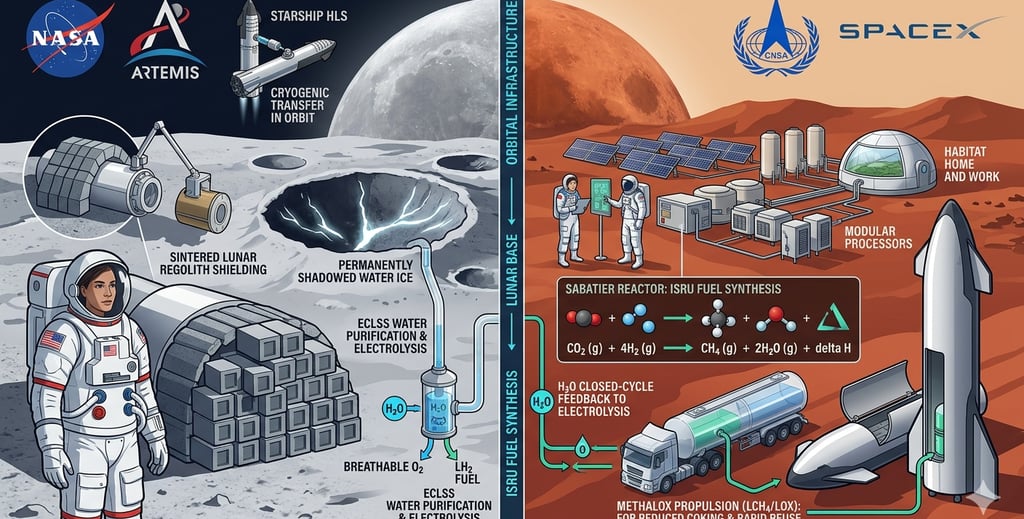
Establishing a stable human presence on the Moon (such as the Artemis Base Camp and the future International Lunar Research Station led by the China-Russia coalition) requires overcoming severe biophysical and logistical challenges.
Radiological and Thermal Shielding
The lack of a dense atmosphere and a global magnetic field exposes lunar infrastructure to solar ionizing radiation (Solar Particle Events - SPE) and Galactic Cosmic Rays (GCR). Structural engineering focuses on utilizing autonomous robotics to cover habitable modules with 1 to 3 meters of sintered lunar regolith via microwaves or lasers, or positioning habitats inside subsurface lava tubes.
The lunar thermal regime—ranging from 130°C to +120°C at the equator—demands advanced two-phase fluid pumping thermal systems and high-efficiency radiators to maintain internal homeostatic equilibrium.
Lunar Ice at the Poles and Life Support
Exploration focuses primarily on Permanently Shadowed Regions (PSRs) located within deep craters at the lunar poles (such as the Shackleton Crater). Cold traps in these regions hold massive deposits of water ice (H₂O).
The mechanized extraction of this ice serves a dual bio-physiochemical purpose:
Life Support (ECLSS): Purification for human consumption and molecular splitting via electrolysis to supply breathable oxygen (O₂).
Cislunar Propulsion: Local generation of LH₂ /LOX for reabastecimento of ascent stages, turning lunar orbit into an interplanetary logistical hub.
In Situ Resource Utilization (ISRU) and the Sabatier Reaction
The long-term planning of SpaceX and state agencies for Martian colonization depends entirely on severing the logistical umbilical cord with Earth. Transporting all the propellant required for a return flight out of Earth's deep gravity well is unfeasible due to the exponential mass penalty of the Tsiolkovsky equation. The solution lies in In Situ Resource Utilization (ISRU) on the surface of Mars, taking advantage of its thin atmosphere composed of 95% CO₂ and its vast subsurface water ice reserves.
The autonomous synthesis of Methalox on Mars operates through a perfectly balanced chemical route spanning two macro-stages:
Stage 1: Electrolysis of Extracted Water
Water ice harvested from the Martian subsurface is mined, melted, purified, and subjected to electrolysis powered by solar arrays or surface nuclear microractors:
2H₂O (l) Electrolysis 2H₂ (g) + O₂ (g)
The resulting molecular oxygen (O₂) is cryogenically cooled and stored directly in the vehicle's oxidant tanks for the return journey.
Stage 2: The Sabatier Reaction
The gaseous hydrogen (H₂) obtained from the first stage is mixed with carbon dioxide (CO₂) captured and pressurized directly from the Martian atmosphere. This mixture is introduced into a fluidized bed catalytic reactor containing ruthenium or nickel as a catalytic agent, operating under pressures of 20 to 40 bar and tightly controlled temperatures between 300 °C a 400°C. This highly exothermic reaction synthesizes methane:
CO₂ (G)+ 4H₂ (G) Catalyst CH₄ (G) + 2H₂ (G) (Delta H = -165 kJ/mol)
Closing the Thermodynamic Loop: The water (H₂O) generated as a byproduct in the Sabatier Reaction is not wasted; it is condensed and fed directly back into the Stage 1 electrolysis loop. This closed-cycle framework optimizes molecular efficiency, allowing for the large-scale production of pure interplanetary propellant with minimal reliance on imported materials from Earth.
Conclusion
The new space race has consolidated a model where the boundaries between state-backed science and private industrial pragmatism have become fluid. The transition to liquid methane and oxygen (Methalox) propulsion represents the maturity of chemical engineering applied to rocket logistics, offering the precise balance needed between structural density, soot-free reusability, and interplanetary manufacturing viability.
The ultimate success of human permanence on the Lunar Station and, eventually, on Martian soil depends entirely on humanity's ability to master and close artificial biogeochemical cycles through automated processes like electrolysis and the Sabatier Reaction (ISRU). Those who hold the mastery over these molecular technologies, combined with automated vertical landing infrastructure, will dictate the economic, geopolitical, and existential rules of the next century.
References
CHINA NATIONAL SPACE ADMINISTRATION (CNSA). China's Space Activities: A Global Perspective and Future Lunar Programs. Beijing: State Council Information Office of the People's Republic of China, 2022.
NATIONAL AERONAUTICS AND SPACE ADMINISTRATION (NASA). Artemis Plan: NASA’s Lunar Exploration Program Overview. Washington, DC: NASA Headquarters, 2020.
SABATIER, Paul; SENDERENS, Jean-Baptiste. New synthesis of methane from carbon dioxide and hydrogen. Comptes Rendus de l'Académie des Sciences, Paris, v. 134, p. 514-516, 1902.
SPACEX. Starship Users Guide. Hawthorne, CA: Space Exploration Technologies Corp., v. 2.0, 2024.
TSIOLKOVSKY, Konstantin E. The Exploration of Cosmic Space by Means of Reaction Devices. The Science Review, St. Petersburg, 1903.
TURNER, Martin J. L. Rocket and Spacecraft Propulsion: Principles, Practice and New Developments. 3. ed. Chichester, UK: Springer, 2009.
ZUBRIN, Robert; WAGNER, Richard. The Case for Mars: The Plan to Settle the Red Planet and Why We Must. New York: Free Press, 2011.
Contact
Contact us for questions or suggestions
contact@turingvision.com
fone: + 55 54 99122 0659
© 2026. All rights reserved. https://turingsvision.com/privacy-policy