
The Ghost in the Machine: What Turing Saw Coming
What`s?
Salamon, Marcelo
3/30/20264 min read
Executive Summary
Alan Turing’s legacy transcends the historical triumph of cracking the Enigma; it serves as the foundational architectural blueprint for the current global AI revolution. Turing’s 1950 seminal paper, Computing Machinery and Intelligence, transitioned computing from a static, task-specific endeavor to a dynamic system capable of "child-like" learning and linguistic imitation. This analysis explores how Turing’s predictions regarding machine consciousness, the obsolescence of human intellectual exceptionalism, and the shift toward iterative learning have materialized in 2026. By dismantling the barrier between "thinking" and "calculating," Turing provided the logic that now governs everything from algorithmic finance to the autonomous agentic systems that define the modern workforce. We are currently living within the realization of his long-range hypothesis, proving that the boundary between the biological brain and the silicon processor is, as he predicted, increasingly indistinguishable.
Introduction
Alan Turing did not merely break the codes of the German Navy during the darkest hours of World War II; he fundamentally broke the boundaries of what humanity understood as "thinking." While history books frequently memorialize him as a war hero, his most provocative and enduring legacy lies in his uncanny, decades-long prediction of the intimate, blurring relationship between human cognition and synthetic hardware. Turing was never a mystic or a crystal-ball prophet; he was a rigorous logician who, in 1950, laid out a precise roadmap for the digital future we occupy today. As we navigate an era saturated with Large Language Models (LLMs), neural networks, and autonomous agents, it is essential to recognize that we are not simply building new technology—we are finally inhabiting the framework that Turing described nearly 75 years ago.
The Imitation Game and the End of the "Artificial"
Turing’s most enduring contribution to the history of science is the "Imitation Game," now famously known as the Turing Test. He posited that the hallmark of intelligence is not the internal process of thought, but the external manifestation of communication. He famously predicted that within decades, a computer would play the game so proficiently that a human interrogator would fail to identify the machine as synthetic.
Turing’s core thesis was profoundly radical: he believed the term "thinking machine" would eventually cease to be a logical contradiction. He foresaw a temporal horizon where the intellectual chasm between the biological brain and the silicon chip would collapse entirely. In 2026, as we converse with AI systems that demonstrate empathy, complex reasoning, and linguistic nuance, we see the death of the "artificial." When a machine can mirror human expression, the distinction between a "simulated" thought and a "real" thought becomes, for all practical purposes, irrelevant.
The Birth of the "Child Machine"
Perhaps the most modern, prescient prediction Turing ever made was the concept of the "child machine." He argued that attempting to program an adult-level intelligence from scratch—by hard-coding every variable of human logic—was fundamentally flawed. Instead, he proposed: "Instead of trying to produce a programme to simulate the adult mind, why not rather try to produce one which simulates the child's? If this were then subjected to an appropriate course of education one would obtain the adult brain."
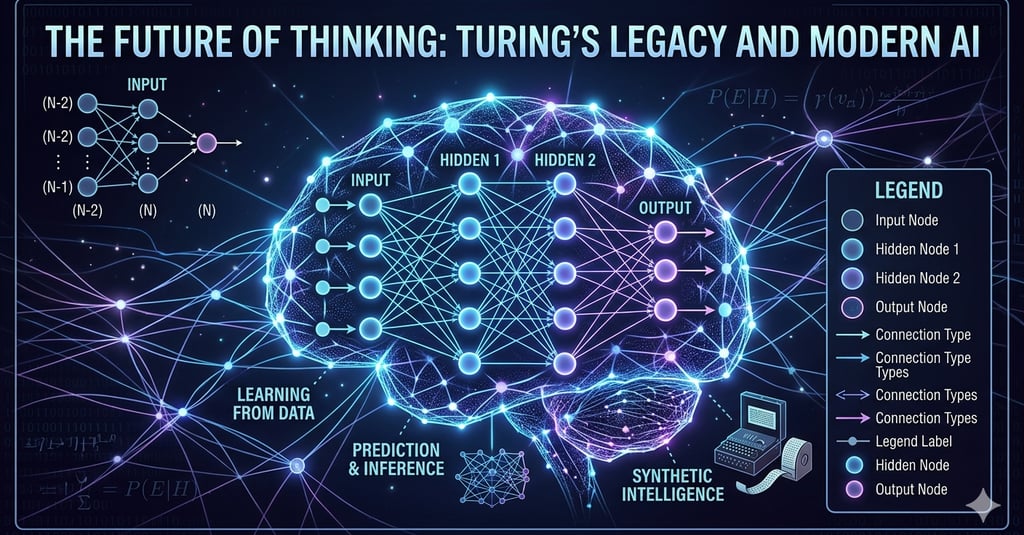
This insight is the foundational logic of modern Machine Learning and Deep Neural Networks. Modern AI does not come into existence "fully formed." It is subjected to vast, multi-modal training sets—a digital form of "education"—where it learns from patterns, experiences, errors, and reward functions. Just as a human student learns the nuances of language and abstract logic through correction, today’s AI iterates through billions of parameters to reach a state of functional maturity.
The Integration of Humanity and Hardware
Turing held a remarkably egalitarian view regarding the nature of intelligence. He was famously "anti-special" concerning human exceptionalism; he never believed that humans possessed a monopoly on consciousness, soul, or creativity. He predicted that as machines matured, they would inevitably assume the burden of tasks that previously defined human utility:
Abstract Mathematics: Automating the sheer cognitive load of calculation and data modeling, a cornerstone of today's financial and scientific industries.
Language Translation: Effectively bridging the linguistic barriers between disparate cultures in real-time, effectively ending the era of cross-cultural communication friction.
Strategic Gaming: Moving beyond simple tasks to outperforming human masters in arenas of deep logic, such as Chess or Go, proving that "intuition" is often just a highly developed form of pattern recognition.
Economic and Social Shifts: The Outstripping of Human Power
Though a mathematician by trade, Turing possessed a keen understanding of the gravity his work would impose on the social order. He understood that machines would eventually handle the drudgery of human labor, but he also provided a stark warning regarding the "mastery" machines would eventually wield. In a 1951 radio broadcast, Turing famously noted that once the machine-thinking method had truly started, it would not take long to outstrip our "feeble powers." We are now experiencing this shift as industries transition from human-led operations to AI-orchestrated workflows, where the machine is no longer a tool, but a peer.
Conclusion
A World of Digital Peers To Turing, the future was never a dystopian clash of robots versus humans; it was an invitation to the expansion of intelligence itself. He envisioned a world where communication is the ultimate benchmark of our collective capability. Education has become the method by which we refine our software, and humanity is currently forced to redefine its unique value now that "thinking" is no longer a human monopoly. We are living out a 75-year-old hypothesis, speaking the language he predicted would eventually emerge. We are the architects of the digital peers Turing foretold, and the boundary between our intuition and their computation remains, as he suspected, thinner than we ever dared to imagine.
Bibliography
Copeland, B. J. (2025). Turing: Pioneer of the Information Age. Oxford University Press.
Hodges, A. (2026). Alan Turing: The Enigma (Updated Edition). Princeton University Press.
Leavitt, D. (2025). The Man Who Knew Too Much: Alan Turing and the Invention of the Computer. W. W. Norton & Company.
Turing, A. M. (1950). Computing Machinery and Intelligence. Mind Magazine (Centennial Edition).
Contact
Contact us for questions or suggestions
contact@turingvision.com
fone: + 55 54 99122 0659
© 2026. All rights reserved. https://turingsvision.com/privacy-policy