The Ghost in the Machine: What Alan Turing Saw Coming
What`s?
Salamon, Marcelo
3/30/20262 min read
Alan Turing didn't just break codes; he broke the boundaries of what we thought "thinking" actually meant. While he is often celebrated for his role in ending World War II, his most provocative legacy lies in his predictions about the relationship between humans and machines.
Turing wasn't a crystal-ball prophet, but his 1950 paper, Computing Machinery and Intelligence, laid out a roadmap for a future we are living in right now.
The Imitation Game and the Death of "Artificial"
Turing’s most famous contribution to the future was the Imitation Game, now known as the Turing Test. He predicted that by the year 2000, a computer would be able to play the game so well that an average interrogator would have no more than a 70% chance of making the right identification after five minutes of questioning.
While we can argue about the exact dates, his core belief was revolutionary: he predicted that the phrase "thinking machine" would eventually cease to be a contradiction. He foresaw a time when the intellectual distance between biological brains and silicon chips would vanish.
Learning Machines: The Birth of AI
Perhaps his most modern prediction was the idea of a "child machine." Turing argued that instead of trying to program an adult-level intelligence from scratch, we should create a simple system and "educate" it.
"Instead of trying to produce a programme to simulate the adult mind, why not rather try to produce one which simulates the child's? If this were then subjected to an appropriate course of education one would obtain the adult brain."
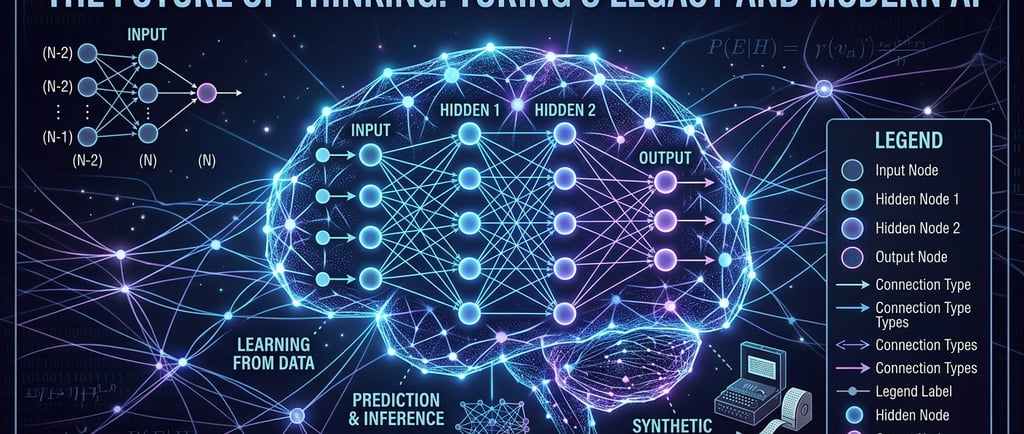
This is the foundational logic behind Machine Learning and Neural Networks. Turing predicted that machines would learn from experience, mistakes, and rewards, much like a human studen
He Integration of Humanity and Hardware
Turing was surprisingly "anti-special" when it came to human exceptionalism. He didn't believe humans had a monopoly on consciousness or soul. He predicted that as machines became more capable, they would take over tasks involving:
Abstract Mathematics: Automating the heavy lifting of calculation.
Language Translation: Bridging the gap between cultures.
Strategic Gaming: Outperforming humans in logic-based arenas like Chess or Go.
Economic and Social Shifts
While Turing was a mathematician, he understood the gravity of his work. He hinted at a future where machines would handle the drudgery of human labor, though he also warned of the "mastery" machines might eventually hold. He famously noted in a 1951 radio broadcast that once the machine-thinking method had started, it would not take long to outstrip our feeble powers.
Summary: A World of Digital Peers
To Turing, the future wasn't about robots vs. humans; it was about the expansion of intelligence. He envisioned a world where:
Communication would be the ultimate benchmark of intelligence.
Education would be the method by which we build software.
Humanity would have to redefine what makes us unique once "thinking" was no longer ours alone.
Today, as we interact with LLMs and AI-driven tools, we aren't just using technology—we are living out Turing's 75-year-old hypothesis. We are finally speaking the language he predicted we would.
Contact
Contact us for questions or suggestions
contact@turingvision.com
fone: + 55 54 99122 0659
© 2026. All rights reserved. https://www.turingsvision.com/privacy-policy