The Future of Work and University
How artificial intelligence is redesigning professions
NEW TECNOLOGY
By Marcelo Salamon
7/14/20268 min read
Abstract
Artificial Intelligence (AI) has established itself as the primary catalyst of transformation in the global labor market. This article analyzes how this technology is redefining the professional landscape through three distinct dynamics: the adaptive modification of existing roles, the progressive decline of routine occupations, and the direct displacement of positions in specific market niches. Additionally, it examines the emergence of new technology-driven careers and the urgent restructuring demanded of traditional higher education systems. We conclude that this technological shift requires the immediate development of complex social-emotional skills, critical thinking, and human-computer collaboration to mitigate income inequality and smooth the inevitable societal frictions of this economic transition.
Keywords: Artificial Intelligence; Future of Work; Cognitive Automation; Professional Reskilling; Higher Education.
Introduction
The rise of generative artificial intelligence and the rapid development of machine learning systems mark an unprecedented transition in modern economic history: the shift from physical automation to the automation of cognitive skills. Unlike previous industrial revolutions, which mechanized manual tasks and extended physical reach, the current revolution targets the core of intellectual, interpretative, artistic, and decision-making activities. This technological leap profoundly redefines the very notion of "white-collar work," altering the daily routines of lawyers, doctors, analysts, and creatives on a global scale.
This transformative phenomenon does not impact all sectors of the economy equally. Instead, it operates at varying speeds and intensities depending on how standardized the underlying tasks of a given field are. While some industries leverage intelligent systems to significantly boost productivity and analytical capacity, others face accelerated and inevitable obsolescence. Faced with this transition, passive corporate resistance or outright denial is futile. For professionals, governments, and educational institutions, understanding these structural shifts represents the critical boundary between professional marginalization and strategic success in the new labor ecosystem.
Moreover, the consequences of this shift extend far beyond corporate boardrooms. They shape societal structures, rewrite the demographic dynamics of major cities, reconfigure global wealth distribution, and demand a drastic overhaul of educational systems that have remained largely unchanged for centuries. The breakneck speed of cognitive innovation challenges traditional labor market protections, necessitating a thorough investigation into how humans can coexist in symbiosis with machines—turning an apparent threat of replacement into a historic opportunity to elevate human creative and productive capabilities.
The Triple Dynamics of Artificial Intelligence in Employment
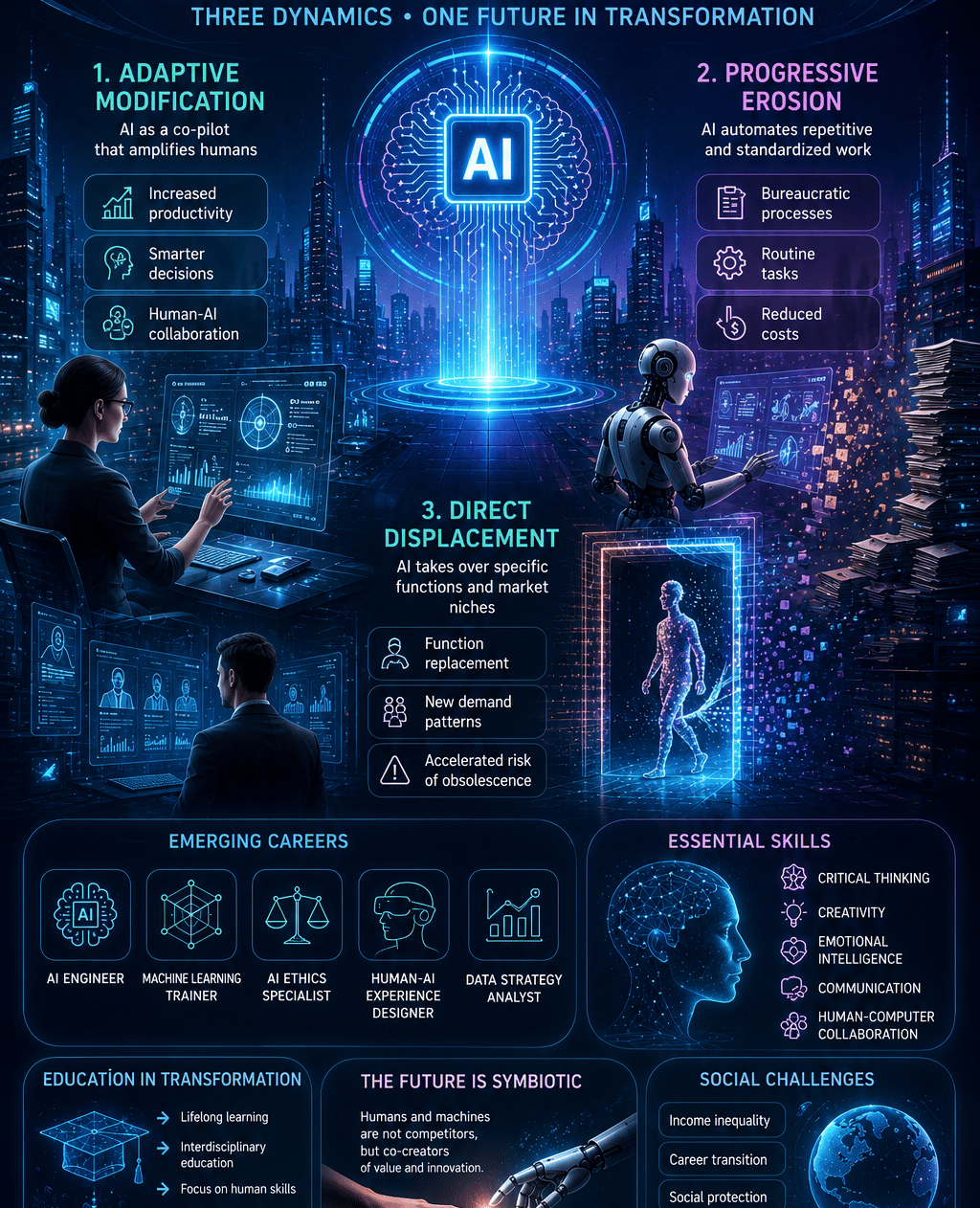
The penetration of artificial intelligence into the modern professional market does not occur through a single, uniform disruption. Instead, it unfolds through three distinct, observable dynamics categorized by the level of complexity and repetition inherent to each job function. Understanding this division is crucial for anticipating career shifts and mitigating the risk of structural technological unemployment. Today's market is thus divided into distinct axes of impact: the symbiotic modification of routines, the erosion of bureaucratic processes, and the absolute displacement of specific roles.
A detailed analysis of this threefold division reveals that a job's primary vulnerability is not necessarily the formal education level it requires, but rather the predictability of its internal processes. Highly skilled activities operating under predictable patterns are being automated just as rapidly as basic data entry tasks. To illustrate this transition practically, the structural forces shaping labor under the impact of artificial intelligence are organized as follows:
============================================================================= DYNAMICS OF AI IMPACT ON THE WORKFORCE =============================================================================
• Adaptive Modification (Symbiosis): The professional utilizes AI as a cognitive co-pilot, enhancing productivity and focusing on high-level strategy.
• Progressive Erosion (Decline): Routine and highly predictable administrative functions face steady, system-wide decline.
• Direct Replacement (Substitution): Dedicated AI solutions completely eliminate the need for human execution in highly standardized niches. =============================================================================
Professions Being Modified
In this category, the human element remains absolutely indispensable, but daily work dynamics are radically altered. Here, artificial intelligence acts as a high-performance intellectual assistant or "co-pilot," removing bottlenecks related to data retrieval, synthesis, and formatting. This allows human professionals to focus on complex decision-making, client relations, and creative strategy.
In diagnostic medicine, for instance, computer vision algorithms scan and identify micro-anomalies in imaging scans with surgical precision, frequently outperforming fatigued specialists. However, final treatment decisions, patient empathy, and human connection remain strictly human domains. In law, processing legal filings and conducting exhaustive case-law research have been cut from days to seconds by natural language processing tools. This frees lawyers to design innovative arguments, exercise emotional intelligence in the courtroom, and negotiate complex strategic settlements.
Similarly, in the creative fields of graphic design and content writing, text and image generators do not eliminate the creator; instead, they redefine their role. The focus shifts away from repetitive technical execution (such as manual vectorization or writing generic copy) to conceptual refinement, stylistic curating, narrative strategy, and high-level art direction.
Professions at Risk of Declining
At the opposite end of the productive spectrum are occupations characterized by highly predictable, mechanical routines focused on linear information processing. These roles are experiencing severe erosion as computational efficiency far outstrips human capacity in terms of cost, speed, and scalability.
Manual audio transcription and clerical data entry are prime examples of this trend. Modern speech-to-text tools leverage advanced neural models to comprehend accents, punctuation, and complex linguistic contexts in real time, virtually eliminating the need for basic human transcription. Outbound and inbound telemarketing, along with tier-one customer service support, are quickly being absorbed by lifelike AI voice agents that handle complex conversational scripts and work 24/7 without fatigue.
Basic technical translation and standard commercial translation have also transitioned to highly accurate, context-aware automatic platforms. This shift drastically shrinks the market for generalist translators, forcing the industry to specialize in highly complex cultural, literary, or legal translation where nuance and cultural context are critical.
Professions Being Directly Replaced
In several tightly defined operational sectors, complete human replacement is no longer a future prediction but an immediate corporate reality. This occurs in fields where human creative input is unnecessary compared to the demand for the instant, standardized, and mass generation of digital assets.
The voiceover market for standard explainer videos, corporate training materials, and cheap tutorials has been largely taken over by ultra-realistic synthetic voices. These models replicate human inflection and pacing perfectly, reducing production costs to near zero. Similarly, traditional stock image libraries have experienced sharp market declines due to generative AI tools, which allow agencies and businesses to create completely customized illustrations on demand without buying third-party licenses. In basic finance, the entry-level work of junior analysts compiling market data and generating standard financial reports has been fully automated by advanced analytical software, fundamentally changing how young professionals enter major investment institutions.
The Emergence of New Occupations
As the economic theory of creative destruction dictates, every major wave of technological innovation destroys obsolete industries while simultaneously creating entirely new opportunities for socioeconomic development. The mass adoption of artificial intelligence has given rise to specialized roles that did not exist in the global corporate landscape just five years ago.
Among the key emerging occupations are prompt engineers, professionals dedicated to refining language interactions and instructions submitted to large models to extract optimal results for corporate and research applications. Curators of training data and algorithmic bias auditors are also rising in demand; their primary role is to evaluate the quality, fairness, and ethical integrity of the datasets feeding learning models, preventing the reproduction of historical biases in credit decisions, hiring algorithms, and public safety systems.
Additionally, AI workflow integrators are tasked with linking text, voice, and data tools into automated pipelines to eliminate operational bottlenecks. Meanwhile, AI governance and ethics consultants specialize in aligning new technology deployments with expanding international data compliance frameworks and privacy regulations.
The Economic Impact and Income Polarization
From a macroeconomic perspective, the rapid advance of intelligent automation carries a serious risk of exacerbating existing socioeconomic inequalities. Recent salary surveys and industry studies point to a worrying trend of income polarization across the international corporate landscape.
"The advance of cognitive automation tends to exert downward pressure on wages for low-to-medium complexity tasks, while exponentially multiplying the financial value of professionals who leverage AI to maximize their strategic judgment, creativity, and critical decision-making."
This economic polarization creates a structural hollow in mid-level career positions—which historically served as a stepping stone to social mobility for the middle class—concentrating generated wealth at the extreme poles of high-level specialization. In response to this potential imbalance, governments and international bodies are actively debating reforms to social safety nets, state-subsidized reskilling initiatives, and tax frameworks adapted to the digital age. These measures aim to cushion the social impact on workforce segments unable to transition independently. Today, tasks that can be automated by software costing less than $20 a month face severe wage deflation, driving an urgent need to revalue human-centric contributions.
The Restructuring of Universities
The classical model of higher education—conceived during the industrial era and built on fragmented knowledge, static memorization, and repetitive procedural training—is facing its deepest relevance crisis to date. With AI systems now passing rigorous medical, legal, and business exams with ease, university education must urgently redefine its role in society.
The Declining Traditional Model
Rigid Curricula: Structured around fixed academic years and static syllabi.
Rote Assessment: Centered on memorizing facts and technical repetition under closed-book conditions.
Execution-Oriented: Trains students primarily for predictable, standardized technical execution.
The Emerging Future Model
Flexible Pathways: Continuous, modular learning paths updated dynamically in real time.
Project-Based Learning: Focused on solving real-world, ambiguous problems through collaborative, multidisciplinary projects.
Strategy and Value-Oriented: Prioritizes deep logical reasoning, ethics, empathy, and systemic critical judgment.
The universities that survive this shift will be those that abandon the transmission of encyclopedic content and transform into hubs for collaborative problem-solving, real-world innovation labs, and centers for human relationship-building (networking). Programs purely focused on procedural repetition are bound to disappear. In their place, skills centered on critical thinking, professional ethics, and lifelong adaptability will become the fundamental currency of high-value higher education.
Ethics, Responsibility, and Regulation
The dizzying pace of AI technological development continuously outstrips the legislative response time of modern democracies. This chronic delay creates a complex legal vacuum surrounding governance, civil liability, and individual data protection.
The first major ethical dilemma lies in civil liability for automated decisions. If a diagnostic algorithm suggests an incorrect treatment, or a self-driving vehicle causes an accident, does the legal fault lie with the human operator, the software engineers who trained the model, or the institution that deployed it? Furthermore, the training of massive neural networks on copyrighted data has triggered monumental legal battles. Artists, writers, and traditional news publishers are demanding fair compensation for the unauthorized use of their intellectual property.
The ideal regulatory framework must be flexible enough to avoid stifling local technological innovation, yet robust enough to protect civil society from biased models, rapid job displacement without support systems, and the unauthorized exploitation of private data.
Conclusion
The artificial intelligence revolution is not an economic catastrophe or an isolated disruption. Instead, it is a continuous, profound reconfiguration of the very nature of human labor. By absorbing repetitive data collection, research, and formatting tasks, cognitive automation forces humanity to ascend to a higher intellectual tier. It liberates us from mechanical roles that treat humans like machines, allowing us to reclaim our role as the architects of our technological future.
This transition demonstrates that the outstanding professional of tomorrow will not be measured by the volume of information they can memorize, but rather by the agility, creativity, and critical judgment they bring to their collaboration with intelligent systems. Human competitive advantage has shifted to areas that machines—by their quantitative nature—cannot replicate: genuine empathy in times of crisis, ethical and moral reasoning in highly ambiguous situations, creative problem-solving within unstructured environments, and the emotional intelligence required to lead multidisciplinary teams.
Beyond individual career choices, the rise of AI imposes an urgent ethical duty on governments, corporations, and civil society to build balanced regulatory frameworks and robust social safety nets. Ensuring that the massive productivity gains and economic dividends of AI are shared equitably requires coordinated action: state-sponsored lifelong learning initiatives, corporate responsibility standards, and modernized university curricula. Only then can we minimize the social disruptions of this historic transition.
Ultimately, artificial intelligence does not herald the end of human work; it marks the beginning of our liberation from tedious, uninspiring labor. By embracing digital tools as powerful intellectual co-pilots and continuously nurturing our empathy, creativity, and critical judgment, contemporary society can pioneer an era of unprecedented social, cultural, and technical progress—one where human intelligence reaches its peak in a harmonious, symbiotic partnership with the machine.
References
Brynjolfsson, E., & McAfee, A. (2014). The Second Machine Age: Work, Progress, and Prosperity in a Time of Brilliant Technologies. W. W. Norton & Company.
Ford, M. (2015). Rise of the Robots: Technology and the Threat of a Jobless Future. Basic Books.
Harari, Y. N. (2018). 21 Lessons for the 21st Century. Spiegel & Grau.
Susskind, R., & Susskind, D. (2015). The Future of the Professions: How Technology Will Transform the Work of Human Experts. Oxford University Press.
World Economic Forum. (2023). The Future of Jobs Report. World Economic Forum.
Contact
Contact us for questions or suggestions
contact@turingvision.com
fone: + 55 54 99122 0659
© 2026. All rights reserved. https://turingsvision.com/privacy-policy