
The Evolution of Modern Space Suits: Integration of AI and Advanced Engineering
Blog post description.
SPACENEW TECNOLOGY
Salamon & Salamon
6/16/20267 min read
Abstract
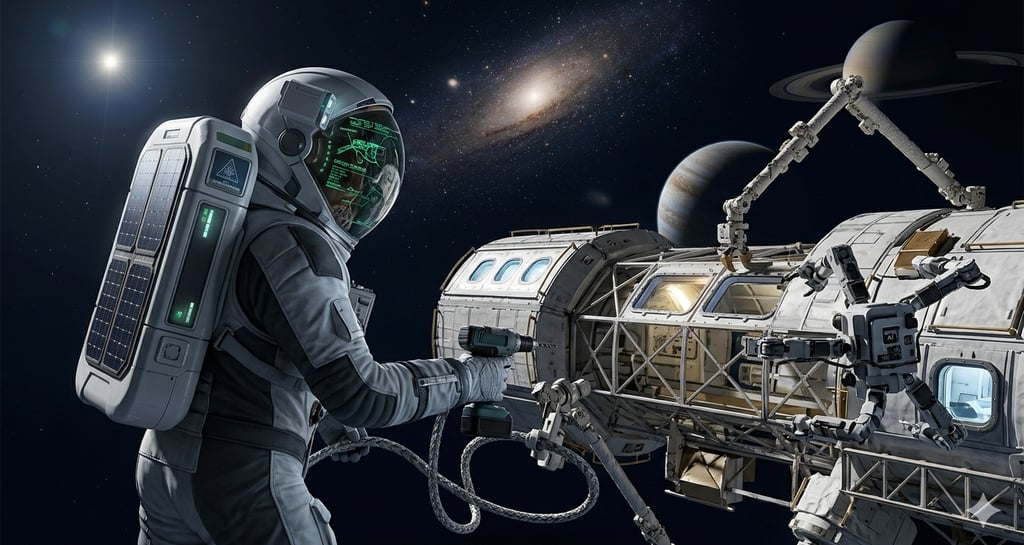
Modern space suits are no longer merely garments; they are complex, pressurized, and highly integrated personal spacecraft. Comprising the helmet, torso assembly, gloves, and boots, these systems are engineered to provide life support, thermal management, micrometeoroid protection, and mobility in the unforgiving vacuum of space. The rapid integration of Artificial Intelligence (AI) is fundamentally altering the design, manufacturing, and operational paradigms of these suits. By utilizing generative design for structural optimization, machine learning (ML) for material discovery, and AI-driven onboard systems for real-time physiological monitoring and autonomous life support management, the next generation of Extravehicular Activity (EVA) gear is becoming significantly more capable, lightweight, and intuitive. Notably, the helmet has transitioned from a passive protective shell into an advanced optoelectronic module featuring Augmented Reality (AR), Heads-Up Displays (HUDs), and embedded AI capable of real-time environmental control and astronaut cognitive support.
Introduction
The design and function of a space suit remain among the greatest challenges in aerospace engineering. The primary mission of the suit is to provide a stable, pressurized environment that protects the human body against extreme thermal fluctuations, ionizing radiation, and the vacuum of space, all while facilitating mission-critical tasks during EVA.
As humanity looks toward sustained presence on the Moon and the eventual colonization of Mars, the requirements for EVA systems have shifted. Current suit architectures must move beyond the limitations of the Apollo-era designs, which were largely rigid and logistically demanding. Today, the focus is on "soft suit" mobility, modularity, and high-degree autonomy. This article provides an in-depth analysis of the technical evolution of space suits, the material science behind their multi-layered construction, and the pivotal role of AI in revolutionizing these systems from the manufacturing floor to the harsh environment of deep space.
Historical Evolution: From Aviation to Deep Space
The genesis of the space suit is deeply rooted in high-altitude aviation. Early designs in the 1930s and 40s were rudimentary, focusing solely on pressure maintenance for pilots flying at high altitudes.
The Foundations: Mercury and Gemini
The Mercury suits (1960s) were derived from Navy high-altitude suits. They were compact and designed for pressurized cabin environments, featuring limited mobility. The Gemini program (1964–1966) marked the first major leap toward dedicated space environments, introducing better sealing technologies and improved communication arrays, yet they still lacked a dedicated Portable Life Support System (PLSS), relying on umbilical connections to the spacecraft.
The Lunar Era: Apollo
The Apollo program (1968–1972) revolutionized EVA capabilities by introducing the PLSS. This allowed astronauts to operate independently of the command module on the lunar surface. However, the suits were constructed from relatively rigid materials and complex mechanical joints, which limited the range of motion and led to significant metabolic fatigue.
The Shuttle and ISS Era: The EMU and Orlan
The Space Shuttle program introduced the Extravehicular Mobility Unit (EMU), a highly modular system that allowed for on-orbit maintenance. Concurrently, the Soviet Orlan suit utilized a rear-entry "hatch" design, prioritizing speed of donning and doffing. These suits incorporated advanced thermal blankets (Multi-Layer Insulation - MLI) and significantly improved glove dexterity, though they remained heavy and limited by legacy analog control systems.
Comprehensive Architecture and Multi-Layered Systems
The modern space suit is a masterpiece of material science, operating like a high-performance, multi-layered filtration and containment system.
The Inner Layers: Comfort and Cooling
The innermost layer is the Liquid Cooling and Ventilation Garment (LCVG). This garment features an intricate network of narrow plastic tubes through which chilled water circulates, absorbing metabolic heat generated by the astronaut. The LCVG is often made of stretch-knit spandex, ensuring it sits flush against the skin for optimal heat transfer.
The Pressure Bladder and Restraint Layer
The pressure bladder, typically composed of polyurethane-coated nylon or neoprene-coated ripstop nylon, maintains the internal pressure (typically 4.3 psi in modern suits). Outside this bladder lies the restraint layer, made of high-strength materials like Dacron, Kevlar, or Vectran. This layer is crucial; it prevents the bladder from ballooning under pressure, ensuring the suit maintains a consistent shape.
The Thermal and Micrometeoroid Protection (TMG)
The outermost layer, the Thermal Micrometeoroid Garment (TMG), is the suit’s first line of defense. It consists of multiple layers of aluminized Mylar (for thermal insulation) and orthofabric (a blend of Gore-Tex, Nomex, and Kevlar) to provide resistance against micrometeoroids and abrasive space dust.
The Helmet: A Cognitive and Optoelectronic Node
The transformation of the helmet from a passive protective module to an active system is the most significant leap in recent space suit engineering.
Optoelectronic Integration
Modern helmets integrate electrochromic visors that use low-voltage currents to adjust the opacity of the glass, providing instant, dynamic protection against blinding solar glare or intense UV/IR radiation without the need for manual visors.
HUD and AR for Cognitive Assistance
The integration of Heads-Up Displays (HUDs) into the helmet’s visor allows for the seamless overlay of mission-critical data. Augmented Reality (AR) systems can highlight exterior targets, provide navigation waypoints, or display schematic diagrams for complex repairs. This reduces the cognitive load on the astronaut, who no longer needs to frequently refer to wrist-mounted checklists.
Embedded AI for Real-Time Decision Making
Embedded AI models monitor the internal environment. Should a structural integrity sensor detect a micro-leak, the AI can pinpoint the location, assess the rate of pressure loss, and automatically adjust the PLSS gas flow to compensate while alerting ground control. Furthermore, AI analyzes heart rate, SpO2, and perspiration to dynamically adjust the LCVG’s cooling rate, preventing hyperthermia before the astronaut even feels discomfort.
The PLSS: The Heart of the Suit
The Portable Life Support System (PLSS) functions as a wearable life support plant. It manages:
Oxygen Supply: High-pressure O2 storage with regulators.
CO2 Scrubbing: Using advanced regenerable solid amine systems that avoid the disposal issues of lithium hydroxide (LiOH) canisters.
Thermal Control: A sublimation or membrane-based heat exchanger that dumps waste heat into space.
AI-Enhanced Autonomy: Modern PLSS architectures utilize "intelligent power management" and predictive failure analysis. By using ML, the PLSS predicts the lifecycle of critical filters and batteries, scheduling maintenance before failure occurs—a critical requirement for long-duration Martian missions.
Engineering and Manufacturing: The AI Revolution
AI is reshaping the production of these suits as fundamentally as the materials themselves.
Generative Design and Topological Optimization
Engineers now use generative design software to create complex suit components. By defining parameters such as load, mass, and material constraints, AI algorithms generate thousands of iterations, resulting in parts that are lighter, stronger, and more flexible than those designed by human hand. These parts are often produced using high-precision additive manufacturing (3D printing).
Advanced Simulations
Digital Twins are now standard in space suit development. These high-fidelity models simulate thousands of hours of EVA scenarios, accounting for thermal fatigue, material aging, and mechanical stress. AI-driven simulations can predict how a specific glove joint will perform after 100 hours of use, allowing for optimized maintenance intervals without requiring destructive physical testing of every prototype.
Quality Assurance via Computer Vision
During the fabrication of the pressure bladder, automated computer vision systems inspect every seam and seal for microscopic defects. This AI-driven quality control ensures a level of manufacturing consistency that is nearly impossible to achieve manually, drastically reducing the risk of catastrophic suit failure.
Future Trends: Toward Mars and Beyond
As humanity transitions from stable orbital environments to the rugged landscapes of lunar and planetary exploration, the engineering requirements for space suits are undergoing a paradigm shift. The most immediate challenge in these extraterrestrial environments is regolith mitigation. Unlike terrestrial dust, lunar and Martian regolith is composed of fine, jagged particles created by billions of years of micrometeoroid impacts. These particles are not only razor-sharp, posing a constant threat of abrasion to the suit's outer layers, but are also electrostatically charged, causing them to cling tenaciously to seals, joints, and fabric fibers. Future suit architectures must incorporate advanced electrostatic shielding and specialized surface coatings to prevent the ingress of these particles into critical mechanical systems. Furthermore, as mission durations extend, the integration of modular, field-repairable components becomes mandatory to ensure that the suit remains operational over multi-year deployments on the Martian surface.
Self-Healing Materials and Structural Resilience
To counter the constant threat of abrasive damage and minor structural fatigue, current material research is heavily focused on the development of self-healing polymers and biomimetic composites. These advanced materials are engineered with integrated micro-capsules or vascular networks containing healing agents; when a puncture or a micro-tear occurs—whether from a sharp regolith grain or a high-velocity micrometeoroid—the material reacts to the change in localized pressure or structural stress, automatically releasing these agents to seal the breach. This passive, autonomous repair capability significantly enhances the suit’s safety margin, reducing the reliance on manual external repairs during critical EVAs. Beyond self-healing, future development is converging on "smart" textiles that can sense localized mechanical stress and dynamically redistribute tension, thereby increasing the durability of joints and high-flex areas. By combining these self-healing polymers with robust, dust-repellent coatings, the next generation of space suits will achieve an unprecedented level of durability, ensuring that the astronaut remains protected even in the most hostile, abrasive environments of the solar system.
Biomimetic Actuators
Future "soft suits" will likely incorporate biomimetic actuators—artificial "muscles" that assist the astronaut’s movement. These actuators will be controlled by AI to provide mechanical advantage, allowing an astronaut to perform heavy labor with the ease of a simple task, thereby conserving critical metabolic energy.
Neural and Sensory Interfaces
The next frontier is the integration of biometric feedback loops that might one day link the suit’s internal status to the astronaut’s own nervous system, providing a sense of "embodiment" that makes the suit feel like an extension of the body rather than a container for it.
Conclusion
The evolution of the space suit from a basic pressure vessel to an intelligent, AI-integrated system represents a cornerstone of human expansion into space. The synergy between material science, advanced electronics, and Artificial Intelligence has enabled a level of safety and operational efficiency previously considered impossible. As the helmet evolves into a true cognitive node and as the suit itself becomes an autonomous partner to the astronaut, we move closer to a future where deep-space exploration is limited not by our technology, but only by our imagination. The integration of AI is not merely a convenience; it is the fundamental enabler for the next great era of human spaceflight.
References
NASA-STD-3001, Space Flight Human System Standard.
European Space Agency (ESA), Advanced Life Support Systems Architecture Reviews.
Journal of Aerospace Engineering, "Generative Design in Soft-Suit Robotics."
Nature Materials, "High-Performance Elastomers for Extremophilic Environments."
Acta Astronautica, "AI-Driven Predictive Maintenance for EVA Hardware."
ILC Dover and Axiom Space, Next-Generation EVA Suit Technical Briefs.
Science Robotics, "Soft Robotic Actuators for Extravehicular Mobility Units."
Contact
Contact us for questions or suggestions
contact@turingvision.com
fone: + 55 54 99122 0659
© 2026. All rights reserved. https://turingsvision.com/privacy-policy