
The Architecture of Extraplanetary Survival: Multidisciplinary Challenges in Implementing a Permanent Lunar Station
Technical Article on Space Frontier Analysis and Critical Infrastructure
SPACESCIENSE
By Marcelo Salamon
6/10/202610 min read
Abstract
The transition from space exploration based on ephemeral missions to the establishment of a permanent infrastructure on the Moon represents the greatest technical, biological, and logistical challenge of the 21st century. This article analyzes the fundamental pillars necessary for the viability and sustainability of a long-duration Lunar Station. Structured around a multidisciplinary matrix, the study examines the hostile physical environment, the dynamics of water and food self-sufficiency, energy matrices and life-support technology, parameters of exploration and field work, as well as the neuropsychological and physiological impacts on the human body. The objective is to provide a holistic and integrated view of the engineering mechanisms and medical sciences required to mitigate the inherent risks of life outside Earth, consolidating the Moon as a viable stepping stone for deep space exploration.
Introduction
Since the conclusion of the Apollo Program in the 1970s, humanity has maintained its presence in space confined predominantly to Low Earth Orbit (LEO), utilizing the International Space Station (ISS) as its primary microgravity laboratory. However, the dawn of the Artemis era and the massive engagement of the private aerospace sector have redirected global focus toward deep space, choosing the Moon not merely as a scientific visitation destination, but as the ground for establishing permanent colonies. The construction and operation of a stable Lunar Station, however, differs substantially from any engineering endeavor ever executed on Earth or in orbit.
The permanent colonization of the lunar surface requires overcoming extreme environmental barriers that challenge the boundaries of materials science, robotics, medicine, and psychology. While the ISS benefits from Earth's magnetospheric protection and a relatively agile logistical supply chain (where cargo capsules can arrive in a matter of hours), a permanent infrastructure on the Moon operates in a regime of severe isolation, at an average distance of 384,000 kilometers. Any systemic failure or supply shortage can instantly translate into a human catastrophe.
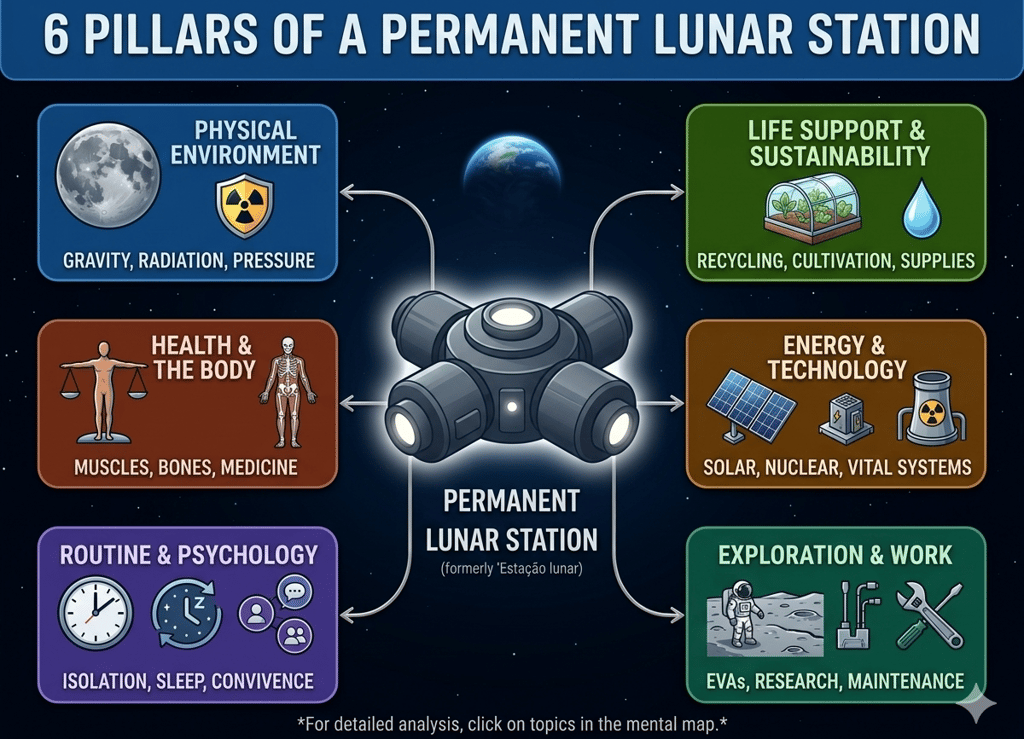
Faced with this complex scenario, the planning of a long-permanence lunar base must be grounded in a systemic approach across six major functional axes: the physical environment, food and water security, the energy and technological matrix, field exploration dynamics, the psychological stability of the crew, and the homeostatic preservation of the human body. Understanding the deep interconnectedness among these variables is the only path to transforming a naturally lethal environment into a safe and economically viable artificial ecosystem for the next generations of cosmic explorers.
The Lunar Physical Environment and Structural Engineering Challenges
The lunar ecosystem is characterized by absolute physical hostility, completely devoid of a significant protective atmosphere and an intrinsic magnetic field. Aerospace engineers face a triad of severe physical threats when designing long-duration habitats: reduced gravity, unattenuated ionizing radiation, and a chronic absence of atmospheric pressure.
Reduced Gravity (1/6g): The acceleration of gravity on the surface of the Moon is approximately $1.62\text{ m/s}^2$, which represents about 16.6% of Earth's gravity. Although this condition reduces the mechanical structural stress required to support large buildings, it introduces unprecedented complexities in fluid dynamics, the behavior of granular materials, and the operation of mobile mechanical systems. The anchoring of structures, the behavior of dust and debris during excavations, and the movement of heavy vehicles demand friction and traction calculations completely distinct from traditional terrestrial models.
Cosmic Radiation and Solar Winds: Without a thick atmosphere and a magnetosphere like Earth's, the lunar surface is constantly bombarded by Galactic Cosmic Radiation (GCR) and Solar Particle Events (SPE). Continuous exposure to these high-energy particles is highly mutagenic and lethal in the medium to long term. To mitigate this risk, permanent habitats cannot rely solely on light metallic alloys, such as aerospace aluminum. Modern engineering advocates the utilization of semi-subterranean structures, the exploitation of natural lava tubes, or the construction of thick protective barriers using local lunar regolith synthesized via microwave sintering or automated 3D printing.
Absolute Vacuum and the Pressure Gradient: The lunar atmosphere is, for practical purposes, a severe vacuum (total pressure around $10^{-12}\text{ torr}$). This generates a massive pressure differential between the interior of the habitat (pressurized to about 1 atm for human comfort) and the exterior. Every square meter of the structure's wall experiences a continuous outward expansion force. Any microfissure resulting from thermal fatigue or micrometeorite impacts can escalate into an explosive decompression. Consequently, airlock systems and elastomer seals must exhibit virtually zero failure rates, operating across thermal bands that oscillate aggressively between $-130^\circ\text{C}$ during the lunar night and $120^\circ\text{C}$ during full peak day.
Design Fact: Radiation protection requires a protective layer of compacted or bagged lunar regolith with a minimum estimated thickness of 1.5 to 3 meters above the roofs of the habitable modules to reduce the annual radiation dose to acceptable occupational levels.
Food, Water, and Closed-Loop Life Support Logistics
The economic and operational viability of a permanent base is intrinsically linked to its ability to reduce dependence on resupply missions from Earth. The cost of mass transportation per kilogram via conventional rockets demands the implementation of a philosophy of extreme circular and regenerative economy.
Advanced Water Recycling: Water is the most critical limiting resource in space. In a lunar station, Environmental Control and Life Support Systems (ECLSS) must achieve water recycling efficiency rates higher than 98%. Every single drop of moisture must be captured, processed, and purified: the sweat exhaled by astronauts into the internal atmosphere, the humidity generated by plants in the greenhouses, and the crew's urine. Utilizing multiphase vacuum distillation processes, reverse osmosis filtration, and high-temperature catalytic oxidation, the system transforms biological effluents into potable water of chemical purity superior to most urban distribution networks on Earth.
Autonomous Cultivation and Bioregenerative Greenhouses: Long-term human nutrition cannot rely exclusively on freeze-dried rations and vacuum-packed foods due to the natural degradation of essential vitamins and the negative psychological impact of dietary monotony. The deployment of automated vertical farms, operating via hydroponics and aeroponics, is vital. In these facilities, selected plant species of rapid growth and high caloric and nutritional density—such as sweet potatoes, dwarf wheat, soybeans, and leafy greens—are cultivated under spectrum-optimized LED lighting arrays. In addition to providing fresh macronutrients and minerals, these plants perform a crucial ecological role in the base: they consume the carbon dioxide exhaled by the crew through photosynthesis and release pure oxygen back into the ventilation system.
In Situ Resource Utilization (ISRU): Although recycling is highly efficient, inevitable losses occur over time. To compensate for these losses and expand operations, the base must mine water locally. Orbital mapping missions have confirmed the presence of billions of tons of water ice mixed with regolith at the bottom of craters located at the lunar poles, which remain in perpetual shadow at temperatures near absolute zero. Extracting this ice using mining rovers and thermal sublimation systems will allow not only the replenishment of the base's vital reservoirs, but also the splitting of $\text{H}_2\text{O}$ molecules into liquid hydrogen and liquid oxygen, generating rocket propellant directly on the Moon.
Energy Matrix and Critical Infrastructure Technologies
No gear of the lunar station moves without a continuous, stable, and resilient supply of electrical power. The energy requirements of a permanent base are orders of magnitude higher than those of small robotic probes, encompassing uninterrupted life support systems, heavy mining machinery, scientific laboratories, and thermal heating systems.
The Challenge of the Lunar Night and Solar Limitations
The rotational cycle of the Moon imposes one of the greatest known energy challenges: the lunar day and night each last approximately 14 Earth days. Relying strictly on traditional solar photovoltaic energy means facing two consecutive weeks of total darkness and deep cryogenic freezing temperatures. To circumvent this restriction, initial bases must position themselves strategically on the "Peaks of Eternal Light"—elevated crater rims at the north and south poles that receive near-continuous solar illumination (above 80-90% of the year due to the Moon's low axial tilt). However, for an expanding base, solar power requires colossal energy storage systems, such as ultra-high-density lithium-ion batteries or regenerative hydrogen fuel cell systems.
Technical Textual Analysis of the Energy Matrix Options
To fully comprehend the operational infrastructure of the station, the primary energy sources are developed below as core architectural elements:
Solar Photovoltaic Power: This relies on mature, lightweight, and modular technology that allows for rapid expansion. However, its primary operational limitation is that it becomes completely inoperable during the 14-day lunar night, demanding mass-intensive battery backups. Its primary application on the base is for primary daytime power generation and localized support on polar peaks of eternal light.
Compact Nuclear Fission: This provides continuous, 24/7 power generation completely independent of solar illumination, yielding an ultra-high power density. Its core challenges involve severe shielding requirements to safeguard against radiation and highly complex thermal dissipation mechanisms. Its primary application is to sustain the uninterrupted baseline load of life support systems, science labs, and industrial mining operations. Projects like NASA's Kilopower utilize enriched uranium and sodium heat pipes to transfer thermal energy to highly efficient Stirling engines, operating autonomously far from residential quarters.
Regenerative Fuel Cells: These offer excellent energy storage density by using the chemical reaction of hydrogen and oxygen, with pure water as a usable byproduct. The main technical hurdle is the requirement for cryogenic storage of highly flammable gases under high pressure. Their primary application on the base is to serve as an emergency backup system and to provide electrification for long-range manned surface rovers.
Exploration Dynamics, Field Work, and Robotic Maintenance
The fundamental purpose of a lunar station is the execution of cutting-edge scientific work and industrial development focused on mining and manufacturing. However, the lunar work environment is unforgiving and imposes severe restrictions on human activities.
Extravehicular Activities (EVAs) and Next-Generation Spacesuits: Every excursion by an astronaut outside the base to install equipment, collect geological samples, or inspect structures constitutes a high-risk operation. Modern spacesuits are not flexible clothing garments, but rather true miniaturized anthropomorphic spacecraft. They must provide stable pressurization, oxygen, active thermal management to withstand extreme thermal variations of hundreds of degrees, and enhanced joint mobility through low-friction bearings. Current design priorities favor rear-entry systems via ports coupled directly to the external wall of the habitat (suitports), which completely prevents hazardous lunar dust from entering the residential modules during ingress and egress.
The Threat of Regolith and Mechanical Wear: Lunar dust, or regolith, does not resemble terrestrial sand or dust. Because the Moon lacks an atmosphere or running water to erode and round the edges of minerals, regolith particles are extremely sharp, fractured, and abrasive, acting like microscopic shards of glass. Furthermore, due to constant bombardment by ultraviolet radiation and solar wind, these particles are highly electrostatically charged, adhering stubbornly to fabrics, visors, mechanical joints, and solar panels. Regolith penetrates seals and destroys mechanical bearings within a few hours of operation. Mitigating this wear requires developing active electrostatic repellent coatings, magnetic brushing, and the extensive use of ultra-hard ceramic and metallic alloys on all tools and surface vehicles.
Human Factors: Routine, Isolation, and Confined Neuropsychology
Often, the greatest threats to the success of a long-duration space mission do not stem from hardware failures, but rather from the collapse of the crew's psychological resilience. Prolonged confinement in restricted artificial environments generates a unique set of psychological and psychiatric stressors.
The Psychological Impact of Isolation and the "Earth-Out-of-View" Phenomenon: Living in a lunar base means being confined to a limited habitable volume, sharing the same physical space for months or years with a restricted group of individuals under a constant risk of death. The absence of natural terrestrial sensory stimuli—such as the sound of wind, the smell of rain, natural light variations, and organic horizons—induces cognitive fatigue, irritability, and episodes of chronic depression. As the mission progresses, astronauts experience a psychological detachment from Earth. This is intensified by the communication latency (which, while short on the Moon at about 1.3 seconds in each direction, still prevents fluid, real-time conversations over conventional digital channels), requiring strict protocols for proactive psychological support and structured group dynamics.
Chronobiology and the Disruption of Circadian Rhythms: The human organism evolved under a strict 24-hour circadian cycle regulated by the alternation of sunlight and darkness. On the Moon, with days that last two Earth weeks, the internal biological clock of the astronauts loses its natural references. Without scientific intervention, this results in severe sleep disorders, insomnia, chronic fatigue, and an acute loss of operational focus, drastically increasing the probability of catastrophic human errors. Modern habitats combat this disruption through internal biodynamic lighting systems controlled by artificial intelligence. These systems alter the intensity and color spectrum of light throughout the artificial day, emitting rich, blue-enriched light in the morning to inhibit melatonin and stimulate alertness, and soft, red-shifted light before mandatory rest periods.
Physiological Health: Body Degradation and Frontier Medicine
The human body is a plastic biological system that adapts rapidly to its environment. When exposed for prolonged periods to the 1/6g gravity of the Moon, terrestrial homeostatic mechanisms begin to operate dysfunctionally, generating a cascade of degenerative biological processes.
Muscle Atrophy and Bone Demineralization: In a reduced gravity environment, the musculoskeletal system is no longer required to support traditional body weight. The brain interprets this lack of mechanical stress as an energy efficiency opportunity, initiating the reabsorption of calcium from bones and the breakdown of muscle fibers. Astronauts in low-gravity environments can lose up to 1% of their bone mass per month of stay, a process analogous to accelerated severe osteoporosis. The calcium released into the bloodstream exponentially increases the risk of developing painful kidney stones. To combat this degeneration, the daily routine at the lunar station must mandatorily include a minimum of two hours of high-intensity physical exercise using load-resistance devices based on springs and vacuum, alongside targeted pharmacological supplementation.]
Fluid Shifts and Cardiovascular Alterations: On Earth, gravity pulls bodily fluids toward the lower limbs. In the reduced gravity of the Moon, a volumetric redistribution of these fluids occurs toward the chest and head. This phenomenon, known as "fluid shift," causes an increase in intracranial pressure, which can lead to edema in the optic nerve and cause Spaceflight-Associated Neuro-ocular Syndrome (SANS), resulting in permanent visual alterations and loss of visual acuity. The cardiovascular system also adapts: the heart, requiring less effort to pump blood to the brain, undergoes subtle myocardial atrophy and a loss of baroreflex conditioning, which can cause severe episodes of orthostatic hypotension when the individual returns to Earth's 1g environment.
Conclusion
The establishment of a permanent Lunar Station transcends the concept of a simple aerospace civil engineering achievement; it constitutes a definitive test of resilience and adaptability of human biology and technology outside its original evolutionary ecological niche. As analyzed throughout this study, none of the six fundamental pillars can be treated in isolation. The engineering of materials that shields the base from the hostile physical environment dictates the volume limits available for biological life support and food cultivation. In turn, the energy efficiency of the infrastructure's energy matrix enables the operational schedules of external mining activities and mitigates, through biodynamic lighting, the psychological and biological collapse of the crew.
The challenges mapped here are monumental, but the solutions developed to overcome them generate positive technological externalities of inestimable value for Earth itself, driving innovations in absolute water recycling, ultra-efficient vertical urban agriculture, advanced solid-state batteries, and ultra-safe modular nuclear reactors. By mastering the science of survival on the Moon, humanity will not only secure a stable base for resource extraction and advanced scientific observation, but will also consolidate the indispensable operational competencies for the next great evolutionary leap of our species: the definitive exploration, colonization, and habitation of the planet Mars and the rest of the solar system.
References
NATIONAL AERONAUTICS AND SPACE ADMINISTRATION (NASA). Artemis Plan: NASA's Plan for Sustained Lunar Exploration and Development. Washington, DC: NASA Headquarters, 2020.
ECKART, Peter. Spaceflight Life Support and Biospherics. 2. ed. Torrance, CA: Microcosm Press, 2013.
MENDELOWITZ, David; COHEN, Ronald. Principles of Human Physiology in Extreme Space Environments. New York: Springer-Verlag, 2022.
BENARROYA, Haym. Turning Dust to Houses: A Technological Assessment of Lunar Regolith Structures. Journal of Aerospace Engineering, v. 34, n. 4, p. 112-128, 2021.
WORLD HEALTH ORGANIZATION / NASA JOINT REPORT. Psychological Health and Group Dynamics during Long-Duration Space Missions. Geneva: WHO Press, 2024.
Contact
Contact us for questions or suggestions
contact@turingvision.com
fone: + 55 54 99122 0659
© 2026. All rights reserved. https://turingsvision.com/privacy-policy