
Performance Monsters
How AI transformed the world’s most powerful notebooks and desktops
NEW TECNOLOGY
By Marcelo Salamon
7/19/202610 min read
Abstract
This article analyzes the revolutionary impact of Artificial Intelligence (AI) integrated directly into the hardware of today's most powerful residential and office computers. Focusing exclusively on desktops with dedicated CPUs and premium notebooks from industry giants HP, Dell, and Apple, this text explores how Neural Processing Units (NPUs) and modern silicon architecture have transformed these machines from passive task executors into autonomous cognitive collaborators. It discusses the new capabilities provided to users—such as massive local workflow automation, enhanced data security, and real-time hardware optimization—culminating in a detailed breakdown of the leading models driving this computational era in the United States market.
Keywords: High-Performance Computing; Local Artificial Intelligence; Enterprise & Residential Hardware.
Introduction
For decades, defining the most powerful computer in the world revolved around purely quantitative metrics: clock frequencies measured in Gigahertz (GHz), raw CPU core counts, and terabytes of graphics card bandwidth. However, today's technological landscape has consolidated a dramatic paradigm shift. The true power of a residential or office machine is no longer measured solely by its ability to exert brute force, but by its cognitive and predictive efficiency. We have officially entered the era of local, AI-assisted computing.
This transformation redefines the utility of the two form factors that still rule the peak of productivity and entertainment: the traditional desktop computer (equipped with a dedicated tower and CPU) and the premium notebook. While smartphones and tablets have captured massive slices of the casual consumer market, the tasks that drive the global economy—software development, ultra-high-definition content creation, legal analytics, and advanced corporate management—continue to demand the robust architecture of these two platforms.
The true modern revolution lies in the fact that Artificial Intelligence has stopped being a cloud-dependent service and has become a physical component soldered directly onto motherboards. This shift solves historical bottlenecks of latency, bandwidth, and, above to all, data privacy. By bringing large language models (LLMs) and neural networks to run natively on residential and corporate hardware, the tech industry has given life to computers that do not just passively execute orders. Instead, they anticipate user needs, manage their own thermal resources, and expand human capabilities to unprecedented heights. This article details how this symbiosis between silicon and algorithms works, what practical skills it delivers to daily operations, and which specific models from HP, Dell, and Apple lead this race for ultimate performance.
Core Content
Brute Force Meets Digital Brain — Today's Elite Hardware
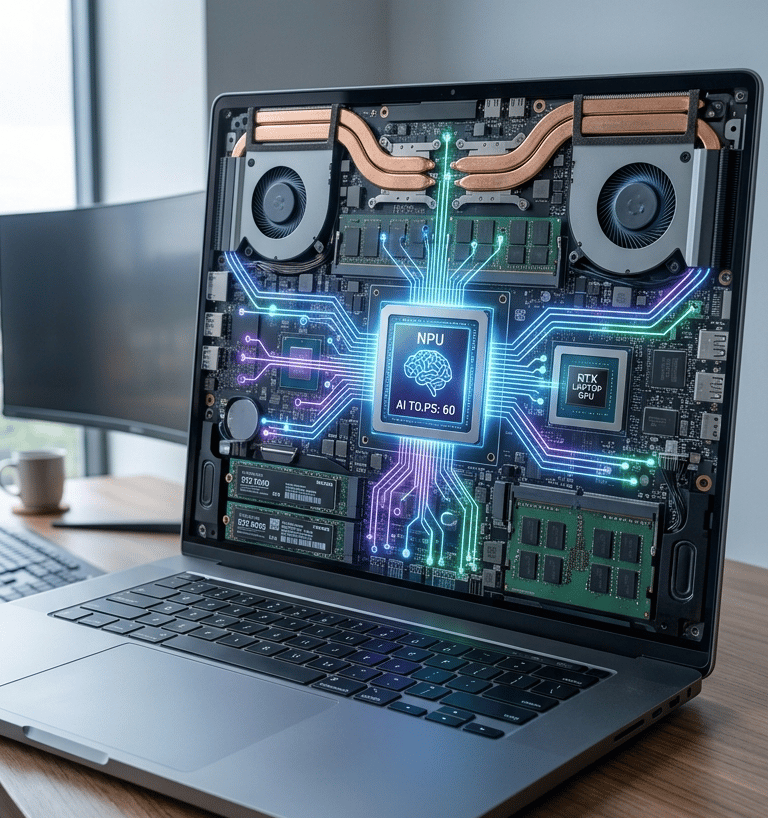
The architecture of top-tier computers has undergone a drastic re-engineering. Until recently, data processing was strictly split between the CPU (excellent for sequential tasks and complex logic) and the GPU (specialized in massive parallel processing, essential for gaming and video rendering). For Artificial Intelligence to operate efficiently at a local level, the industry introduced a vital third pillar: the NPU (Neural Processing Unit).
In desktop computers featuring a traditional tower CPU, this combination reaches colossal performance levels. Next-generation processors integrate dedicated neural acceleration blocks that work in parallel with robust graphics cards. The result is an ecosystem where the CPU manages the operating system, the GPU renders complex three-dimensional environments or compiles massive codebases, and the NPU handles real-time machine learning algorithms. This precise division of labor prevents system stuttering, allowing heavy AI tasks to run seamlessly in the background without the user noticing any performance drop in their main interface.
In the notebook universe, the challenge was even steeper: how to squeeze this massive neural processing power into thin, lightweight chassis with severe thermal dissipation and battery life constraints? The answer came through the extreme energy efficiency of custom silicon chips and hybrid processors. By delegating AI tasks to the NPU—a chip that consumes a tiny fraction of the power required by a traditional GPU—premium notebooks can keep intelligent assistants operating continuously without causing the aluminum chassis to overheat or draining the battery in a matter of hours. Contemporary elite hardware is a masterful balancing act between low energy consumption and instant responsiveness.
How Artificial Intelligence Changed Computer Architecture
The presence of Artificial Intelligence at the heart of hardware has deeply altered how internal components interact. The first major impact is found in dynamic power management and cooling. Historically, cooling fans and liquid cooling systems reacted to temperature spikes; the processor would heat up under a heavy workload, and the fans would spin up afterward. Today, predictive AI algorithms analyze user behavior and software usage patterns in milliseconds. If you initiate an 8K video render or open a massive database, the machine proactively raises the cooling curve and redirects power distribution beforehand, mitigating thermal throttling before it even has a chance to occur.
Another fundamental architectural change is in memory allocation and storage. The data bus connecting the SSD and RAM is now continuously monitored by local machine learning models. The computer learns the user's daily routine: it understands which files are opened at specific times, which software tools are launched together, and how to optimize memory caching so that data access feels instantaneous.
Furthermore, in the graphics domain, AI has introduced advanced predictive rendering and image reconstruction techniques (such as neural network upscaling). Instead of forcing the GPU to physically calculate every single pixel of a complex image in 4K or 8K—whether in design, architecture, or gaming applications—the AI renders a lower base resolution and utilizes deep statistical models to "draw" the remaining pixels with photographic precision. This triples framerates and visual fluidity without requiring the hardware to draw more power from the wall or generate extra heat.
Supernatural Skills: What You Can Do Now in the Office and at Home
All of this engineering evolution translates into practical capabilities that completely transform daily office work or high-end residential use. Local Artificial Intelligence has endowed computers with skills that previously seemed restricted to science fiction.
In the office environment and corporate productivity spheres, the greatest gain is the elimination of mechanical, time-consuming organization tasks:
Photographic Memory and Contextual Search: Tools integrated natively into modern operating systems perform continuous semantic indexing of everything that passes across the user’s screen. If you need to find a contract signed months ago, a graph displayed during a brief video conference, or a specific email, you no longer need to remember the file name or the folder where it was saved. You simply type or speak natural language commands, such as: "Show me that blue spreadsheet about logistics costs I looked at last week." The machine sweeps the local history instantly, interpreting the visual and textual context of saved images, web pages, and documents.
Real-Time Transcription, Summarization, and Translation: During high-stakes business meetings or international conferences, the computer can capture multi-focal audio, isolate participants' voices (filtering out background typing or street traffic), transcribe speeches with high accuracy, translate them simultaneously into dozens of languages, and generate a detailed meeting summary with key action items. Crucially, because it relies on dedicated local hardware, the computer executes this entirely offline, without sending a single byte of data to the internet, fully preserving corporate confidentiality and trade secrets.
In residential, creative, and entertainment environments, these new technologies break individual creation barriers:
Automated Production Studio: For video editors, digital artists, and enthusiasts, complex tasks that used to demand hours of meticulous manual masking are now executed in seconds. Local AI allows users to isolate moving subjects in high-resolution 8K video clips with surgical precision without a green screen (chroma key). Residential audio processing reaches professional studio levels, removing room echoes from untreated spaces and restoring old voice recordings with a single click.
Adaptive Interfaces and Continuous Fluidity: Software-induced system freezes are effectively gone. If the system detects that a user is heavily multitasking between 3D modeling tools and dense web browsing, hardware resources are dynamically and elastically shaped in real time to ensure the active foreground application receives absolute priority.
Market Titans: The Peak of Performance from HP, Dell, and Apple
To ground this technological revolution, we must look at how the three leading global brands have materialized these concepts into top-tier products widely available in the United States market. Each brand has taken a distinct path to merge raw power with advanced AI capabilities.
Below, these elite machines are categorized into three strategic high-performance groups, detailing their raw specifications, U.S. market pricing, and target applications.
Heavyweight Desktops & Stationary Workstations
Engineered for engineering firms, corporate offices requiring massive data automation, data scientists, and design studios that demand continuous peak performance and maximum thermal headroom.
Dell Precision 7960 Tower (Elite Enterprise Workstation)
Suggested Configuration: Intel Xeon W-2400 or W-3400 series processor (up to 56 cores), up to 1TB of DDR5 ECC RAM (Error-Correcting Code), up to 16TB of PCIe Gen 5 NVMe M.2 SSD storage, and support for up to 4x NVIDIA RTX 6000 Ada Generation graphics cards (48GB VRAM each).
Estimated Price: Starts around $4,500 for entry configurations, scaling past $25,000 for fully customized top-tier setups.
Best Suited For: Training localized Large Language Models (LLMs), executing massive real-time architectural rendering, compiling proprietary corporate AI algorithms, and processing multiple dense financial or legal databases simultaneously with zero cloud dependence.
Apple Mac Studio (M4 Ultra Configuration)
Suggested Configuration: Apple M4 Ultra chip featuring a 24-core CPU, up to a 76-core GPU, a 32-core Neural Engine for AI acceleration, up to 192GB of ultra-fast Unified Memory (800 GB/s bandwidth), and up to 8TB of integrated SSD storage.
Estimated Price: Between $3,999 and $8,799 depending on memory and storage selections.
Best Suited For: Professional video editors dealing with multiple simultaneous streams of raw 8K ProRes footage, industrial-grade graphic designers, audio engineers managing hundreds of complex audio tracks, and developers using local AI tools to accelerate code generation within the Apple ecosystem.
Premium Notebooks & Copilot+ PCs (Ultra-Efficient Productivity)
Machines tailored for executive mobility, boardroom presentations, complex contract analysis, corporate governance, and premium residential design use where battery life and contextual intelligence matter.
Dell XPS 16 (9640 - Copilot+ AI Elite)
Suggested Configuration: Intel Core Ultra 9 processor 185H (16 cores with integrated Intel AI Boost NPU), 64GB of LPDDR5X RAM (7467 MT/s), dedicated NVIDIA GeForce RTX 4070 graphics card (8GB GDDR6), 2TB NVMe PCIe 4.0 SSD, and a 16.3-inch Touch OLED 4K display (3840 x 2400).
Estimated Price: Approximately $2,899 to $3,499.
Best Suited For: Senior executives, corporate attorneys, and creative directors. This is the definitive machine for running Microsoft's Copilot+ ecosystem natively and offline, allowing instant document cross-referencing via Recall, real-time multilingual meeting translations, and dense corporate report auditing while traveling.
HP OmniBook Ultra Flip 14 (Premium AI 2-in-1)
Suggested Configuration: Intel Core Ultra 9 processor (Series 2 featuring up to 48 NPU TOPS), 32GB of LPDDR5X RAM, 2TB PCIe Gen 4 SSD, and a 14-inch Touch OLED 3K display (2880 x 1800) with a 360-degree drop-hinge.
Estimated Price: Ranging from $1,649 to $2,199.
Best Suited For: Consultants and traveling professionals who value versatility and all-day battery life. Excellent for interactive client pitches in tablet mode, digital contract signing via stylus, and automating meeting minutes and emails locally using the HP AI Companion without sacrificing battery longevity.
Apple MacBook Pro 16" (M4 Max Configuration)
Suggested Configuration: Apple M4 Max chip with a 16-core CPU, 40-core GPU, 128GB of Unified Memory, 2TB NVMe SSD storage, and a 16-inch Liquid Retina XDR display.
Estimated Price: Around $3,999 to $4,699.
Best Suited For: Independent content creators, mobile software engineers, and studio photographers who require the exact power of a full desktop workstation but need the flexibility to work from home or on location with identical performance stability on battery power.
GROUP 3: Elite Gaming Computers (Dual-Use: Gaming & Professional Superpower)
Modern gaming rigs are no longer just for entertainment. Due to the extreme hardware demands of modern real-time rendering, physics engines, and high framerates, these machines harbor the most powerful GPUs on earth. This makes them highly sought-after tools for heavy professional AI workflows.
Dell Alienware Aurora R16 (High-End Gaming & Stealth Workstation)
Suggested Configuration: Intel Core i9-14900KF processor (24 cores, up to 6.0 GHz) or AMD Ryzen 9 equivalent, 64GB of DDR5 RAM (5600 MHz), dual storage setup with 2TB PCIe 5.0 NVMe SSD + 2TB PCIe 4.0 SSD, and an NVIDIA GeForce RTX 4090 graphics card (24GB GDDR6X VRAM) equipped with factory liquid cooling.
Estimated Price: Approximately $3,299 to $4,199.
Best Suited For: Professional-consumer (prosumer) hybrid users. It delivers absolute peak performance for running AAA gaming titles at maximum 4K settings with Ray Tracing, while doubling perfectly as a powerhouse for heavy 3D modeling (Blender, Maya), complex AutoCAD engineering renders, and local machine learning model training utilizing the RTX 4090's dedicated Tensor Cores.
HP OMEN Transcend 16 (Premium High-Performance Gaming Laptop)
Suggested Configuration: Intel Core i9 or AMD Ryzen 9 high-output processor, 32GB of DDR5 RAM, 2TB NVMe M.2 SSD, and an NVIDIA GeForce RTX 4080 graphics card (12GB VRAM) housed in an advanced magnesium-aluminum thermal chassis with a 240Hz refresh rate display.
Estimated Price: Between $2,199 and $2,799.
Best Suited For: Independent game developers, architects who need to bring heavy models directly to client sites, and enthusiast gamers. The dedicated Tensor Cores on the RTX card execute advanced AI visual processing (such as DLSS frame generation) for games, which seamlessly translates into blistering hardware acceleration when rendering 4K videos or applying heavy neural filters in Adobe Premiere and Photoshop.
Conclusion
The evolution of high-performance desktop towers and notebooks proves that Artificial Intelligence is not a mere software add-on or a transient marketing gimmick. It has structurally altered the engineering of hardware. Contemporary power is no longer summarized by how fast a machine can spin its fans under stress, but by how intelligently it mitigates energy waste, ensures absolute data privacy by running complex models locally, and returns the most precious asset to the user: time.
The solutions engineered by HP, Dell, and Apple demonstrate that there are distinct paths to achieve excellence. Whether through the flexibility and raw brute force of Windows architectures leveraging high-TOPS NPUs, or via the revolutionary energy efficiency of Apple's unified silicon, the ultimate beneficiary is the corporate professional and high-end residential user.
When choosing a top-tier machine today, the analysis must go beyond traditional gigabyte and storage checklists. The primary focus must shift toward local neural processing capability and how fluidly the hardware integrates with intelligent workflows. The modern computer has ceased to be a simple tool; it has become a high-speed thinking partner, ensuring that the only real limitation left is the creativity of the person sitting in front of the screen.
References
HENNESSY, John L.; PATTERSON, David A. Computer Architecture: A Quantitative Approach. 6th ed. San Francisco: Morgan Kaufmann / Elsevier, 2019. (Foundations on data buses, parallel processing, and silicon evolution).
INTEL CORPORATION. Intel Core Ultra Processors: Architecture Brief and AI Acceleration Capabilities. Technical White Paper, 2024-2026. Retrieved from https://www.intel.com.
DELL TECHNOLOGIES. Dell XPS and Precision Workstations: Leveraging Local NPU Architecture for Next-Generation Enterprise AI Workflows. Product Technical Documentation, 2025-2026. Retrieved from https://www.dell.com.
APPLE INC. Apple Silicon Media Architecture and Neural Engine Performance Overview. Tech Specs & Developer Documentation, 2025-2026. Retrieved from https://www.apple.com/developer.
HEWLETT-PACKARD DEVELOPMENT COMPANY. HP OmniBook and AI Companion: Security and Efficiency Standards in Hybrid Work Environments. HP Innovation Insights, 2026. Retrieved from https://www.hp.com.
RUSSELL, Stuart; NORVIG, Peter. Artificial Intelligence: A Modern Approach. 4th ed. Hoboken: Pearson, 2020. (Analysis on predictive models and machine learning applied to localized computing systems).
Contact
Contact us for questions or suggestions
contact@turingvision.com
fone: + 55 54 99122 0659
© 2026. All rights reserved. https://turingsvision.com/privacy-policy