
How Starlink Is Rewriting the Rules of Global Internet Access
The new technology by Elon Musk
NEW TECNOLOGY
By Marcelo Salamon
7/6/20266 min read
Abstract
This article analyzes the disruptive impact of Starlink, SpaceX’s satellite broadband network, on global connectivity infrastructure through 2026. By deploying a mega-constellation of thousands of satellites in Low Earth Orbit (LEO), Starlink overcomes the historical latency and speed limitations of legacy geostationary (GEO) satellite technologies, competing directly with terrestrial broadband. This study explores the company’s rapid expansion into the residential market, its growing footprint in the aviation and maritime sectors, and its strategic push into Direct-to-Cell technology. Finally, it addresses the geopolitical, regulatory, and economic challenges, as well as the environmental risks of orbital congestion associated with the company’s virtual monopoly in the aerospace sector.
Keywords: Starlink, SpaceX, LEO Satellites, Global Broadband, Telecommunications, Aerospace Connectivity.
Introduction
For most of internet history, getting online depended heavily on physical infrastructure—running fiber-optic, coaxial, or copper telephone lines directly to a property. Communities living in remote, mountainous, or economically disadvantaged regions were routinely left behind by the digital revolution because the massive capital expenditure required to extend those physical lines simply couldn't be justified.
Starlink, the satellite broadband network built and operated by SpaceX, has fundamentally upended this dynamic. Over the last few years, the service has evolved from an ambitious pilot program into a cornerstone of global telecommunications infrastructure in 2026, proving that high-speed connectivity no longer needs to be anchored to the ground.
What Makes Starlink Different From "Normal" Internet
Traditional high-speed internet—fiber, cable, and DSL—relies on a physical grid of cables running from central servers straight to the end user's router. On the other hand, legacy satellite internet solutions (such as those operated by Viasat and HughesNet) depended on a handful of massive geostationary (GEO) satellites parked roughly 22,300 miles (36,000 km) above the equator. While these legacy systems provided wide geographic coverage, the immense physical distance required signals to travel over 44,000 miles in a single round trip. This introduced a crushing latency well above 600 milliseconds (ms), making modern, real-time applications like video calls, online gaming, and cloud-based enterprise software frustrating or entirely unusable.
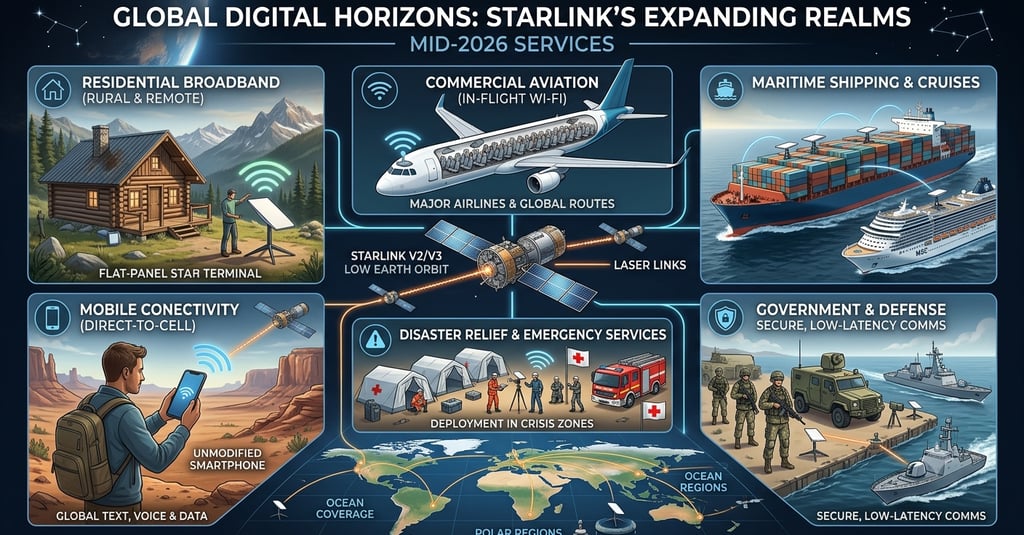
Starlink’s core innovation lies in the orbital repositioning of its hardware. Instead of relying on a few distant satellites, the company utilizes a "mega-constellation" of thousands of small satellites in Low Earth Orbit (LEO), flying just 340 miles (550 km) above the Earth's surface. By mid-2026, Starlink's active fleet surpassed the historic milestone of 10,000 operational satellites. This staggering volume accounts for roughly two-thirds to three-quarters of all active satellites currently orbiting the planet, making it the largest satellite fleet ever assembled in human history.
This close proximity to the ground slashes data round-trip times. Starlink’s network latency routinely hovers between 20 and 40 ms, effectively matching the performance of stable cable or DSL connections. Download speeds typically range from 50 to 250 Mbps, depending on the specific service plan and local network congestion. Furthermore, newer generations of Starlink satellites feature optical inter-satellite laser links. This technological breakthrough allows data to be routed and transmitted directly through space from one satellite to another, removing the need for nearby ground stations (gateways) and enabling seamless coverage across oceans, deserts, and polar regions.
Technical Comparison of Connectivity Models
Terrestrial Fiber and Cable Infrastructure
Required Infrastructure: Physical cabling routed directly to the user's property.
Typical Latency: Ultra-fast and responsive, ranging between 5 and 20 ms.
Average Speed: Massive capacity, ranging from 100 Mbps to well over 1 Gbps.
Deployment Time: Slow and labor-intensive, requiring months or years for civil engineering and permitting.
Best Use Case: High-density urban areas and master-planned suburban neighborhoods.
Legacy Satellite Systems (GEO)
Required Infrastructure: Local satellite dish pointed at a single massive satellite in a fixed, distant orbit.
Typical Latency: Extremely high, consistently exceeding 600 ms due to the orbital distance.
Average Speed: Limited bandwidth, typically sitting between 12 and 100 Mbps.
Deployment Time: Quick setup once the hardware kit arrives, but delivers a heavily degraded user experience.
Best Use Case: Residual backup coverage and deeply isolated rural areas with no alternative digital options.
LEO Satellite-Based Networks (Starlink)
Required Infrastructure: A compact, self-aligning receiver dish connected to a dynamic constellation in low-altitude orbit.
Typical Latency: Low and highly responsive, operating in the 20 to 40 ms range.
Average Speed: Highly competitive broadband speeds, typically varying from 50 to 250 Mbps.
Deployment Time: Immediate activation in approved regions, offering a continuously improving user experience.
Best Use Case: Agriculture, remote communities, maritime fleets, commercial aviation, disaster relief, and global mobility.
Market Dominance and Financial Indicators
Starlink’s commercial and financial growth metrics are difficult to overstate. The network officially passed the 10-million active global subscriber milestone in February 2026, with recent industry reports indicating the user base has since climbed past 12 million connections across roughly 150 to 160 countries and territories. In the U.S. residential satellite broadband market specifically, Starlink commands an estimated 70% to 75% market share, completely overshadowing legacy incumbents like HughesNet and Viasat, whose combined subscriber bases peaked years before SpaceX even began commercial operations.
In network performance audits, independent speed-test data shows that SpaceX’s infrastructure accounts for over 95% of all global satellite broadband speed-test samples, effectively turning Starlink into the gold standard against which the entire category is measured. Financially, the satellite division has become the primary profit engine for SpaceX as a whole. The business generates billions of dollars in annual revenue with robust operating margins that resemble a software company rather than a traditional telecom utility. This commercial success has propelled SpaceX’s private valuation into the $750 billion to $1 trillion range, fueling intense Wall Street speculation regarding an upcoming initial public offering (IPO) for the satellite spinoff.
Beyond the rural residential market, Starlink has aggressively expanded into high-revenue enterprise and industrial verticals:
Commercial Aviation: Global contracts to provide high-speed, in-flight Wi-Fi for passengers on major carriers, including Singapore Airlines, American Airlines, and Wizz Air.
Logistics and Maritime Shipping: Full fleet integration across shipping giants like Maersk and Hapag-Lloyd, alongside comprehensive deployments on cruise lines operated by Royal Caribbean, Carnival, and MSC.
Direct-to-Cell Mobile Technology: Strategic partnerships with terrestrial mobile network operators, such as T-Mobile in the U.S., leveraging existing cellular spectrum to connect satellites directly to unmodified, off-the-shelf smartphones. The rollout began with basic text messaging and is scaling to full cellular voice and data services.
Future Growth Trajectory and Roadblocks
Long-term strategic projections indicate that Starlink is transitioning from a niche backup option for isolated areas into a primary layer of ubiquitous global connectivity:
Rollout of Next-Gen V3 Satellites: Deploying hardware with significantly higher data-throughput capacity per unit and an expanded laser-link mesh network, substantially narrowing the performance gap with terrestrial fiber.
Mobile Carrier Disruption: The maturation of Direct-to-Cell services will allow standard smartphones to route calls and data packets natively through space, putting SpaceX in direct competition with traditional mobile network operators.
Regulatory Hurdles and Geopolitical Friction: While major new markets continue to open—such as Vietnam granting full operational approval in early 2026—other heavily populated nations like India have paused licensing processes, citing data sovereignty concerns, national security requirements, and geopolitical sensitivities surrounding ongoing international conflicts.
Emergence of Sovereign and Corporate Competitors: Starlink’s current monopoly will face intense headwinds in the coming years as rival heavyweights deploy their networks. Key players include Amazon’s Project Kuiper, the European Eutelsat/OneWeb merger, and China’s state-backed Guowang constellation.
Critical Analysis: Pros and Cons
Pros
Bridging the Digital Divide: Delivers reliable, high-speed internet to geographically isolated regions where deploying physical infrastructure is economically or physically impossible.
Productivity-Grade Latency: Low response times seamlessly support remote work, real-time corporate collaboration platforms, and cloud-integrated enterprise applications.
Tactical Deployment Speed: The ability to activate functional networks across entire regions in a matter of hours, serving as a critical asset for governments, defense forces, and humanitarian aid workers during natural disasters.
Cons
Price and Accessibility Barriers: Upfront hardware costs and monthly subscription fees remain prohibitively expensive for low-income populations in emerging markets.
High-Density Congestion: Temporary drops in download speeds have been observed in areas with high user density due to the finite bandwidth capacity of individual satellites.
Environmental Impact and Orbital Debris: Growing concern within the international scientific community regarding the sheer volume of hardware in low orbit, which increases the risk of cascading collisions (Kessler syndrome) and interferes with astronomical research.
Centralization of Critical Infrastructure: Placing a global connectivity grid under the control of a single private corporation raises serious questions about data governance, private censorship, and geopolitical leverage during wartime or diplomatic crises.
Conclusion
Starlink has fundamentally rewritten the rules of the global telecommunications market by proving the technical and financial viability of Low Earth Orbit satellite constellations. By matching the performance of terrestrial networks and aggressively capturing enterprise, maritime, and cellular markets, SpaceX has secured a competitive moat that will be incredibly difficult to breach in the near term. The future of the industry will ultimately be shaped by how fast rival consortiums can deploy their own constellations, and how effectively global regulatory bodies can balance private innovation with national sovereignty and orbital sustainability.
References
SpaceX / Starlink. Official Operational Reports and Aerospace Constellation Launch Updates (2024-2026).
S&P Global. The State of Satellite Connectivity: Market Evolution and Low Earth Orbit Disruptions. Strategic Market Report, 2025.
Ookla Speedtest. Global Satellite Broadband Performance and Speed Samples Analysis. Compiled via Telecompetitor, 2025-2026.
Reuters. Geopolitical Implications, National Security and Regulatory Pauses in Satellite Internet Deployments. Global Infrastructure Desk, 2026.
MarketsandMarkets / Fortune Business Insights. Satellite Internet Market: Global Forecast, Trends, and Competitive Landscape. Industry Commercial Intelligence Reports, 2025.
Contact
Contact us for questions or suggestions
contact@turingvision.com
fone: + 55 54 99122 0659
© 2026. All rights reserved. https://turingsvision.com/privacy-policy