
From Turing’s Mathematics to the Beam of Light
Part II: How Laser Weapons Are Redefining Modern Warfare
WARS
By Marcelo Salamon
5/22/20263 min read

Abstract
This article examines the evolution of modern warfare systems—from networked drones and guided missiles to directed-energy laser systems. It traces the intellectual lineage connecting Alan Turing to this transformation and assesses how the laser represents a rupture with the logic of conventional warfare.
Introduction
Warfare has always mirrored the science of its era. During World War II, the physicist pitted fissile material against concrete, while the mathematician pitted code against silence. Decades later, the battlefield became essentially an information processing system, and artificial intelligence—a direct heir to Alan Turing’s thought—began guiding missiles, piloting drones, and determining targets in fractions of a second.
Today, a new technological layer is superimposed on this architecture: directed-energy weapons, specifically high-power laser systems, which operate at the speed of light and transform electricity into destructive power without firing a single projectile. This article traces this journey, compares two generations of weaponry, and situates the laser within the strategic and intellectual horizon that Turing helped build.
Weapons of the Digital Age: Drones, Satellites, and Precision Missiles
The weapons dominating conflicts over the last three decades function through a logical chain of information. Satellites identify the target; AI algorithms process data in real-time; and drones or cruise missiles strike with meter-level precision. The "brain" of this system is computational, tracing back to Alan Turing’s formalization of logic in the 1930s.
However, the operational cost is a significant "Achilles' heel": a Tomahawk missile costs approximately $2,000,000 per shot. Networked warfare is precise and intelligent, but it is expensive and dependent on physical stockpiles.
How a Laser Weapon Works: From Physics to Damage
The laser is applied quantum physics. Unlike common light, a laser beam concentrates all photons in the same direction and wavelength in perfect synchronicity. This energy does not dissipate easily over distance, reaching the target almost entirely even miles away.
The power source is electrical; a vehicle or ship converts electricity into coherent light through crystals or optical fibers. There is no projectile, gunpowder, or explosion; the shot is silent and often invisible to the naked eye. When the laser stays focused on a point for three to ten seconds, it generates extreme heat. In a drone, this can puncture the hull or melt the engine ; in a missile, it can detonate the warhead prematurely. Systems like Lockheed Martin’s HELIOS can destroy, blind sensors, or provide surveillance within a single platform.
The Cost of a Shot: The Laser’s Economic Revolution
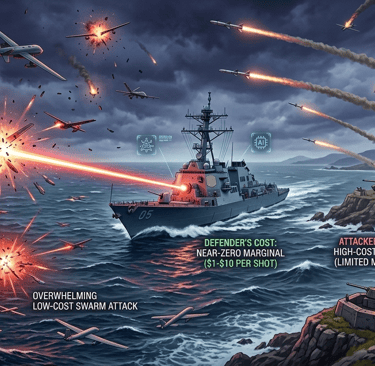
The most disruptive aspect of laser weaponry is economic. Each shot consumes between $1 and $10 in electricity. There is no ammunition to replenish and no logistical burden for storing warheads. As long as the engine runs, the weapon has unlimited shots. Recent operations in the Red Sea (2023–2025) highlighted the unsustainability of using expensive missiles to intercept low-cost drones. The laser inverts this logic: the expensive weapon belongs to the aggressor, while the defender operates at a near-zero marginal cost.
Laser vs. Conventional Weapons: A Strategic Comparison
Conventional weapons remain versatile and can strike through adverse weather like fog, rain, or smoke. In contrast, a laser depends on good visibility, as water particles and dust disperse the beam. Furthermore, high-speed targets like supersonic cruise missiles represent a much greater challenge than the slow drones where lasers have already proven effective.
The future lies in layered defense: the laser as the first line of interception against numerous small threats, and missiles reserved for high-complexity targets. The U.S. Navy has already deployed destroyers equipped with the ODIN system in real operations.
Turing and the Laser: An Indirect but Essential Heritage
Alan Turing died in 1954, years before the first functional laser was built in 1960. While the laser was born from quantum physics, its connection to Turing is structural: without the computation he founded, a laser would be intense light without an aim.
Systems like HELIOS or ODIN are lethal because of the computational "brain" that directs them. The algorithms that predict trajectories and maintain sub-millimeter precision are direct heritages of Turing’s logic. Quantum physics created the bullet; computation created the marksman.
Conclusion
Modern warfare is a war of information systems, and the laser is its latest expression—a weapon operating at light speed with negligible costs. It is not the end of conventional war, but the beginning of a new strategic equation where the cost of defense may finally be lower than the cost of attack. Turing did not see the laser, but the logic he left to the world is what makes this weapon work.
References
Congressional Research Service. Navy Shipboard Lasers: Background and Issues for Congress. Washington: Library of Congress, 2024-2025.
Army Recognition. U.S. Navy Destroyer Deploys ODIN Laser Directed-Energy Weapon System During Operation Epic Fury. 2026.
Defense News. What We Know About the US Military's New Joint Laser Weapon System. April 2026.
Military Times. The US Navy Brought a 'One-of-a-Kind' Laser Weapon Back from the Dead. March 2026.
ZME Science. The US Navy Just Tested a Laser Weapon That Could Change Warfare Forever. 2025.
Army Recognition. Exclusive: First Operational Use for U.S. Army Laser Weapons with DE M-SHORAD Air Defense Vehicle. July 2025.
Hodges, Andrew. Alan Turing: The Enigma. Princeton University Press, 2014.
Einstein, Albert. Zur Quantentheorie der Strahlung (On the Quantum Theory of Radiation). Physikalische Zeitschrift, 1917.
Contact
Contact us for questions or suggestions
contact@turingvision.com
fone: + 55 54 99122 0659
© 2026. All rights reserved. https://turingsvision.com/privacy-policy