
Flying Cars and Artificial Intelligence
The urban air mobility revolution has begun
AINEW TECNOLOGY
BY Marcelo Salamon
6/23/20265 min read
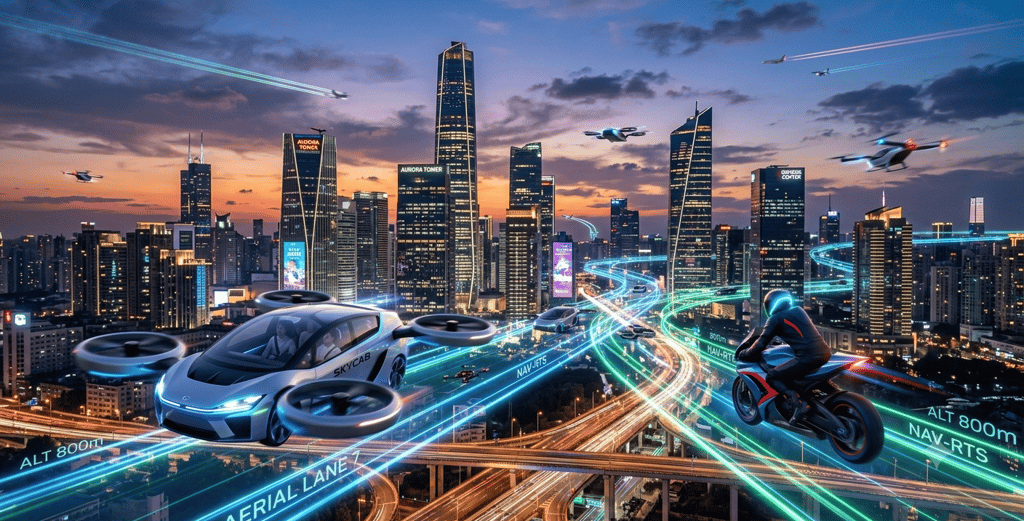
Abstract
For decades, flying cars were a staple of the popular imagination, appearing in movies, books, and futuristic predictions. Today, however, this vision is leaving the realm of science fiction to become a technological reality. So-called eVTOLs (Electric Vertical Take-Off and Landing), electric vertical take-off and landing vehicles, represent one of the most promising innovations in urban mobility.
The development of these vehicles is directly linked to advancements in artificial intelligence, embedded computing, electrification, and autonomous systems. Together, these technologies are creating a new form of transportation capable of reducing congestion, increasing logistical efficiency, and transforming how people move within major cities.
More than just an aeronautical innovation, flying cars represent a structural shift in the relationship between technology, mobility, and urbanization, paving the way for a future where urban air transportation could become part of the daily routine for millions of people.
Keywords: Flying cars; eVTOL; Artificial Intelligence; Urban Air Mobility; Autonomous Transportation; Technological Innovation; Smart Cities; Future of Mobility; Electric Aviation; Aerospace Technology.
Introduction
The history of humanity is marked by a constant search for new ways to travel. From the invention of the wheel to modern commercial airliners, each technological breakthrough has expanded the possibilities of connecting people, cities, and countries. Currently, a new transformation is beginning to take shape: urban air mobility.
Electric vertical take-off and landing vehicles, known by the acronym eVTOL, are being developed by technology companies, aerospace manufacturers, and startups worldwide. Unlike traditional helicopters, these vehicles utilize electric motors, multiple rotors, and intelligent systems capable of making flights safer, quieter, and more efficient.
However, the true game-changer of this revolution lies not just in the aircraft design, but in the artificial intelligence operating behind its systems. Sensors, advanced algorithms, machine learning, and real-time data processing allow these aircraft to perform complex tasks that previously depended exclusively on human intervention.
The result is the emergence of a new transportation paradigm, capable of integrating airspace into daily urban life in an unprecedented way.
The Future of Urban Air Mobility
Increasing Automation: The evolution of artificial intelligence is expected to significantly increase the level of automation in eVTOLs. In the initial years of commercial operations, the presence of human pilots will remain critical to ensuring public trust and meeting regulatory requirements. However, intelligent systems are already capable of handling various navigation, monitoring, and real-time decision-making tasks. As algorithms become more sophisticated and accumulate operational experience, the trend is for human involvement to be gradually reduced, enabling increasingly autonomous and efficient flights.
The Expansion of Air Taxis: The concept of air taxis is moving from the experimental phase into the urban transportation market. Initially, these services are expected to cater to a corporate clientele and high-income users due to the high costs of operation and aircraft acquisition. However, the history of technological innovation demonstrates that scale production tends to lower prices over time. Just as occurred with personal computers, smartphones, and electric vehicles, urban air mobility is expected to become progressively more accessible to the general public.
Multimodal Integration: The success of flying cars will depend on their integration with existing transportation systems. Instead of replacing buses, subways, and trains, eVTOLs will serve as a complement within a smart mobility network. Applications will be able to plan complete itineraries, combining different modes of transportation automatically. A passenger could begin their journey by subway, use an air taxi to cover long urban distances, and complete the trip via ground transportation, all coordinated by artificial intelligence-based systems.
Specialized Infrastructure: The widespread adoption of air mobility will require significant investments in urban infrastructure. New arrival and departure terminals, known as vertiports, will need to be built in strategic city locations. These spaces must feature maintenance areas, electric charging stations, traffic monitoring, and passenger services. Additionally, the creation of specific aerial corridors will be necessary to organize aircraft flow and ensure operational safety in densely populated urban environments.
Smart Airspace Management: The simultaneous presence of hundreds or thousands of aircraft flying at low altitudes will demand advanced air traffic management systems. In this context, artificial intelligence will play an essential role. Specialized algorithms will continuously analyze routes, weather conditions, energy consumption, and the movement of other aircraft. The objective will be to prevent aerial congestion, optimize trajectories, and guarantee high safety standards for both passengers and operators.
Widespread Technology Adoption: Although flying cars are still viewed by many as a futuristic product restricted to a select few, several factors indicate that their adoption could grow in the coming decades. Improvements in battery technology, the evolution of artificial intelligence, lower production costs, and maturing regulations are poised to accelerate market expansion. As with other disruptive technologies, what seems exclusive today may become part of the daily routine in large urban centers, profoundly changing the way people move.
Future Professions and New Opportunities
Every technological revolution fundamentally alters the job market, and the rise of urban air mobility will be no different. The emergence and consolidation of eVTOLs will demand a new wave of highly skilled professionals prepared to work at the intersection of classical aerospace engineering and advanced data science.
Among the careers showing the highest growth potential and strategic relevance are: Autonomous Systems Engineer, responsible for designing and testing structures that enable flight without direct human intervention; Aviation AI Specialist, focused on developing predictive algorithms and neural networks to guide aircraft decision-making; Aerospace Cybersecurity Analyst, dedicated to shielding communication and navigation systems against cyber attacks and external interference; Urban Air Mobility Manager, a professional in charge of strategic planning and integrating vertiports into the macro flow of smart cities; Electric Aircraft Maintenance Technician, specialized in high-voltage mechanics, electric propulsion systems, and battery diagnostics; Embedded Software Developer, responsible for programming internal interfaces and direct control systems for eVTOL components; Flight Data Analyst, focused on processing massive volumes of sensor-generated data for performance optimization and preventive maintenance; and Smart Air Traffic Controller, a ground-based professional supervising automated traffic managed by AI systems in real time.
At the same time, workers in traditional logistics and ground transportation sectors will need to adapt to a highly automated and connected ecosystem. This dynamic landscape reinforces the vital importance of continuing education and constant technological upskilling as mandatory tools for thriving in the coming decades.
Conclusion
Flying cars have ceased to be a distant forecast to become a rapidly developing reality. Driven by artificial intelligence, electrification, and aerospace engineering breakthroughs, eVTOLs represent one of the most profound transformations in global mobility since the popularization of the automobile at the turn of the last century.
More than an isolated technological innovation, they symbolize a new approach to thinking about transportation, urban planning, and connectivity between people and major metropolitan hubs. Artificial intelligence serves as the true heart of this process, enabling unprecedented levels of automation, predictive safety, and logistical efficiency.
Although robust challenges related to international regulation, physical infrastructure re-adaptation, and public acceptance must still be overcome, the historical trend points to a steady and gradual expansion of this technology. The future of mobility is no longer limited to roads; inevitably, it will also occupy the skies. And by all indications, this irreversible transformation has already begun.
References
Federal Aviation Administration. (2024). Urban air mobility (UAM) concept of operations (Version 2.0). U.S. Department of Transportation.
National Aeronautics and Space Administration. (2023). Urban air mobility landscape: Market and technology assessment. NASA Langley Research Center.
Russell, S., & Norvig, P. (2020). Artificial intelligence: A modern approach (4th ed.). Pearson.
Thrun, S., Burgard, W., & Fox, D. (2005). Probabilistic robotics. MIT Press.
Contact
Contact us for questions or suggestions
contact@turingvision.com
fone: + 55 54 99122 0659
© 2026. All rights reserved. https://turingsvision.com/privacy-policy