Your blog post
Global medical Robotics for civilization
MEDICAL TECHNOLOGYNEW TECNOLOGY
6/7/20265 min read

📌 INTRODUCTION
For centuries, medicine rested upon an immutable triad: the physician’s clinical eye, the dexterity of their hands, and the knowledge accumulated over decades of practice. This triad has not been destroyed—it has been silently expanded by advanced engineering and computer science. We are witnessing the beginning of a profound metamorphosis in healthcare, where the convergence of high-precision hardware and artificial intelligence algorithms redefines the boundaries of what is possible.
From complex operating rooms to specialized hair transplant clinics, and now reaching into mental health offices, machines are operating where once only human judgment and touch could reach. This article delivers a detailed technical analysis of this transformation: the systems in operation, the drastic drop in costs enabling their expansion, the benefits in patient volume, and the massive fiscal savings generated for governments worldwide, culminating in exact projections for the workforce transition between 2030 and 2040.
📊 THE GLOBAL MEDICAL ROBOTICS MARKET
The medical robotics market has transitioned from an experimental niche into a multi-billion dollar foundational pillar of global health infrastructure. With over 10,000 active surgical platforms globally executing over 1.5 million complex procedures annually, the baseline of surgery has shifted. Driven by a 50% reduction in entry-level hardware costs due to patent expirations, high-precision automated surgery is no longer exclusive to elite medical centers—it is democratizing rapidly into regional public healthcare networks.
🩺 THE MACROECONOMIC AND FISCAL IMPACT ON GOVERNMENTS
The widespread integration of artificial intelligence diagnostics and automated surgical execution functions as a massive structural corrective for public state finances. For governments managing public healthcare systems, the transition yields deep, permanent fiscal relief across four primary pillars:
Public Sector Payroll Containment: Autonomous screening platforms and precise robotic technicians sharply curb the expansion of state-funded permanent medical bureaucracies. Governments transition from carrying lifetime pension and salary liabilities of vast public clinical personnel to managing streamlined technology service contracts.
Bed Turnover and Inpatient Optimization: Automated surgeries reduce post-operative recovery timelines by an average of 2 to 3 days. This shift increases total hospital capacity by up to 30% without requiring new real estate infrastructure, slashing state hospitality, food, and medication expenditures.
Mitigation of Welfare and Disability Claims: Precision robotics drastically lower human medical error and hospital-acquired infection rates. Consequently, state budgets experience a corresponding decline in long-term worker compensation claims, early disability retirements, and medical negligence payouts.
Accelerated Workforce Re-entry: Rapid recovery paths return treated citizens to the economic production line in a fraction of traditional times. Sick or injured individuals transform from tax-draining public healthcare dependents back into active, revenue-generating consumers and taxpayers.
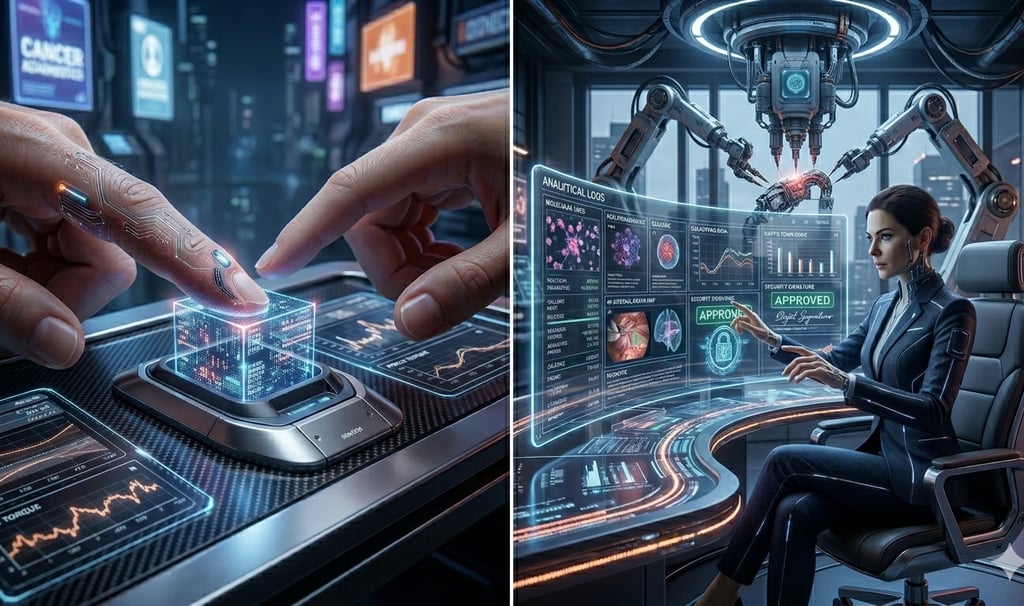
🖼️ ROBOTIC PRECISION IN ACTION
Refer to the file named "watermarked_img_17127976074618444812.png" for the visual representation of automated technical execution.
📱 FROM LAB TUBES TO THE PALM OF YOUR HAND: EVERYDAY ACCESSIBILITY
The most profound shift in medical history is the migration of high-end diagnostic power away from specialized corporate laboratories directly into the personal environments of ordinary citizens. The historical friction of healthcare—scheduling appointments, taking time off work, and waiting days for clinical blood panels—is being eliminated by continuous, decentralized monitoring hardware.
🏠 Diagnostics from Your Home Computer and Smartphone
Consumer electronic devices are evolving into ambient clinical outposts. Standard smartphone lenses paired with advanced machine-learning subroutines can continuously monitor cardiovascular metrics, heart rate variability, and detect complex dermatological developments like melanoma. Furthermore, compact plug-and-play desktop modules utilize silicon photonics to cast infrared laser arrays through the skin, measuring blood-glucose levels, lipid profiles, and metabolic waste markers continuously from a home keyboard setup without a single needle scratch.
🛑 Decentralized Street Kiosks: The Health ATM
For deeper screenings requiring physical or structural diagnostics, patients will bypass general practitioner clinics entirely via standalone urban biometric cabins. Distributed widely across pharmacies, transit hubs, and residential centers, these enclosed kiosks function as secure health ATMs. By placing a hand onto a unified sensor plate and engaging a localized ultrasonic sensor array, a user receives a full internal structural and chemical body map within 60 seconds. The data is parsed on edge servers, cross-referenced with the patient's decentralized digital profile, and issues automated prescriptions validated remotely by autonomous auditing systems.
💇♂️ AUTOMATED EXTRACTION: THE HAIR TRANSPLANT CASE STUDY
The clinical success of automated hair restoration through platforms like the ARTAS® iX demonstrates the practical viability of autonomous tissue manipulation. Operating via advanced computer vision, the platform maps hair follicles, calculates growth vector angles between 15° and 45°, and performs micron-level extraction automatically. By dropping follicle damage rates to under 3% and reducing procedure times by half, this application proves that automated machines routinely outpace human physical endurance and spatial tracking in highly repetitive micro-procedures.
⏳ THE 2030–2040 WORKFORCE INVERSION
The displacement of traditional healthcare career paths follows a structured trajectory driven by algorithmic maturity. By 2030, primary medical intake, basic pharmaceutical dispensing, and radiology interpretation will rest entirely with specialized medical Large Language Models.
By 2040, technical diagnostic fields like Pathology, Radiology, and routine Dermatology will experience an 80/20 market inversion: 80% of all diagnostic and operational decisions will be generated autonomously by machine algorithms, while the remaining 20% of human professionals step back into high-level oversight roles, acting strictly as system programmers, forensic data log perits, and final legal sign-offs for the automated machinery.
🧠 CLINICAL PSYCHOLOGY: THE AUTOMATION OF MENTAL HEALTH
The automation wave is expanding past mechanical biology into mental health care. Driven by convolutional behavioral networks, artificial intelligence systems can parse facial micro-expressions, speech pacing, vocal pitch, and lexical choices in real time to diagnose and treat anxiety, depression, and stress disorders. Free from emotional fatigue, burnout, or cognitive bias, virtual psychological frameworks deliver scalable, continuous mental health support tailored dynamically to a patient's historical lifetime data stream.
🖼️ THE FUTURE OF CLINICAL OVERSIGHT
Refer to the file named "watermarked_img_4785629296609038828.png" for the visual representation of the modern human medical auditor verifying automated analytical logs.
🏁 CONCLUSION
The transition of medicine and analytical psychology toward models predominantly executed by artificial intelligence and robotic systems represents more than a victory of technical innovation; it marks a wholesale restructuring of global public finance. The stark market inversion projected for 2040—where intelligent systems assume 80% of the operational and technical workload, leaving 20% to human professionals—will deliver some of the largest fiscal relief margins in modern history to state governments.
By curbing the need to fund expansive, permanent public sector payrolls, mitigating long-term welfare expenditures on disability benefits, and, above all, rapidly returning cured citizens to the active workforce, medical automation pays for itself many times over. Humanity stands to inherit a healthcare delivery model that is exponentially more scalable, swift, and affordable. Meanwhile, the remaining human physicians and psychologists will experience a profound evolution in status: they will step away from the physical exhaustion of manual, repetitive tasks to establish themselves as the developers, data log auditors, and legal gatekeepers of a flawless automated machine. The robots inherit execution and scale; human beings retain governance, ethics, and the final word.
📚 REFERENCES
Intuitive Surgical Data Report: Cumulative global procedure logs and active commercial installation base metric sheets for the da Vinci surgical platform.
U.S. Food and Drug Administration (FDA): Public safety filings, approvals, and de novo clearances for artificial intelligence and machine learning-backed medical devices (MIRA™, ACE XACT Robotics, and Pixel Watch 3 frameworks).
National Medical Products Administration (NMPA - China): 2024 White Papers regarding the commercial registry and implementation metrics of algorithmic clinical prediction and diagnostic AI systems.
McKinsey Global Institute: Economic impact analysis reports focusing on labor automation thresholds, core automated task competencies within clinical workflows, and fiscal returns across public versus private healthcare networks.
Restoration Robotics / Venus Concept Tech Manuals: Robotic system engineering white papers and clinical validation data tracking follicular unit transecction margins via the ARTAS® iX interface.
Massachusetts Institute of Technology (MIT) Labs 2025: Research briefs and laboratory data sheets detailing intravascular microdevice navigation and circulatronics architecture.
GlobalData Health Intelligence: Macroeconomic sector modeling, compound annual growth rate (CAGR) tracking, and supply cost evaluations for surgical robotics through 2033–2035.
CNN Business / Bill Gates Public Keynotes: Sector analysis essays and prospective projections detailing the operational capabilities of large language models and generative AI frameworks in replacing technical cognitive labor.
Medscape & Journal of Medical Internet Research (JMIR): Peer-reviewed clinical trials monitoring the socioeconomic impact of shortened hospital stays via targeted robotic interventions and algorithmic behavioral tracking in diagnostic mental health.
Contact
Contact us for questions or suggestions
contact@turingvision.com
fone: + 55 54 99122 0659
© 2026. All rights reserved. https://turingsvision.com/privacy-policy