Blackboard to Neural Bit: The Second Edition
Continuation
NEURALINK
By Marcelo Salamon
5/20/20263 min read
Abstract
This article analyzes the trajectory and impact of Neuralink’s neurotechnology, exploring everything from the technical mechanics of the "N1" implants to their broader sociopolitical implications. Focusing on the transition from lab testing to real-world clinical applications, we detail how Brain-Computer Interfaces (BCIs) offer hope for patients with severe paralysis while sparking urgent ethical debates regarding mental privacy and human autonomy. The analysis concludes that the future of human-machine integration depends less on technical capacity and more on global governance of neural data.
Introduction
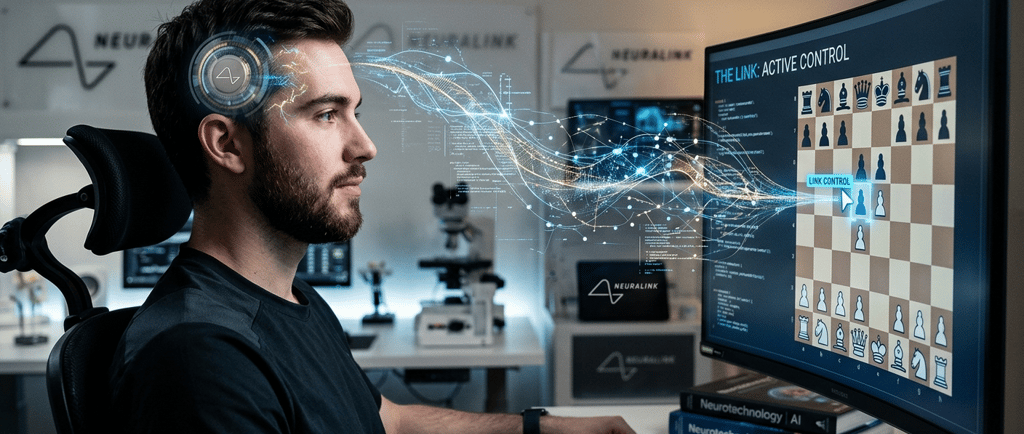
In January 2024, humanity reached a milestone: Noland Arbaugh, a young man with quadriplegia, used only his thoughts to control a computer cursor and play chess. This event wasn't just a technical demo; it was proof that technology has crossed the most intimate human frontier—the brain. Founded in 2016 by Elon Musk, Neuralink proposes a symbiosis between biological and artificial intelligence. What was once science fiction is now a "cognitive prosthesis" with the potential to redefine life for millions suffering from motor or neurological impairments.
What is the Neuralink Brain Chip?
The device, known as "The Link" or the "N1" implant, is a coin-sized chip designed to be placed directly into the skull. Unlike external tech, it is invisible after surgery and communicates with the outside world via Bluetooth. Neuralink’s goal isn't just to create a mental remote control, but a "generalized input/output device" that allows for a permanent, two-way connection between the human mind and the digital ecosystem.
How the Tech Works in Practice
Implementing this system requires precision far beyond human hands; thus, Neuralink uses a specialized surgical robot. This robot inserts ultra-fine, flexible threads—thinner than a human hair—into specific regions of the cerebral cortex. These electrodes capture the electrical signals generated by neurons during thought and translate them into digital commands. The system is powered by a wirelessly charged battery, ensuring users aren't tethered to physical connections.
Medical and Therapeutic Applications
The immediate focus of the technology is strictly clinical. Its primary goal is to restore autonomy to individuals with severe spinal cord injuries, ALS, or stroke complications. Through the chip, these patients can browse the web, engage in digital life, and control robotic limbs. Furthermore, projects like "Blindsight" aim to restore vision to the blind, while other research targets neurodegenerative diseases like Parkinson’s and Alzheimer’s by stimulating affected cognitive functions.
Potential Benefits and Breakthroughs
The advancements projected by Neuralink fall into two categories. In the short term, we have precision medicine, offering quality of life through the restoration of senses and movement. In the long term, Musk envisions cognitive expansion, where human processing speed is amplified by a direct connection to AI. This would theoretically allow for digital memory storage and functional "telepathic" communication, preventing biological intelligence from becoming obsolete.
Risks, Limitations, and Ethical Challenges
Despite the optimism, the risks are profound. Physical safety involves surgical complications and the long-term durability of threads in the brain's corrosive environment. However, the biggest concern is neural privacy: if the chip reads thoughts, who owns that data? There is a legitimate fear that authoritarian states or corporations could use this interface for surveillance or behavioral manipulation. Additionally, social inequality could worsen if "brain amplification" is restricted to the wealthy.
The Future of Brain-Machine Integration
As of mid-2026, roughly 12 people worldwide are using functional implants, with projections to expand to thousands of users in the coming years. The future of brain-machine integration points toward increasingly sophisticated bidirectional interfaces. The success of this journey will be measured not just by the number of electrodes inserted, but by the creation of international legal frameworks that protect mental integrity.
Pros and Cons
AspectBenefits (Pros)Risks and Challenges (Cons)HealthRestores movement for the paralyzed; treats Parkinson’s.Inherent surgical risks and long-term technical complications.CognitionDirect AI connection; potential to boost memory and senses.Risk of behavioral manipulation and external mental influence.SocietyDigital autonomy for those with severe disabilities.Access inequality and a divide between "augmented" and "natural" humans.SecurityVoluntary control (option to turn the chip off).Vulnerability to cyberattacks and lack of neural data privacy.
Conclusion
The Neuralink chip has moved from a futuristic promise to a documented clinical reality. It carries the duality of all great innovations: the power to heal and the potential to surveil. While some show individualistic skepticism and others debate the philosophical ethics, the core truth remains: the chip is a neutral tool. Whether it becomes a tool for liberation or oppression depends entirely on corporate transparency and the strength of the laws humanity implements before this technology goes mainstream.
References
Information in this article is based on the following studies and reports through May 2026:
Pew Research Center (2021–2024): Public opinion and BCI acceptance in the US.
Neuralink & Olhar Digital (2024–2025): Technical updates on N1 implants and patient trials.
MIT Technology Review & UFSM: Bioethical and technical analysis of brain-computer interfaces.
Neurapod / TechGenyz: Market projections and Neuralink's expansion into the UK and Canada.
Contact
Contact us for questions or suggestions
contact@turingvision.com
fone: + 55 54 99122 0659
© 2026. All rights reserved. https://turingsvision.com/privacy-policy