Blackboard to Neural Bit: Education, Consciousness, and Brain Health Maintenance in the Era of Neural Chips (2040–2050)
Beyond the Download: Consciousness and Cognitive Health in the BCI Era
FUTURE TODAY
by Marcelo Salamon
5/18/20266 min read
Abstract
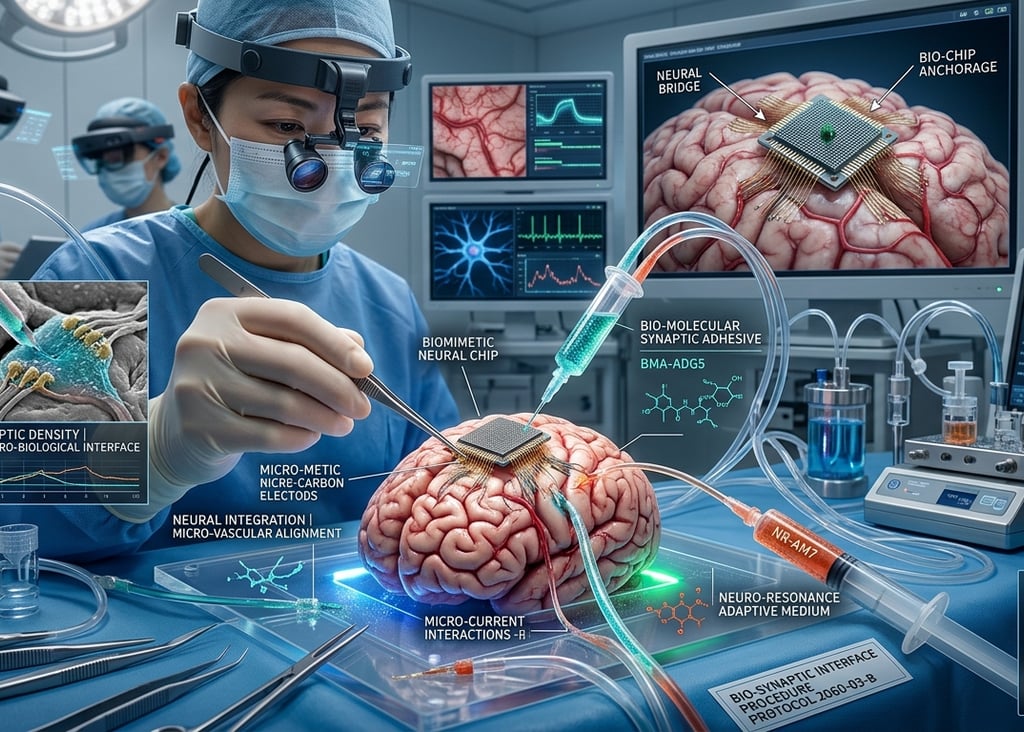
This article explores the disruptive impact of Brain-Computer Interfaces (BCIs)—such as neural chips inspired by the evolution of Neuralink and similar technologies—on the global educational framework between the years 2040 and 2050. It analyzes the radical transformation of schools and universities, which shift from data-retention facilities to centers of mental curation, emotional intelligence, and socialization. The paper deconstructs the myth of "absolute intellectual equality" provided by neural implants, demonstrating that while access to information becomes instant, deep processing capacity (organic IQ) and cerebral plasticity still dictate significant individual differences. Furthermore, it details the neurobiological necessity of shielding pure organic development up to the age of 14 to prevent cortical atrophy, introduces "Assisted Active Neuroplasticity" as a brain health maintenance protocol, and maps the phenomenological spectrum of human consciousness over algoritmically injected knowledge.
Introduction
Historically, human education has relied on an external information-transfer model: the instructor presents the content, the textbook records it, and the student biologically stores it. However, the advancement of invasive and non-invasive neurotechnologies throughout the first decades of the 21st century paved a one-way street toward the symbiotic integration of Artificial Intelligence (AI) and the human cortex [1.1.2].
Projecting society into the 2040–2050 horizon, with the maturity of high-bandwidth BCI devices integrated directly into the human brain, the dynamics of knowledge will undergo the most radical mutation since the invention of writing. When access to humanity's entire database can occur at the speed of thought, the very concepts of "studying," "learning," and "knowing" must be completely redefined. This article analyzes the consequences of this transformation on educational infrastructure, human intellectual stratification, and the core of cognitive development.
The Metamorphosis of Schools and Universities
One of the first questions raised by "instant knowledge" is the practical utility of physical educational institutions. If a neural chip can download complex quantum calculus concepts or the grammar of a dead language into the working memory within minutes, why spend years sitting in classrooms?
The Pragmatic Role of Institutions in 2050
Schools and universities will not cease to exist, but their functional purpose will shift fundamentally:
From Retention to Curation: The educational focus will completely pivot away from data memorization. Educators will act as "cognitive curators" and ethical mentors, training students to filter, evaluate, and connect the oceans of data streamed directly into their streams of consciousness by the chip [1.2.3].
Human Development and Socialization: Schools will remain indispensable environments for developing emotional intelligence, empathy, teamwork, and navigating social-ecological conflicts—purely biological skills that a chip cannot simply install.
Laboratories of Applied Innovation: Universities will transform into mega-hubs for physical experimentation and raw creativity. Because theoretical frameworks are already internalized through BCIs, university time will be dedicated exclusively to pioneering new technologies, advanced philosophy, and the arts, pushing the absolute boundaries of human knowledge [1.2.3].
The Neurobiological 14-Year Threshold: Shielding Against Cerebral Atrophy
Early educational theorists estimated that keeping children under the age of 7 or 8 away from invasive neurotechnologies would suffice to guarantee healthy development. Modern neuroscience by 2050, however, has thoroughly debunked this assumption.
Neurobiological Reality: The human brain does not finish its structural formation or cortical myelination during early childhood; the prefrontal cortex and interhemispheric networks continue deep, active maturation until at least 14 years of age.
The Critical Risk of Disuse Atrophy: Implementing a robust neural chip prior to age 14 introduces a severe risk of cognitive involution. Under the neurological principle of "use it or lose it", if the chip’s AI automates calculation, translation, logical association, and short-term memory, the developing organic neural pathways undergo mass synaptic pruning. The brain discards what it deems redundant, resulting in the chronic atrophy of areas that should naturally process these faculties.
An Ethical and Moral Redline: Establishing a strict minimum age limit of 14 for elective implants and direct working-memory cybernetic interfaces has become the most vital medical and moral global regulation. The objective is to ensure that the individual's baseline biological architecture is fully consolidated, preventing technology from cannibalizing the biological potential earned throughout childhood.
Coexistence and Maintenance: Keeping the Biological Brain Alive and Active
For neural integration to remain viable long-term, the implant cannot simply substitute for the brain; it must act as a processing co-anchor. If the biological organ becomes purely passive, the human mind eventually collapses into functional dementia. Biomedical engineering in 2050 focuses not just on chip performance, but on brain health maintenance.
Assisted Active Neuroplasticity (Synchronicity Protocols)
To mitigate atrophy and keep endogenous electrical impulses pulsing vigorously, cutting-edge chips operate under strict mutual-stimulation protocols:
Gated Effort Demands: The chip does not immediately hand over a completed answer to the conscious mind. It acts as a synaptic pathway stimulator, forcing the organic brain to fire neurotransmitters and perform foundational cognitive processing before the AI fills in the highly complex variables [1.1.2, 1.3.3].
Bioelectric "Brain Gym" Nightly Routines: During deep sleep and REM phases, the implant executes automated neurofeedback routines [1.3.3]. It delivers microcurrents specifically engineered to exercise long-term memory centers, spatial reasoning, and motor cortex areas, ensuring that biological tissue remains highly oxygenated, vascularized, and functional.
Metabolic Health Mapping: The device constantly monitors cellular activity and oxidative stress in adjacent neurons, dynamically adjusting its data transmission rate so the machine respects biological rhythms, functioning as a catalyst rather than a crushing replacement of human biology [1.2.4, 1.3.1].
The Spectrum of Consciousness: Mechanical Use vs. Epistemic Epiphany
One of the most complex philosophical dilemmas of the post-chip era is: When a chip injects knowledge, does the person possess real consciousness of it, or is it merely a mechanical reaction? In the classical model, humans can only ponder what they know; if they are ignorant of a concept, it cannot exist within their internal monologue. With a chip, the knowledge is readily available. How does the ego process this?
The human relationship with cybernetically acquired data is divided into four distinct stages of cognitive consciousness:
[Stage 1: Mechanical Access] ➔ [Stage 2: Semantic Absorption] ➔ [Stage 3: Noetic Integration] ➔ [Stage 4: Epistemic Epiphany]
Stage of Mechanical Access (Functional Indexing)
The individual evokes data, but it operates in a purely instrumental fashion—akin to reading instructions off an invisible screen. The user can recite a complex mathematical theorem or speak fluent Mandarin via the AI's silent speech synthesis, yet fail to comprehend the underlying deep logic [1.1.2]. This is exogenous consciousness; the individual explicitly recognizes that the knowledge belongs to the chip, not to themselves.
Stage of Semantic Absorption (Conceptual Understanding)
The chip’s AI translates raw data into tailored mental imagery, analogies, and synthetic memories optimized for that specific user’s cognitive architecture [1.2.3]. The individual begins to understand the profound meaning behind the data. They no longer repeat it mechanically; they can synthesize it in their own words, naturally integrating the information into their intellectual routine.
Stage of Noetic Integration (Unified Consciousness)
At this juncture, the boundaries between what is biological and what is artificial begin to dissolve. The injected knowledge triggers cortical association areas so seamlessly that the subject loses perception of where their organic memory ends and digital servers begin. The knowledge feels like a native recollection, generating an innate conviction that "I have always known this."
Stage of Epistemic Epiphany (Wisdom Generation)
This represents the zenith of human consciousness mediated by BCIs. It occurs when algorithmic knowledge injected by the chip collides with the individual's unique life experiences, traumas, emotions, and organic intuition. This fusion sparks entirely original creative breakthroughs (unprecedented insights), upgrading technical data into living wisdom and philosophy. The human is no longer a passive host to data; they leverage the neural platform to reach echelons of intellectual evolution that neither the machine nor an isolated biological brain could ever achieve alone.
The IQ Paradox Redefined
Through this framework of consciousness stages, the debate regarding the equalization of low and high biological IQ individuals becomes clearer.
Biological IQ LevelCognitive Behavior with Neural Chip UsageLow Organic IQ IndividualsAble to leapfrog directly into Stage 1 (Mechanical Access) and Stage 2 (Semantic Absorption). They become highly efficient operators within society, executing complex technical tasks and wiping out functional data exclusion.High Organic IQ IndividualsDue to a native biological architecture optimized for abstract correlation and synaptic plasticity, they rapidly migrate into Stage 3 (Noetic Integration) and Stage 4 (Epistemic Epiphany).
Exportar para as Planilhas
Consequently, intellectual asymmetry will endure. The chip equalizes the informational starting line (access and technical implementation of data), but human biology, depth of consciousness, and the unique capability to transform data into revolutionary new ideas will remain the true differentiator among minds in 2050.
Conclusion
The transition to a chip-augmented cognitive society requires a rigorous global bioethical pact that prioritizes the sanctuary of biological neurodevelopment until age 14. Failing to do so risks turning future generations into atrophied minds entirely dependent on corporate algorithms. Protecting electrical impulses and keeping the organic brain highly active through forced plasticity regimes is our only guarantee that neural chips will serve to expand human consciousness, rather than render our biology obsolete. Cybernetic knowledge only transforms into human wisdom when it encounters a living, healthy, and fully conscious brain ready to turn data into art, ethics, and innovation.
References
[1.1.2] Specialty Care (2026). Neuralink and Brain-Computer Interfaces: The Future of Neurological Medicine. Available at: [https://specialtycareus.com/blog-neuralink-bci-future-neurology/](https://specialtycareus.com/blog-neuralink-bci-future-neurology/)
[1.2.2] Tech for Impact Summit (2026). Brain-Computer Interfaces: The Promise and Perils of Minds Connected. Available at: [https://tech4impactsummit.com/blog/brain-computer-interfaces-promise-perils-2026/](https://tech4impactsummit.com/blog/brain-computer-interfaces-promise-perils-2026/)
[1.2.3] DeepFA AI Platform (2025). Brain-Computer Interface and Artificial Intelligence: The Future of Human-Technology Interaction. Available at: [https://deepfa.ir/en/blog/brain-computer-interface-ai-future-interaction](https://deepfa.ir/en/blog/brain-computer-interface-ai-future-interaction)
[1.2.4] Andersen NeuroTech Insights (2025). Neurochips: The State of Brain-Computer Interfaces in 2025. Available at: [https://andersenlab.com/blueprint/bci-challenges-and-opportunities](https://andersenlab.com/blueprint/bci-challenges-and-opportunities)
[1.3.1] International Electrotechnical Commission - IEC (2025). Driving innovation and safety in brain computer interfaces. Available at: [https://iec.ch/blog/driving-innovation-and-safety-brain-computer-interfaces](https://iec.ch/blog/driving-innovation-and-safety-brain-computer-interfaces)
[1.3.3] ELearning Industry (2025). Neuroadaptive Learning And The Rise Of Brain-Computer Interfaces In Education. Available at: [https://elearningindustry.com/neuroadaptive-learning-and-the-rise-of-brain-computer-interfaces-in-education](https://elearningindustry.com/neuroadaptive-learning-and-the-rise-of-brain-computer-interfaces-in-education)
Contact
Contact us for questions or suggestions
contact@turingvision.com
fone: + 55 54 99122 0659
© 2026. All rights reserved. https://turingsvision.com/privacy-policy