
Beyond the Computer: How Alan Turing Cracked the Secret Behind the Zebra’s Stripes and the Leopard’s Spots
Alan Turing
SCIENSE
Salamon & Salamon
5/29/20265 min read
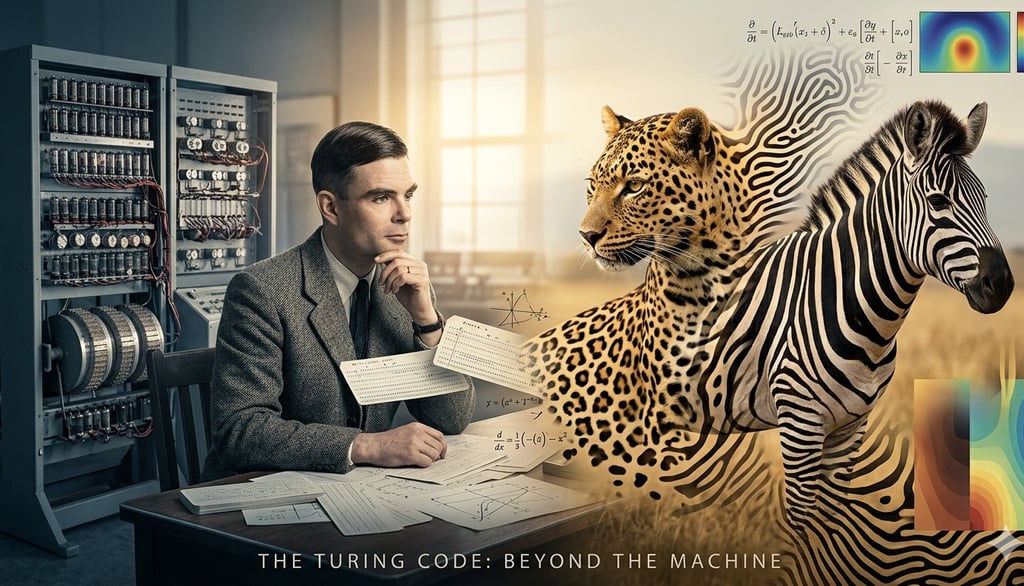
Summary: Did you know the father of modern computing also unlocked the deepest mysteries of biology? Discover Alan Turing’s fascinating, lesser-known 1952 theory on how math and chemistry work hand-in-hand to design animal coats, coral reefs, and the very patterns of life itself.
🚀 Introduction
When we think of Alan Turing, our minds immediately go to the bleak, gray landscapes of World War II, the clacking gears of the Bombe machine at Bletchley Park, or the screens of our modern computers. After all, he is globally celebrated as the genius who broke the Nazi Enigma code and laid the theoretical foundations for software.
Yet, Turing’s genius couldn't be contained within a metal box, electronic circuits, or punch cards. In his final years, during the early 1950s, he turned his restless gaze toward a much larger, analog, and infinitely more complex canvas: nature itself.
Stepping away from the digital computers he had helped bring to life, Turing set out to crack one of the greatest mysteries in developmental biology—how life, starting from a cluster of identical embryonic cells, organizes itself into such perfectly ordered shapes, textures, and colors.
🔬 The Backstory: A Genius in Search of Life
To appreciate this massive pivot in Turing’s career, we have to look back at the University of Manchester in 1951. Turing was growing frustrated with the limitations of early computers, which he considered sluggish and incapable of truly simulating human thought. He began to wonder: if we want to build artificial intelligence that mimics the human brain, shouldn't we first understand how nature builds complex structures from scratch?
At the time, biology was stuck. Scientists knew that genes carried the blueprints for life, but no one could physically explain how those instructions translated into intricate patterns. How does a single cell on the skin of a leopard embryo "know" to turn black, while its immediate neighbor decides to turn yellow?
The consensus among most traditional biologists was that it was either a completely random process or driven by incomprehensible biological forces. Turing, being a mathematician and cryptanalyst, refused to accept chaos. To him, wherever there was a pattern, there was a code waiting to be broken.
🧠 The Concept: The Math Behind the Masterpiece (Morphogenesis)
In 1952, Turing published a groundbreaking paper titled "The Chemical Basis of Morphogenesis." The word morphogenesis comes from Greek (morphê = shape / genesis = origin)—literally, the study of how shapes are born.
In this paper, Turing proved on paper that nature's geometry was actually the result of predictable chemical reactions and physical laws of spreading. He proposed a mathematical model driven by two theoretical chemical substances that he called morphogens. On the skin of a developing animal, these two chemicals lock into a constant tug-of-war:
The Activator: A localized chemical that triggers the production of color (like the dark pigment of a spot) and also stimulates more production of itself (auto-catalysis).
The Inhibitor: A fast-acting chemical that travels to neighboring cells to block and turn off the activator.
The secret to Turing’s theory lies in speed. He discovered that if the inhibitor spreads through the tissue faster than the activator can expand, the system locks into a state of balanced instability. In scientific circles, this phenomenon is known as the Turing Instability.
💡 The Forest Fire Analogy: Imagine a massive wildfire spreading through a dry forest. The fire represents the activator tearing through space. Now, imagine a crew of elite firefighters representing the inhibitor. If the firefighters move too slowly, the entire forest burns down (leaving the animal completely black). But if the firefighters move and deploy water much faster than the fire can advance, they can successfully contain the blazes. Looking down from a helicopter, the final map of the forest will show isolated black patches of burned trees ringed by green patches of saved trees. This chemical tug-of-war is exactly how a leopard gets its spots.
By slightly tweaking the spreading speed or the reaction strength of these two substances in the mathematical equations, the pattern transforms completely:
If the chemical spreads linearly in one direction, it creates zebra stripes.
If it breaks out in isolated pockets, it creates leopard spots.
If the rates shift slightly toward the animal's extremities, the pattern breaks apart—explaining why many big cats have spotted bodies but striped tails.
🏆 The Legacy: Decades of Skepticism and Scientific Redemption
When it was first published, the scientific community met the theory with a mix of awe and deep skepticism. Traditional biologists found the model far too abstract. How could differential equations dictate the behavior of living cells? Furthermore, Turing lacked the technology to identify what these actual chemical substances were inside an animal's body.
Tragically, Alan Turing passed away in 1954, just two years after publishing his paper, never seeing his theory put to the test. His biological work sat on dusty shelves for decades.
The turning point finally arrived at the dawn of the 21st century. Equipped with advanced molecular biology and high-resolution imaging, scientists began hunting for the actual "morphogens" Turing had predicted on paper. And they found them.
Today, Turing’s reaction-diffusion principles are widely proven across the natural world, stretching far beyond animal coats:
Teeth and Palates: The perfectly spaced ridges on the roof of your mouth are dictated by a Turing system.
Human Fingers: A landmark 2012 study proved that the separation of our fingers during embryonic development (when our hands transition from webbed paddles to distinct digits) strictly follows Turing's equations.
Non-Biological Systems: The theory is so robust that it even explains geological phenomena, such as the flawless, rippling patterns of desert sand dunes and the growth structures of ocean coral reefs.
🤖 The Modern Connection: From Turing to Generative AI
In a fascinating twist of fate, Turing’s work on morphogenesis has come full circle back to computing. Today, video game developers and digital artists use reaction-diffusion algorithms to generate realistic textures for creatures and environments procedurally—meaning the computer codes them automatically rather than an artist drawing them line by line.
Even more striking, modern generative AI image models (like Midjourney or Stable Diffusion) rely on physics and diffusion concepts strikingly similar to what Turing scribbled in his notebook in 1952 to understand how clean, structured shapes emerge out of visual noise and chaos.
🏁 Conclusion
Alan Turing’s deep dive into biology reminds us that, at his core, he was a codebreaker. He looked at the universe and didn't see an overwhelming mess; he saw universal laws waiting to be unraveled through logic.
After saving millions of lives by shattering the Nazi wartime code and paving the way for the digital age, he spent his final intellectual energies decoding the blueprint of life itself.
The "Turing Code" isn't just etched into the silicon microchips of our smartphones or running on AI servers; it is elegantly written into the fur of every leopard roaming the savanna. Turing proved to us that nature, at the end of the day, is the ultimate programmer.
📚 References
TURING, Alan M. The Chemical Basis of Morphogenesis. Philosophical Transactions of the Royal Society of London. Series B, Biological Sciences, v. 237, n. 641, p. 37-72, 1952.
HODGES, Andrew. Alan Turing: The Enigma. London: Vintage Books, 2014. (The definitive biography covering Turing's transition into quantitative biology at Manchester).
SHETH, Rushikesh et al. Hox Genes Regulate Digit Patterning by Controlling the Wavelength of a Turing-Type Mechanism. Science, v. 338, n. 6113, p. 1476-1480, 2012. (A modern genetic study that isolated the molecules responsible for digit formation using Turing's model).
BALL, Philip. Shapes: Nature's Patterns: A Tapestry in Three Parts. Oxford University Press, 2011. (An excellent popular science book detailing the impact of chemical reactions on natural geometry).
Contact
Contact us for questions or suggestions
contact@turingvision.com
fone: + 55 54 99122 0659
© 2026. All rights reserved. https://www.turingsvision.com/privacy-policy