Prospective Analysis of Quantum Supremacy and Market Impacts (2026)
Quantic
QUANTIC
By Marcelo Salamon
5/1/20264 min read
Executive Summary
The dawn of 2026 marks the definitive transition of quantum computing from theoretical physics to the epicenter of a global industrial revolution. With market revenues projected at $2 billion and indirect economic impacts scaling into the trillions, this technological leap is the logical successor to Alan Turing’s "Universal Machine." By shifting from binary bits to the probabilistic power of qubits and superposition, we are redefining the limits of "computability." This article analyzes the geopolitical race between China and the United States, the evolution toward fault-tolerant systems through Quantum Error Correction, and the disruptive impacts on pharmacology, cybersecurity, and global logistics. Ultimately, the integration of quantum processors into the classical Turing-based digital infrastructure is not merely an improvement; it is a total re-engineering of the physical world.
Introduction
Quantum computing has transitioned from a theoretical frontier of physics to the epicenter of a new global industrial race. By 2026, the market projects revenues of approximately $2 billion, with indirect economic impacts reaching the trillions. This leap, while utilizing the principles of quantum mechanics, is the direct heir to the logical foundations established by Alan Turing. While classical computing materialized the "Turing Machine" through binary bits, the quantum era expands this concept to processing in states of superposition, redefining the boundaries of what is "computable" within a human lifetime.
The Turing Legacy and Quantum Genesis
The connection between Alan Turing and quantum computing is not merely historical; it is functional. The concept of Computability defined by Turing established the limits of what machines can solve.
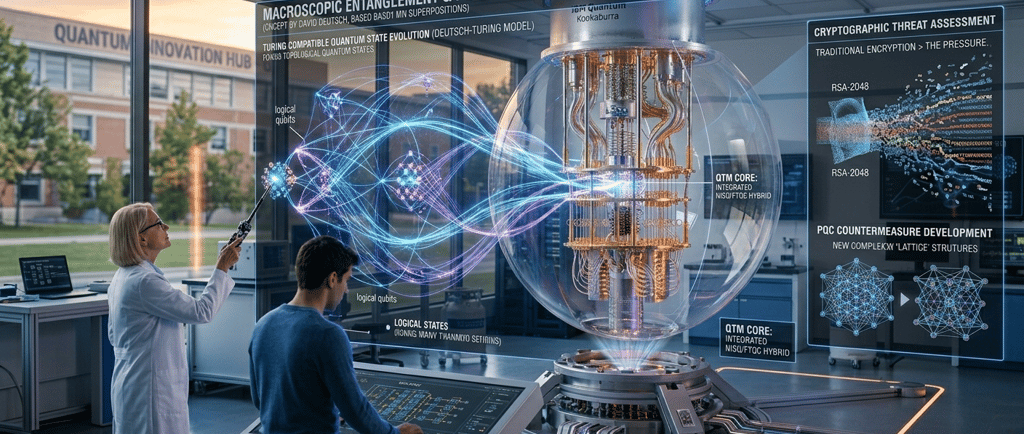
From the Universal Machine to the Quantum Machine: Turing proved that a machine could simulate any logical process (Universality). Quantum computing pushes this idea to the physical limit: since nature is quantum, we require a "Quantum Turing Machine" (a concept formalized by David Deutsch in the 1980s) to simulate it effectively.
The Turing Test and Quantum AI: Turing’s ideas on artificial intelligence find their necessary "fuel" in quantum computing. Quantum processing speeds allow complex neural networks—which Turing only theorized in his papers on "Intelligent Machinery"—to finally process data volumes and probabilities at superhuman scales.
Market Hegemony: The Lead Protagonists
Currently, the race for quantum leadership is polarized between two distinct models of innovation:
China: Consolidates itself as the leader in state-led investment, focusing on unbreakable quantum communication (quantum satellites) and photonic computing. The goal is to create a sovereign "Quantum Internet" infrastructure.
The United States: Maintains leadership in terms of the software ecosystem and hardware diversity (superconductors, trapped ions, and silicon). Major players like IBM, Google, and IonQ dominate the market through Quantum-as-a-Service (QaaS) models, integrating quantum processors with classical supercomputing via the cloud.
Technical Developments and Perspectives
Advances in 2026 focus on the transition from the NISQ (Noisy Intermediate-Scale Quantum) era to fault-tolerant systems:
Quantum Error Correction (QEC): The primary industry challenge is stabilizing qubits. We are now implementing algorithms that allow the machine to "correct itself," a concept that echoes Turing’s obsession with logical precision and error correction in automatic systems.
Hybrid Systems: The industrial norm has become "quantum-centric supercomputing," where classical binary logic (Turing-based) and quantum probabilistic logic work in tandem to solve specific bottlenecks.
Practical Impacts and Areas of Interference
Quantum computing does not replace the classical computer; instead, it "destroys" and "recreates" the foundations of strategic sectors:
A. Materials Science and Pharmacology (Creation and Improvement)
Part Replacement: The ability to simulate atomic interactions allows for the creation of new polymers and lighter, stronger alloys, replacing expensive and rare materials in the aerospace and defense industries.
Drug Discovery: Accurate protein folding simulations move pharmaceutical development from "trial and error" to exact molecular design.
B. Cybersecurity (Destruction and Reconstruction)
The Codebreaker’s Paradox: Just as Turing famously broke the Enigma code, Shor’s quantum algorithm threatens to break modern encryption (RSA and ECC). This is forcing a global migration to Post-Quantum Cryptography (PQC)—a total reconstruction of worldwide digital security.
C. Logistics and Energy
Extreme optimization of global supply chains and smart grids, drastically reducing energy waste and carbon emissions by solving combinatorial problems that are impossible for classical architectures.
Consequences for the Supply Chain and Equipment
The new era demands a physical overhaul of infrastructure:
Cryogenic Systems: Replacing standard server racks with dilution refrigerators that operate at temperatures near absolute zero.
Specialized Hardware: Increased demand for isotopically purified silicon (Silicon-28) and high-precision laser systems for quantum state manipulation.
Conclusion
In summary, quantum computing in 2026 represents the ultimate evolution of Alan Turing's vision. It not only fulfills the dream of a universal machine but expands that universality to the fundamental laws of physics. The result is more than financial gain; it is a re-engineering of the physical world. We are witnessing the replacement of empirical methods with exact simulations, resulting in the creation of materials and medicines once deemed impossible, while the foundations of our digital security are destroyed and rebuilt under a new logic. The "Turing Machine" is now quantum, and its capacity to process reality will alter the course of technological civilization.
Conclusion
In summary, quantum computing in 2026 represents the ultimate evolution of Alan Turing's vision. It not only fulfills the dream of a universal machine but expands that universality to the fundamental laws of physics. The result is more than financial gain; it is a re-engineering of the physical world. We are witnessing the replacement of empirical methods with exact simulations, resulting in the creation of materials and medicines once deemed impossible, while the foundations of our digital security are destroyed and rebuilt under a new logic. The "Turing Machine" is now quantum, and its capacity to process reality will alter the course of technological civilization, marking the end of the classical era and the birth of a new, probabilistic order.
Bibliography
Arute, F., et al. (2026). Quantum Supremacy and the Acceleration of Computational Logic. Nature Portfolio.
Deutsch, D. (2025). The Fabric of Reality: The Quantum Turing Machine. Penguin Science.
Nielsen, M. A., & Chuang, I. L. (2025). Quantum Computation and Quantum Information: 25th Anniversary Edition. Cambridge University Press.
World Economic Forum. (2026). Quantum Technologies: Global Policy and Industrial Strategy. WEF Publishing.
Contact
Contact us for questions or suggestions
contact@turingvision.com
fone: + 55 54 99122 0659
© 2026. All rights reserved. https://turingsvision.com/privacy-policy