
📝 O Código Turing – A Certidão de Nascimento do Software
Blog post description.
AI
Salamon and Salamon
5/29/20264 min read
📝 Article Summary (TL;DR)
If you are just passing through, here are the key points to take with you:
The Old Paradigm: Before Turing, every machine required a different physical format (hardware) to perform different tasks.
The 1936 Innovation: Turing proved that an extremely simple theoretical machine (a tape, a head, and logical rules) could solve any mathematical problem.
The Universal Machine: The great turning point was placing the behavior instructions inside the tape itself. Instead of changing the machine's parts, we change the code.
The Impact: This abstract concept is the exact foundation for the operation of all modern computers, smartphones, and AI.
Introduction
Imagine you are in the early 1930s. If you need to write a letter, you use a typewriter. If you need to perform complex calculations, you use a mechanical calculator made of gears. If you want to listen to music, you turn on a gramophone. Back then, the concept of a "machine" was rigid: a physical object built to execute a single and exclusive task. If you wanted a machine to do something different, it was necessary to redesign its atoms, change its gears, and rebuild its physical structure.
In 1936, a 24-year-old British mathematician looked at this scenario and asked a question that would change the history of humanity forever: What if we could create a single machine capable of imitating any other existing machine, just by changing its instructions?
That young man was Alan Turing. In the most important academic paper in the history of computer science, he didn't build a single circuit; he used only logic and paper to break the paradigm of physical matter and give life to what we know today as software. The "Turing Code" is not a programming language like Python or Java, but rather the fundamental discovery that code is behavior.
🎞️ Chapter 1: The Visual Metaphor – What Is the Turing Machine?
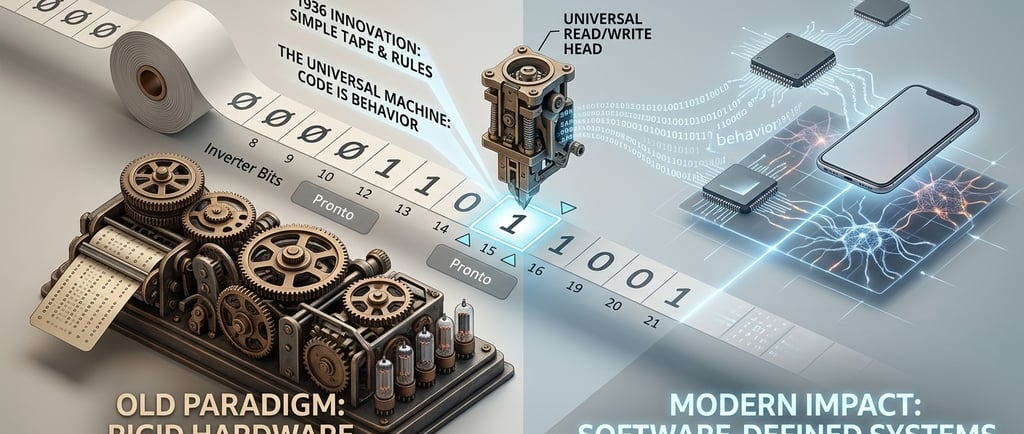
To understand how he changed the world, we need to visualize his most famous thought experiment. Imagine an infinitely long strip of photographic film, divided into small squares. On top of this tape, there is a read/write head (like the one in an old cassette player).
📸 IMAGE ABOVE
Image Suggestion: A minimalist illustration or elegant infographic of a theoretical Turing Machine (a long tape divided into squares containing the symbols 0 and 1, and a pointer/head pointing to one of the squares). You can use the reference image_1aaf7e.png to represent this simulation interface.
Alt-Text: Conceptual illustration of the Turing Machine with an infinite tape containing binary data and a read/write head.
This theoretical machine only knows how to perform four ridiculously simple actions:
Read the symbol that is in the current square.
Erase or write a new symbol (such as a 0 or a 1).
Move the tape to the left or to the right.
Change state based on a table of predefined rules.
Turing's great masterstroke was to mathematically prove that, by combining these four simple steps, this theoretical machine could solve any computable problem in the world, as long as it could be broken down into a logical sequence of steps—what we call an algorithm today.
💡 Chapter 2: The Great Turning Point – The Birth of the Universal Machine
Up to this point, Turing had designed a machine for each task. One machine with rules for adding, another for translating symbols. But his genius reached its peak when he made a master move:
"If the rules of how the machine must act also change, why not write the rules themselves inside the tape, using the same symbols?"
At that exact moment, the Universal Turing Machine was born.
📸 IMAGE ABOVE
Image Suggestion: A visual parallel or comparative graphic. On the left side, old gears representing rigid hardware. On the right side, an abstract digital data flow representing software shaping the machine's behavior.
Alt-Text: Comparative graphic between rigid hardware gears and digital data flow representing software.
Instead of building a physical machine to add, another to subtract, and another to play chess, you create a single "dumb" physical machine (the hardware) and feed it a tape with instructions on how it should behave at that moment (the software). Turing discovered that you don't need to change the machine's atoms to change what it does; you only need to change the bits.
🚀 Chapter 3: The Echo of 1936 in Your Pocket
When we look at the speed at which technology advances today, with neural chips, supercomputers, and generative artificial intelligences, it is easy to forget that all this complexity rests upon the brilliant simplicity of that tape designed in 1936.
When you download a new app on your phone or update your computer's operating system, you are not taking the device to a technical service to move the chips around. You are merely feeding the "digital tape" of your processor with new logical instructions.
Nearly a century later, the entire world runs on the ecosystem that Turing designed on paper. We do not just live in the digital age; we live in Alan Turing's conceptual universe.
📚 Bibliographic References
TURING, Alan M. On Computable Numbers, with an Application to the Entscheidungsproblem. Proceedings of the London Mathematical Society, v. 42, n. 1, p. 230-265, 1936. (The original paper where Turing introduces the Turing Machine and the concept of Computability).
HODGES, Andrew. Alan Turing: The Enigma. London: Vintage Books, 2014. (The definitive biography of Turing, which served as the basis for the movie "The Imitation Game").
PETZOLD, Charles. The Annotated Turing: A Guided Tour Through Alan Turing's Historic Paper on Computability and the Turing Machine. Indianapolis: Wiley Publishing, 2008. (An excellent read that explains, line by line, Turing's original paper without getting lost in heavy mathematics).
SIPSER, Michael. Introduction to the Theory of Computation. Boston: Cengage Learning, 2012. (Standard university textbook that mathematically formalizes the operation of Turing Machines and automata theory).
Contact
Contact us for questions or suggestions
contact@turingvision.com
fone: + 55 54 99122 0659
© 2026. All rights reserved. https://turingsvision.com/privacy-policy